

“In 2018, sports travel accounted for 8 percent of the total domestic travel market, translating into 190 million trips and $41 billion in spending.” (U.S. Travel Association)
This figure shows how big the sports travel and event logistics sector has become. The scale is hard to ignore. Still, when you look beyond the surface, past each tournament or global championship, one core question always sits there: how do transportation leaders gauge the return on investment (ROI) of moving thousands of athletes, VIPs, media teams, and fans, all while keeping everything smooth and safe? That’s the challenge everyone in event transportation management faces.
To explore how modern technology is reshaping event logistics, check out this in-depth guide.
Today, ROI in event transportation goes far beyond cost savings. It’s about transportation efficiency, guest experience, sustainability, and legacy, the pillars that define whether event transportation services are seen as an operational headache or a strategic advantage.

When people usually think of ROI (Return on Investment), they imagine financial accounting, how much money was spent, and how much came back. But in the world of event logistics and event transportation solutions, ROI is much bigger than that. For transportation managers, heads of logistics, and event operations leaders, ROI means measuring the true value that enterprise transportation services add to a sporting event.
A sporting event logistics plan goes a long way. The right approach keeps vehicles in rotation and minimizes wasted runs. Drivers stay busy, not idle. Event shuttle services stick to their schedules. All of this cuts down on idle time and keeps arrivals and departures management on track. Every piece feeds straight into a stronger operational ROI.
Transport often sets the tone for the whole event. It’s the first hello at the airport and the last goodbye after the finals. A smooth pick-up, a stress-free ride to the venue, or a perfectly timed shuttle during departures is how guests remember the event. When they leave happy, satisfaction scores rise, and so does transportation ROI.
A single mishap, like a delayed VIP corporate event transportation shuttle or long queues caused by an inefficient accreditation system, can overshadow the success of the entire event. On the other hand, flawless event transportation logistics reinforce the image of a world-class event. This reputation builds trust with sponsors, sports federations, and fans. It also plays a big role in the chances of landing future events.
The effect lasts beyond the final whistle. When a city or organization nails reliable event mobility solutions and sustainable event transportation, it earns credibility that pays off for hosting future tournaments, championships, and even large conferences. Think about London’s Olympics; the investments made in global transportation solutions created a lasting legacy for the city’s residents.
For a deeper look at how software enhances ROI, explore our detailed overview of event transportation solutions.

Put simply: Every airport transfer, accreditation-linked ride, or shuttle departure is a chance to show professionalism, strengthen the event’s brand, and leave a good mark on athletes, VIPs, and other guests. If it falls short, frustration and a damaged reputation follow. Get it right, though, and it becomes a powerful, often overlooked driver of logistics ROI metrics in event transportation solutions.
While defining ROI conceptually is important, transportation leaders also need practical ways to measure it during and after an event. This is where data-backed metrics and modern transportation management tools become critical.
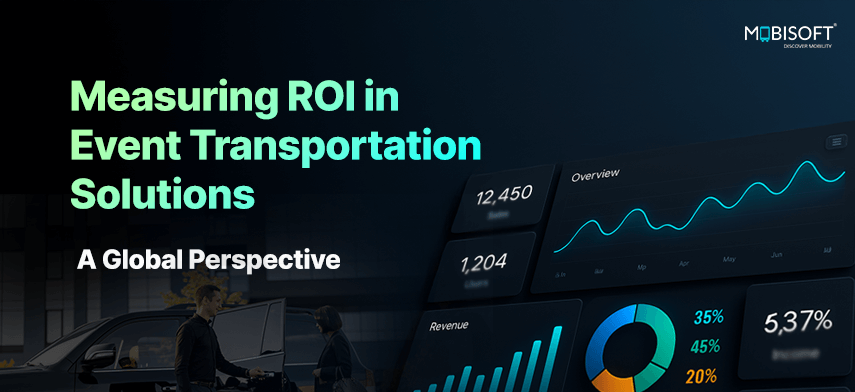
Advanced event transportation platforms allow organizers to track performance in real time and analyze outcomes post-event. Metrics such as average wait time, on-time pickup percentage, route deviation frequency, and vehicle occupancy rates provide a clear picture of how efficiently the transportation operation performed. These insights help event teams move away from assumptions and toward evidence-based decision-making.
Post-event reports generated from transportation software also make it easier to justify investments to stakeholders. Instead of anecdotal feedback, organizers can demonstrate ROI using dashboards and analytics that show reduced delays, improved utilization, and better guest satisfaction outcomes.
One of the most overlooked elements of ROI in event transportation is risk mitigation. Large events carry inherent risks—traffic congestion, weather disruptions, security incidents, or last-minute schedule changes. Manual transportation systems struggle under these conditions, increasing the likelihood of breakdowns.
Automated and technology-driven event transportation solutions significantly reduce operational risk. Real-time alerts, geofencing, contingency routing, and centralized control enable teams to respond proactively rather than reactively. When disruptions are handled smoothly, the event avoids reputational damage, financial penalties, and stakeholder dissatisfaction.
In this sense, ROI is not only about gains but also about losses prevented. Avoiding one major transportation failure can protect millions in sponsorship value, media reputation, and future hosting opportunities.
Sustainability is no longer optional in global sporting events and large-scale gatherings. Cities, governing bodies, and sponsors increasingly expect event organizers to demonstrate environmentally responsible practices.
Transportation plays a major role here. Optimized routing, shared shuttle services, electric or low-emission vehicles, and reduced idle time directly contribute to lower carbon emissions. When transportation systems are measured for fuel efficiency and emissions reduction, sustainability becomes a measurable ROI outcome rather than a vague commitment.
This sustainability-driven ROI resonates strongly with:
Global sports federations
Government authorities
Corporate sponsors with ESG mandates
Environmentally conscious attendees
In many cases, strong sustainability performance in transportation can be a deciding factor in winning bids for future events.

© 2025 Crivva - Hosted by Airy Hosting Managed Website Hosting.