

Have you ever launched a B2B eCommerce platform only to find that customers aren’t engaging with your content the way you expected? Maybe your homepage converts well, but once a dealer or reseller logs in, engagement drops. Or perhaps your product descriptions work for purchasing managers but confuse technical buyers.
If that sounds familiar, you’re experiencing a very real challenge: content that isn’t personalized for different stakeholders.
In today’s competitive B2B digital landscape, generic messaging simply doesn’t cut it. A B2B eCommerce development company might build you a robust site, but without tailored experiences, you’ll miss out on conversions, loyalty, and long-term growth.
Thankfully, personalized content isn’t as complex as it sounds, and in this blog, we’ll explore how you can tailor content for multiple stakeholders to improve engagement and increase revenue. We’ll also touch on how personalized experiences tie into broader business strategy, especially when choosing the right B2B eCommerce development agency to support your journey.
In the early days of online retail, a one-size-fits-all landing page worked fine. But today’s customers, whether they’re procurement leads, distributors, or internal decision-makers, expect relevance. They want content that speaks directly to their role, challenges, and priorities.
Why? Because B2B buying is rarely impulsive. It involves:
Generic content dilutes trust. Tailored content builds context. And context accelerates buying decisions.
Personalization in B2B eCommerce is not just a luxury; it’s a strategic advantage.
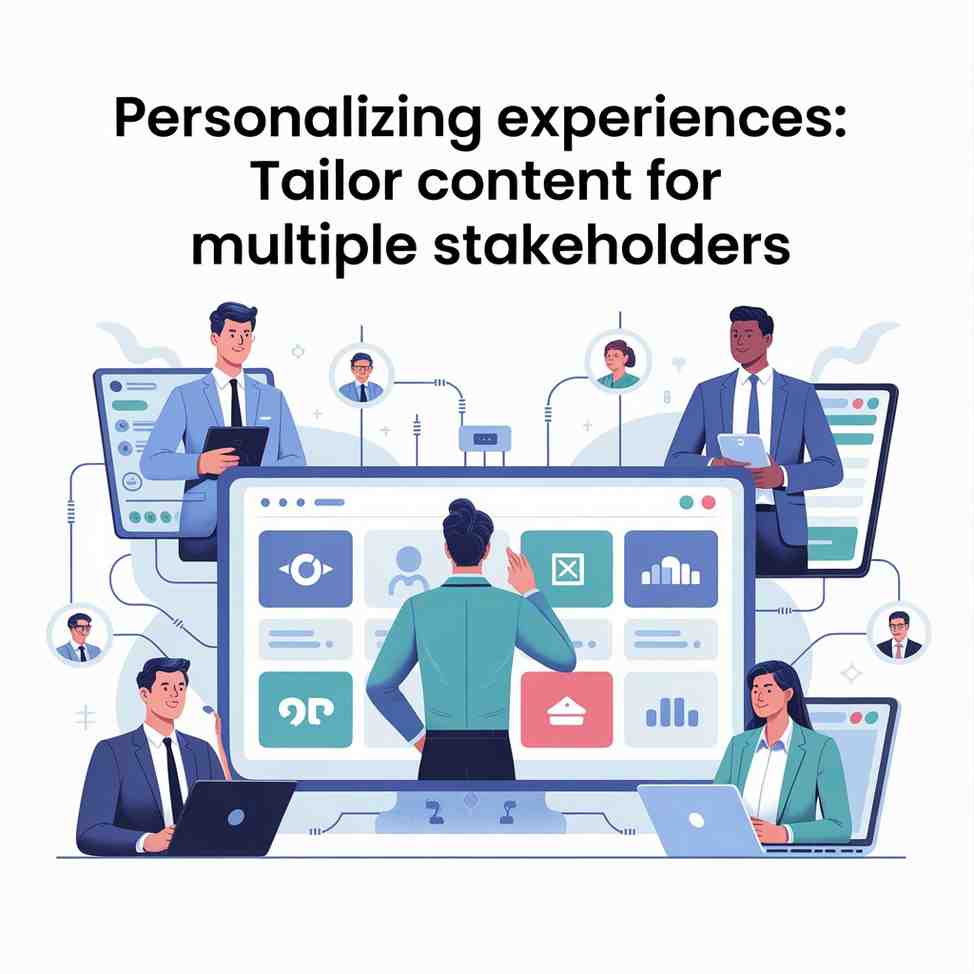
Before you personalize anything, you must understand your audience. In a B2B context, stakeholders typically include:
Different stakeholders have different information needs. Speaking to just one group means ignoring the others and missing out on potential conversions.
Segmentation is the foundation of personalization. Think of it like creating multiple personas that require slightly different messaging:
Content speaks differently to procurement teams than to technical evaluators.
A distributor in food processing has different priorities compared to one in industrial machinery.
New visitors need awareness content; returning visitors need detail-rich comparison guides.
Effective segmentation requires data. This can come from:
Once segmented, your content becomes sharper, more relevant, and more effective.
Personalization starts before someone reads a word of copy.
When users land on your site, the first impression matters. Personalized navigation and homepage sections can help users find what matters to them instantly. Consider:
Instead of presenting the exact same home screen to everyone, a dynamic eCommerce experience helps users feel understood, increasing engagement and trust.
This is where working with a capable B2B eCommerce development agency makes a difference. They not only build the site, but they also architect the experience.
Product information is the heart of any eCommerce transaction. In B2B, one description doesn’t fit all.
A procurement manager might care about bulk pricing tiers and delivery times. A technical buyer, however, wants detailed specs, compatibility charts, and compliance data.
Consider dynamically tailoring your product pages:
These tailored experiences reduce confusion and help users self-qualify, lowering the support burden on your team.
Unlike B2C, B2B pricing is rarely flat. Many businesses have:
Dynamic pricing personalization not only improves transparency but also nurtures long-term relationships.
For example, a distributor who orders large volumes shouldn’t see the same rates as a small reseller. Personalization ensures users see pricing that makes sense for them.
This is especially critical when a B2B eCommerce development company builds your site. Advanced platforms can integrate CRM and ERP systems to make real-time, personalized pricing a reality.
Not all personalization happens on the product page. Content marketing plays a big role, too.
Imagine a library of resources where:
Contextual content pushes users further down the funnel without friction.
Educational content also signals expertise, a key trust factor in B2B sales.
Personalization is powerful, but it also comes with challenges:
If your CRM, analytics, and CMS don’t talk to each other, you can’t deliver consistent personalization.
Solution: Unified data platforms and API integrations.
Users expect personalization, but also data safety.
Solution: Transparent data policies and user consent management.
Dynamic content requires advanced development and planning.
Solution: Partner with a seasoned B2B eCommerce development services team that understands dynamic experiences.
Choosing the right partner can make personalization a strategic advantage, not a technical headache.
Personalization isn’t set-and-forget.
You need to track:
Use analytics not just to measure results but to refine personalization over time.
This ongoing optimization turns personalization from a feature into a growth engine.
In B2B eCommerce, personalization is what makes people want to buy something. Basic websites are easy to set up. To make a website that really speaks to people,e you need a good plan and the right tools. Working with a B2B eCommerce development agency helps you make a website that people can relate to, not just a website that works.
When you show people content that is for them, prices that are just for them, and messages that are meant for the people who make decisions, they feel like you get them. When they feel like you get them, they are much more likely to buy something from you. Personalization is not something you can ignore anymore; it is what B2B commerce will be like in the future. B2B eCommerce needs personalization to be successful.

© 2025 Crivva - Hosted by Airy Hosting Managed Website Hosting.