

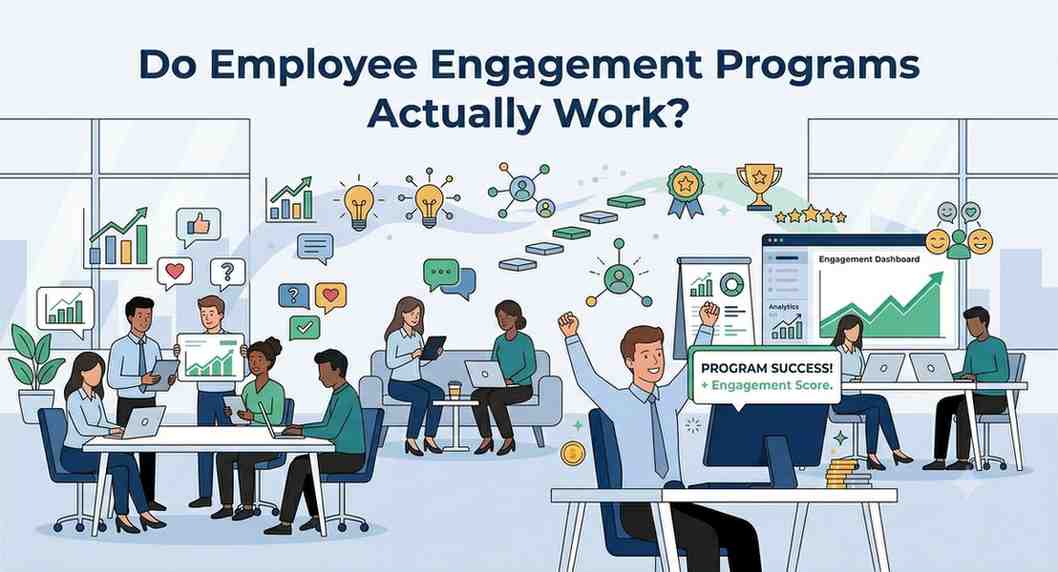
Your company just rolled out a new “engagement initiative.” Maybe it’s a peer recognition platform, a monthly town hall, or a point-based rewards system. On paper, it looks great. But if you’ve been around the block a few times, you’re probably sitting there wondering: is this actually going to change anything, or will it be forgotten by Q2? You’re not cynical; you’re asking exactly the right question.
Here’s where most conversations about employee engagement programs go sideways. Leaders measure launch success by participation rates. Employees measure it by whether anything meaningfully changes about their day-to-day experience. Those two things are almost never the same metric.
Gallup’s research consistently shows that only around 23% of employees globally are engaged at work. That number hasn’t moved dramatically in over a decade, despite billions spent on engagement software, retreats, and recognition platforms. That’s not a condemnation of the idea; it’s a signal that execution is the problem, not the concept.
When employee engagement programs are designed with clear intent and tied to real management behavior, they do produce measurable outcomes. Think: reduced absenteeism, lower voluntary turnover, better customer satisfaction scores, and improved safety records. These aren’t soft wins; they show up in the P&L.
The catch is that most programs are deployed in response to a poor engagement score rather than as a proactive culture strategy. That reactive framing almost guarantees limited results. You can’t give someone a free lunch on Friday and expect them to stop updating their LinkedIn profile.
One area where structured incentive programs genuinely move behavior is sales and performance-driven teams. SPIFF programs, short-term performance incentive funds, have a documented track record of driving specific, measurable behavioral outcomes when the target is clear, the reward is meaningful, and the timeline is short enough to feel real. The keyword there is specific. Blanket reward structures rarely create the same urgency.
More broadly, recognition is the least expensive and most underutilized engagement tool available to most organizations. Study after study shows that employees who feel genuinely recognized are significantly more likely to stay, perform at a higher level, and recommend their company to others. The challenge isn’t designing a recognition program; it’s getting managers to actually use it consistently.
Most employee engagement programs underdeliver for a small set of predictable reasons. Understanding them upfront is worth more than any vendor demo.
When HR designs an engagement program in a vacuum and rolls it out company-wide, the signal employees receive is: “We think we know what you need.” That perception alone shows trust. Programs that involve employees in the design process, even just through a survey or a focus group, lead to better adoption and more meaningful outcomes.
Engagement is a local experience. An employee’s relationship with their direct manager accounts for a disproportionate share of their overall engagement at work. When programs treat engagement as an HR function rather than a management responsibility, they’re solving the wrong problem. The best programs train managers, give them tools, and hold them accountable for their team’s well-being, not just their output.
If the primary metric for your engagement program is “did people attend the event” or “were surveys completed,” you’re measuring activity, not impact. Programs that tie engagement investments to business outcomes, retention rate, internal promotion rate, and eNPS create a feedback loop that enables iteration and improvement.
Beyond survey scores, meaningful engagement shows up in behavior. Voluntary attrition goes down. Internal referrals go up. Employees start raising problems before they become crises rather than after. Cross-team collaboration improves without being mandated. These are the signals worth tracking.
Anecdotally, the organizations that engage best tend to have one thing in common: they treat engagement as an ongoing conversation, not a campaign. The program is less a product and more a habit, a set of practices that become embedded in how the organization operates week to week.
Yes, employee engagement programs can work, and when they do, the returns are significant and measurable. But the ones that fail share a common pattern: they’re treated as a quick fix rather than a long-term investment, they sidestep managers’ role, and they optimize for participation over impact.
The organizations seeing real results aren’t just buying software or running quarterly surveys. They’re building cultures where recognition is habitual, feedback is acted on, and employees can see a clear connection between their work and something larger than a quota. That’s not a program, that’s a practice. And that distinction is everything.
The most effective employee engagement programs are tied to real management behavior, involve employees in their design, and are measured against business outcomes, not just participation. Recognition that’s timely, specific, and consistent matters far more than one-time perks or events.
Key ROI indicators include the voluntary turnover rate, absenteeism, the internal promotion rate, the employee net promoter score (eNPS), and team productivity metrics. The strongest programs create a feedback loop by connecting engagement data to business performance on a quarterly basis rather than annually.
They fail for a few predictable reasons: they’re designed without frontline input, they don’t hold managers accountable, they measure activity instead of impact, and they’re treated as one-time initiatives rather than an ongoing cultural practice. Reactive engagement programs launched in response to bad survey scores rarely solve root causes.
Managers are the single biggest factor in an employee’s level of engagement. Research consistently shows that an employee’s relationship with their direct manager accounts for the largest share of their daily engagement experience, far more than company benefits, office perks, or broader culture initiatives. Programs that skip manager accountability are solving for the wrong variable.
Annual engagement surveys are largely considered outdated. High-performing organizations run shorter “pulse” surveys monthly or quarterly, supplemented by always-on feedback tools and regular one-on-ones. The goal is to identify and act on issues in near real-time rather than discovering problems that have been festering for months.

© 2025 Crivva - Hosted by Airy Hosting Managed Website Hosting.