

Managing day-to-day cash flow remains one of the biggest operational challenges for growing businesses. Delayed customer payments, extended credit cycles, and seasonal demand can strain working capital even when sales are healthy. To bridge this gap, many businesses turn to invoice-based financing options such as bill discounting and factoring.
Although both solutions help unlock funds tied up in receivables, they differ significantly in structure, risk allocation, cost, and control. Understanding these differences is essential before choosing the right financing method. This article examines bill discounting and factoring in depth, compares their processes, and explains when each option is best suited for a business.
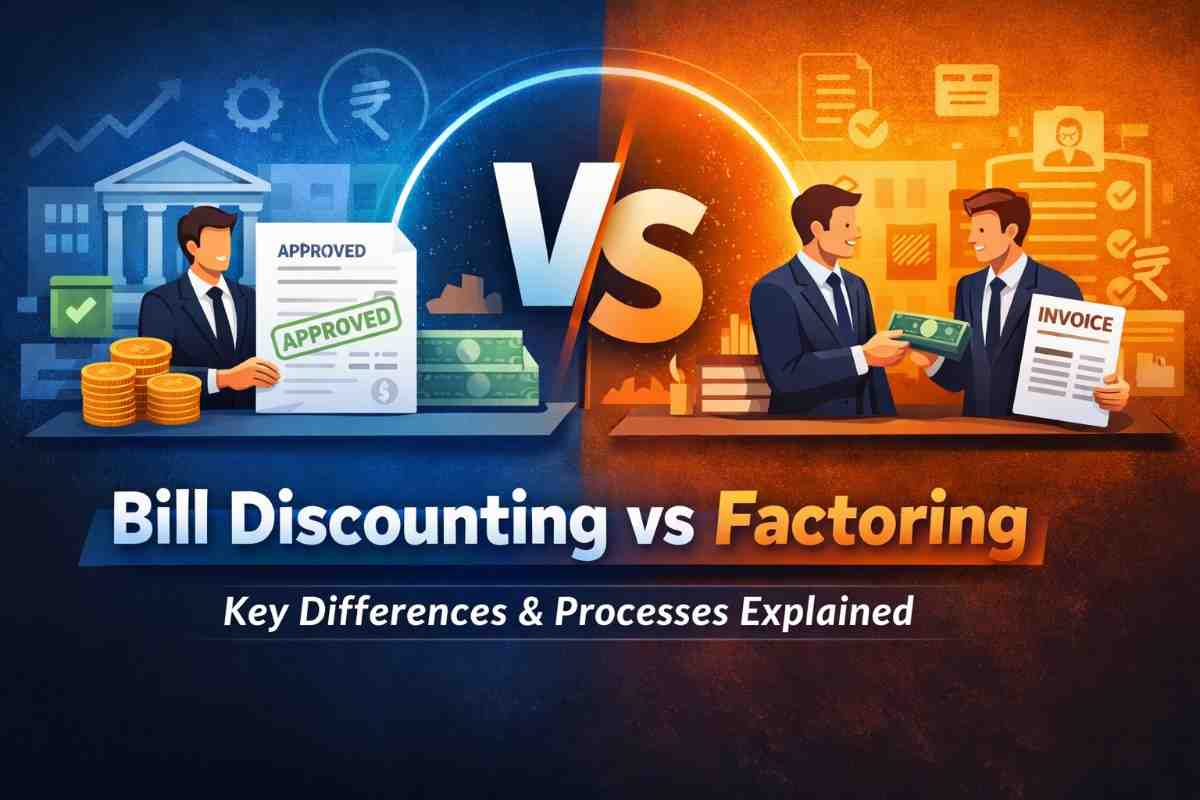
At a high level, both bill discounting and factoring allow businesses to access funds before invoice maturity. The key distinction lies in ownership, collection responsibility, and credit risk.
In bill discounting, the business continues to own the receivable and remains responsible for customer collections. The lender simply advances funds against the invoice for a fee. In factoring, ownership of the receivable is transferred to the factoring company, which then manages collections and, in some cases, assumes the risk of non-payment.
These structural differences directly affect confidentiality, pricing, and operational involvement.
Bill discounting is a short-term financing arrangement where a business submits its unpaid invoices to a bank or financial institution in exchange for immediate funds. The invoice value is discounted, and the remaining amount is paid to the business upfront.
Importantly, the ownership of the invoice does not change. The business remains accountable for ensuring that the buyer pays on the due date.
For instance, if a company raises an invoice worth ₹1,00,000 payable in 60 days, it may receive around ₹94,000–₹97,000 immediately, depending on the discount rate. This enables the business to meet payroll, pay suppliers, or manage operational expenses without waiting for customer payment.
Bill discounting is widely used by MSMEs and corporates seeking cost-effective working capital finance without disrupting customer relationships.
Factoring involves selling accounts receivable to a specialised financial entity known as a factor. Once invoices are assigned, the factor advances a portion of the invoice value—typically 80% to 90%—to the business.
Unlike bill discounting, factoring generally includes collection services. The factor communicates directly with customers, tracks payments, and handles follow-ups. In non-recourse arrangements, the factor may also absorb the risk of customer default.
Factoring is often preferred by businesses that want to outsource receivables management, reduce administrative overhead, or mitigate credit risk associated with uncertain buyers.
The bill discounting process follows a structured and relatively straightforward flow:
Digital platforms such as the Receivables Exchange of India Limited (RXIL) TReDS platform have streamlined this process by enabling transparent, multi-financier bidding and faster access to working capital for MSMEs.
Factoring follows a more service-oriented model:
This model provides liquidity along with operational relief, particularly for businesses with limited credit control resources.
Bill discounting typically involves three parties:
Factoring includes the following participants:
Bill discounting can be structured in multiple ways depending on documentation and disclosure:
Funds are advanced without extensive supporting documents. This option is quicker but may carry higher scrutiny or limits.
Invoices are supported by delivery proofs and transaction documents, adding security for the financier.
The buyer is aware of the financing arrangement, and payments are routed directly to the financier.
The buyer remains unaware, allowing the business to maintain confidentiality while improving cash flow.
Factoring arrangements vary based on risk and geography:
The seller remains liable for unpaid invoices. Fees are lower due to reduced risk for the factor.
The factor assumes the risk of customer default, offering protection at a higher cost.
Used when transactions occur within the same country.
Supports international trade by managing overseas receivables and mitigating cross-border payment risks.
The choice between bill discounting and factoring depends on business priorities:
Understanding customer payment behaviour, internal resources, and cash flow urgency is key to making the right decision.
Both bill discounting and factoring are effective tools for improving liquidity, but they serve different strategic purposes. Bill discounting offers faster access to working capital while retaining control and ownership of receivables. Factoring provides liquidity along with collection support and, in some cases, credit risk protection.
By carefully assessing operational needs, cost considerations, and customer profiles, businesses can select the financing approach that supports sustainable growth and financial stability.

© 2025 Crivva - Hosted by Airy Hosting Managed Website Hosting.