

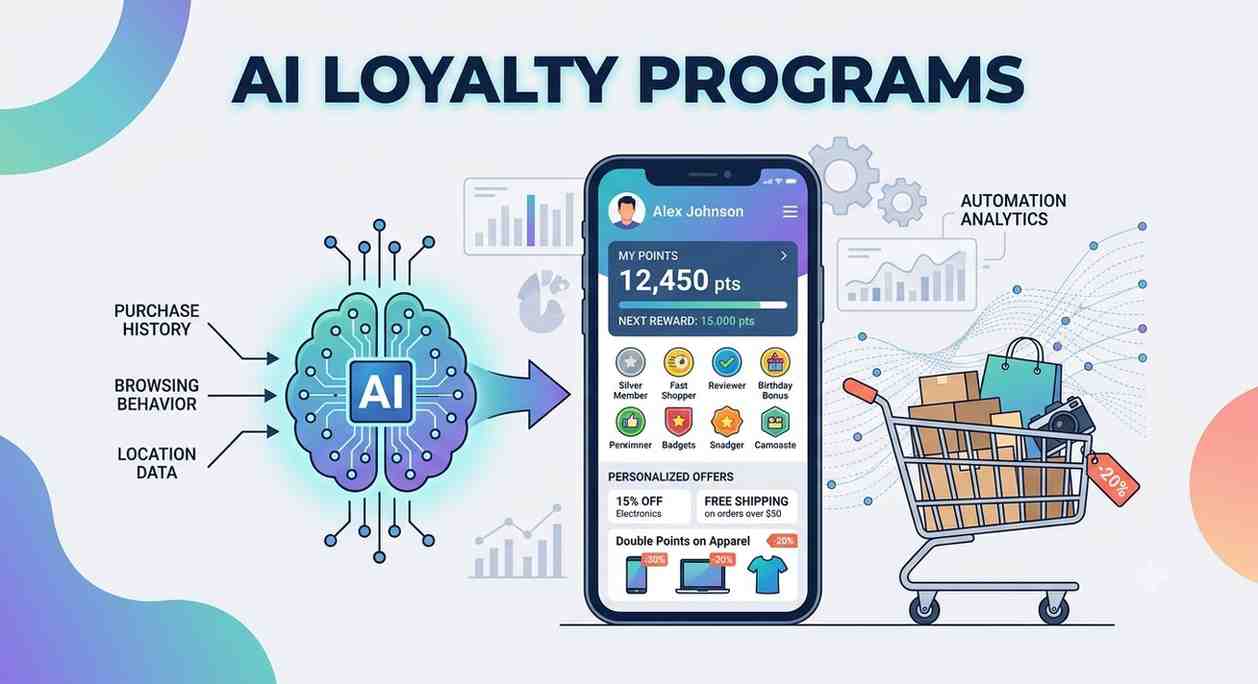
You’ve probably punched enough coffee cards to wallpaper a room, downloaded loyalty apps you forgot about by Tuesday, and collected points that expired before you remembered they existed. Traditional rewards programs were built for a different era, one where “personalized” meant putting your first name in an email. Today, something fundamentally different is happening. Brands are quietly replacing those tired punch-card systems with something far smarter, and if you’ve noticed that your favorite retailer seems to know you better than it did a year ago, that’s not a coincidence. That’s AI loyalty programs at work.
At its core, a loyalty program rewards customers for coming back. That part hasn’t changed. What has changed is the intelligence behind the decisions.
A traditional program gives everyone the same deal: spend $100, get $10 back. An AI-powered program watches how you shop, what you skip, when you tend to leave, and what brings you back, then builds a reward experience around you specifically, not the average customer.
Think of it like the difference between a vending machine and a bartender who’s known you for years. One gives everyone the same options. The other remembers you like your drink a certain way and tells you about the special before you even ask.
AI loyalty programs use machine learning, behavioral data, and predictive analytics to make that “bartender” experience scalable across millions of customers at once.
This is where it gets interesting and where most explainers skip the good stuff.
Every interaction a customer has with a brand generates data. Purchases, yes, but also browsing behavior, time spent on product pages, items added to cart but not bought, support tickets, app opens, and even the time of day someone tends to shop. AI loyalty platforms pull all of this together into a continuously updating customer profile.
The AI identifies patterns humans would never catch at scale. It notices that customers who buy product A tend to churn within 60 days unless they’re introduced to product B. It notes that a segment of shoppers responds to early-access offers but ignores discount codes entirely. It flags customers who are showing early signs of disengagement before they actually leave.
Based on those patterns, the system delivers the right incentive to the right person at the right moment. One customer gets a surprise birthday reward. Another gets an early access invite to a product launch. A third gets a “we miss you” offer timed precisely to when they’re most likely to lapse. None of this is manually triggered; the AI handles the timing, the content, and the channel.
This is what separates AI programs from even the best traditional segmentation. The system learns from outcomes. If a particular offer underperforms in a customer segment, it is adjusted. If a new pattern emerges, it adapts. The program gets smarter with every campaign, every purchase, every ignored email.
Understanding the cause of customer loyalty has always been the holy grail of marketing, and for decades, the answer businesses settled for was “give people points.” Points are easy to copy, easy to ignore, and do little to create a genuine emotional connection with a brand.
AI changes the underlying equation. Instead of asking “what reward can we offer?” the system asks “what does this specific person actually value, and when do they need to hear from us?” That shift from transactional to relational is what’s driving real loyalty outcomes, not just repeat purchases out of habit.
Research consistently shows that customers who feel understood by a brand spend more, refer more, and stick around longer. AI creates that feeling of being understood at a scale no human team could replicate manually.
Not every AI loyalty platform is built the same, but most of the serious ones share a common feature set:
From a customer’s perspective, a well-built AI loyalty program should feel almost invisible in the best possible way. You shouldn’t feel like you’re being profiled. You should just feel like the brand gets you.
The most effective AI-powered loyalty incentive programs don’t overwhelm customers with constant offers. They show restraint. They reach out when it’s relevant, reward behavior that actually matters to the individual, and make the experience feel like a genuine relationship rather than a marketing funnel dressed up in point clothing.
The brands that get this right tend to see something that goes beyond retention metrics; they build the kind of customer base that defends them publicly, forgives the occasional mistake, and genuinely prefers them over cheaper alternatives.
It’s not all frictionless and futuristic. There are real considerations that brands and customers need to sit with.
AI loyalty programs represent a genuine shift in how brands build lasting customer relationships, not a buzzword rebrand of the same old points system. By moving from mass incentives to individualized, predictive engagement, they address something that traditional programs never could: the fact that loyalty is personal. What keeps one customer coming back has almost nothing to do with what keeps another coming back. AI is finally making it possible for brands to act on that truth at scale. Whether you’re a business evaluating your loyalty strategy or a consumer trying to understand why your favorite brand suddenly feels more intuitive, the underlying engine is the same: smarter data, better timing, and a genuine attempt to make every customer feel like the only one.
An AI loyalty program is a customer retention system that uses machine learning and behavioral data to deliver personalized rewards, offers, and engagement rather than applying the same incentives to every customer regardless of their individual preferences or history.
Traditional programs reward all customers the same way based on spend thresholds. AI-powered programs analyze individual behavior patterns to deliver the right reward to the right person at the right time, making the experience feel personal rather than generic.
They can be, but it depends entirely on the brand’s data practices. Reputable programs are transparent about what data they collect and how it’s used, and they give customers meaningful control. Always review a brand’s privacy policy if you’re concerned about how your data is used to inform their loyalty experience.
Yes, increasingly so. While enterprise platforms remain dominant, a growing number of mid-market and small-business solutions now incorporate AI-driven personalization without requiring a large technical team or massive data infrastructure to get started.
The evidence points strongly toward yes, particularly when programs focus on emotional relevance rather than just transactional rewards. Customers who receive timely, personalized engagement are significantly more likely to stay active, spend more over time, and recommend the brand to others.

© 2025 Crivva - Hosted by Airy Hosting Managed Website Hosting.