


When dealing with ongoing back pain, recovering from an injury, or simply trying to move without stiffness, finding the right path to recovery can feel overwhelming. Many people alternate between resting on the couch and pushing through painful gym sessions, only to find themselves right back where they started. Thankfully, local general practitioners and specialists are increasingly sending their patients down a different path: Clinical Reformer Pilates.
This specific approach is far from a standard fitness trend. It is a targeted, evidence-based method of physical rehabilitation. While standard gym classes use a one-size-fits-all approach, clinical programs focus entirely on your unique body mechanics, structural alignment, and injury history.
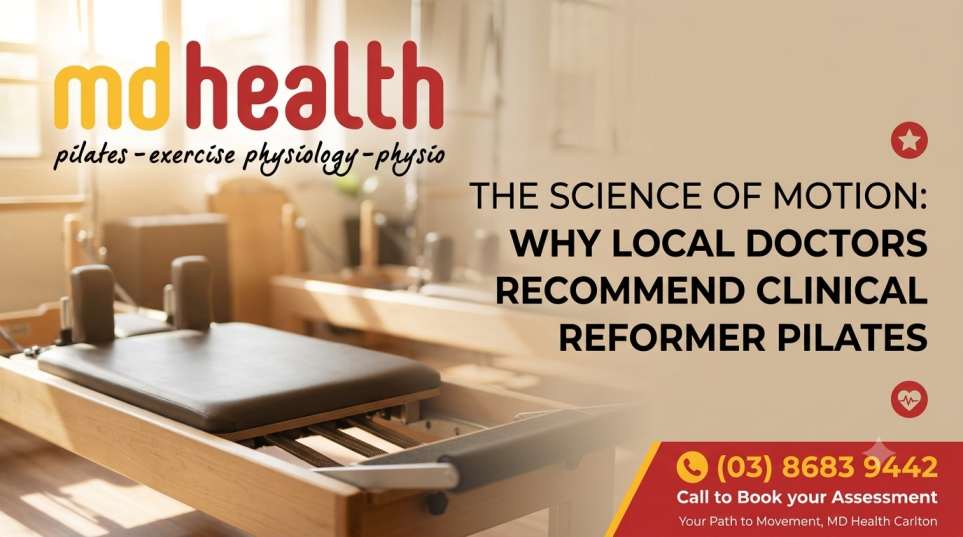
To understand why medical professionals value this method, it helps to look at the equipment itself. The reformer bed uses a sliding carriage, spring-loaded resistance, pulleys, and straps to assist your movement. Instead of lifting heavy, static weights that can stress vulnerable joints, the adjustable springs provide a custom level of tension. This setup allows you to build strength while lying down, sitting, or kneeling, taking the pressure off your spine.
The true magic happens when you combine this specialized equipment with clinical expertise. In a standard fitness environment, a trainer might lead twenty people through the exact same routine. In a clinical setting, your program is designed and supervised by a qualified healthcare professional, such as a physiotherapist or exercise physiologist.
Medical research highlights that Clinical Pilates is uniquely effective because it adapts to a person’s “directional preference”—meaning exercises are selected based on what specific movements relieve your pain and help you recover faster (Kwok et al., 2021). Every movement is selected to address your specific muscle imbalances, structural weaknesses, or structural asymmetries.
Medical practitioners do not hand out recommendations lightly. They look for long-term solutions backed by clinical data. Here is why local doctors frequently recommend this approach for body conditioning and rehabilitation:
Many people believe that building a strong core simply means doing endless sit-ups. In reality, deep stability relies on a complex muscular unit that includes the deep abdominal layers, the pelvic floor, and the tiny stabilizing muscles along your spine (Meikis et al., 2021).
When you experience an episode of back pain, these deep stabilizing muscles often switch off or experience delayed firing patterns. A clinician uses the reformer to retrain these specific muscle groups, helping them activate in the correct sequence to protect your spine during everyday activities like bending down to pick up groceries.
For individuals suffering from joint conditions like osteoarthritis, high-impact activities like running can cause further irritation. The reformer allows you to perform functional patterns, such as a squatting motion, while lying flat on your back. This position removes gravity from the equation, reducing the load on painful knee or hip joints while safely strengthening the surrounding muscles. Peer-reviewed systematic reviews confirm that Pilates significantly reduces pain, improves range of motion, and enhances dynamic balance in individuals managing joint issues like knee osteoarthritis (Meikis et al., 2021).
Most human bodies are naturally asymmetrical; we might consistently carry a heavy bag on one side or sit twisted at an office desk. Over time, these habits cause one side of the body to become tight and dominant, while the other side grows weak. Clinical studies show that a structured, 12-week Reformer Pilates program can result in a 37.1% improvement in postural symmetry and a 50% reduction in perceived pain.
To see the benefits in action, consider two common scenarios that local practitioners see in their clinics every day.
If you decide to start your journey, your first step won’t involve jumping straight onto the equipment. Instead, you will begin with a thorough initial assessment. The clinician will look at your posture, measure your joint mobility, test your muscle strength, and discuss your health history.
From there, they will build a tailored program designed specifically for you. Even in a small group setting, you will be working through your own specific routine under close supervision. The professional will continually monitor your form, adjust the spring tension, and progress your exercises as your body becomes stronger and more resilient.
Clinical Reformer Pilates offers a clear, structured path toward moving freely and living without constant discomfort. By blending the core principles of controlled movement with strict medical science, it bridges the gap between acute injury care and long-term physical conditioning.
If you are tired of dealing with nagging aches or want to prevent injuries before they happen, speak to your local health practitioner. Investing in a personalised, clinically guided program is a powerful way to reclaim control over your movement and improve your everyday quality of life.
Clinical classes are designed and supervised by qualified healthcare professionals who tailor every movement to your specific injuries, medical history, and structural goals. Fitness classes use a generic, high-intensity routine for a large group, which may not be safe if you are managing pain.
No, you do not need a doctor’s referral to book an initial assessment at a clinical studio. However, because these sessions are run by allied health professionals, a referral may help you claim rebates through specific health management plans.
Most clinicians recommend attending two structured sessions per week to build muscle memory, develop core stability, and notice distinct changes in your movement patterns. Consistent practice over a few weeks helps your body maintain these new alignment habits.
Yes, it is highly recommended for managing ongoing lower back pain because it focuses on activating the deep stabilizing muscles of the spine. By supporting your trunk and pelvis, it unloads pressure from your lower back and helps you move without discomfort.
Yes, because the spring resistance on the reformer can be modified to assist your movements rather than strain your muscles. The close supervision of a clinician ensures you perform exercises that safely support your rehabilitation without risking reinjury.

© 2025 Crivva - Hosted by Airy Hosting Managed Website Hosting.