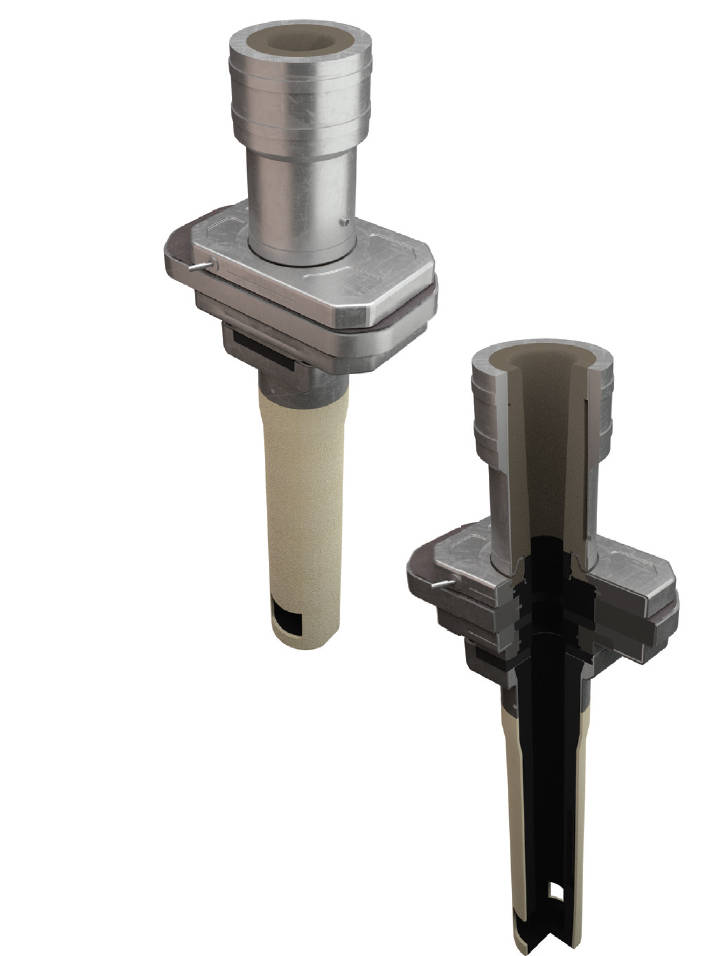
In modern continuous casting operations, the tundish nozzle plays a crucial role in regulating molten steel flow from the tundish into the Submerged Entry Nozzle (SEN) or directly into the mold. Its reliability and flow-control stability directly impact mold level fluctuation, inclusion removal, casting speed, steel cleanliness, and overall process efficiency. Among various nozzle types, the isostatic tundish nozzle—also known as the isostatically pressed tundish nozzle—has emerged as a high-performance solution due to its superior density, strength, and anti-erosion characteristics. These nozzles leverage advanced isostatic pressing technology to achieve uniform microstructure and enhanced service life, thereby supporting high-productivity and high-quality steelmaking.
This article provides a comprehensive technical overview of the isostatic tundish nozzle, including its definition, manufacturing principles, material properties, performance advantages, design features, and application recommendations for steel plants.
An isostatic tundish nozzle is a tundish refractory component manufactured using cold isostatic pressing (CIP) technology to achieve a highly uniform, high-density, high-strength structure. It is typically installed at the bottom of the tundish and serves as the primary outlet for molten steel flow. Its functions include:
Compared with conventional vibration-molded or press-formed nozzles, isostatic nozzles present:
Isostatic tundish nozzles are now widely used in billet, bloom, and slab casters, particularly industries demanding long casting sequences and high steel cleanliness, such as automotive steel, silicon steel, pipeline steel, and bearing steel.
Isostatic pressing is a forming method in which powder materials are compacted under equal pressure from all directions. Unlike conventional pressing methods that apply pressure only from one axis, isostatic pressing ensures uniform compaction and consistent density distribution.
The typical process includes:
The material compositions vary based on the steel grade, casting time, and tundish design. Typical materials include:
The material choice significantly influences performance, and isostatic technology further enhances inherent material properties.
Isostatic tundish nozzles are designed with special geometries to maintain stable flow and reduce stress concentration:
Common bore shapes include:
Venturi and converging designs help stabilize flow and minimize turbulence entering the SEN.
Isostatic nozzles maintain very tight tolerances:
This precision contributes to more predictable flow and better compatibility with slide gate or stopper mechanisms.
Isostatic tundish nozzles outperform conventional nozzles in several critical areas:
This significantly reduces fracture and chipping incidence.
Dense microstructure minimizes thermal gradient damage, making the nozzle more resistant to:
Especially important when casting:
Zirconia-based isostatic nozzles can easily handle long sequences exceeding 16–20 hours.
The lifetime of an isostatic tundish nozzle is typically:
These benefits directly contribute to higher productivity and quality consistency.
Isostatic tundish nozzles are used in:
Their durability and stability reduce maintenance and downtime across all these areas.
Long casting sequences require high zirconia content.
Aggressive slags demand improved corrosion resistance materials.
While isostatic nozzles have higher initial cost, lifecycle savings are substantial.
The isostatic tundish nozzle represents a significant advancement in tundish refractories for continuous casting. By combining high-purity materials with isostatic pressing technology, these nozzles achieve unmatched uniformity, strength, erosion resistance, and thermal shock stability. Their precise dimensions and microstructural consistency ensure smooth molten steel flow, reduced turbulence, and improved casting stability.
For steel plants seeking improved process reliability, longer nozzle life, and higher product quality—particularly in demanding steel grades and long-sequence casting—the isostatic tundish nozzle is an essential and highly effective solution. As steelmaking continues to evolve toward cleaner, more efficient, and more automated operations, isostatically pressed nozzles will remain a core technology supporting the next generation of continuous casting performance.More information please visit Henan Yangyu Refractories Co.,Ltd

© 2025 Crivva - Hosted by Airy Hosting Managed Website Hosting.