


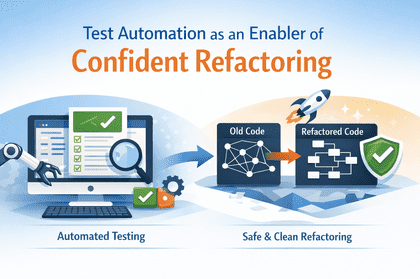
Refactoring is one of the most valuable activities in software development, yet it is often delayed or avoided. Teams refactor to improve readability, reduce technical debt, simplify complex logic, and make systems easier to extend. However, refactoring also carries risk. Even changes that seem harmless can unintentionally alter behavior, introduce regressions, or break edge cases that no one remembers anymore.
This tension is where test automation becomes essential. When done well, test automation gives teams the confidence to refactor regularly and responsibly. Instead of fearing the unknown impact of changes, teams can rely on automated tests to verify that behavior remains consistent. Over time, this confidence transforms refactoring from a risky event into a normal, ongoing practice.
In theory, refactoring should not change how a system behaves. In reality, most production systems contain hidden complexity:
Implicit dependencies between modules
Legacy code written without tests
Business rules embedded deep in logic
Edge cases discovered only after incidents
As systems grow, institutional knowledge fades. Developers who originally wrote the code may no longer be on the team, and documentation often lags behind reality. Under these conditions, refactoring becomes less about improving structure and more about avoiding landmines.
Without strong test automation, teams are forced to rely on manual testing, partial checks, or gut instinct. This uncertainty slows progress and encourages teams to postpone refactoring until problems become unavoidable.
Test automation shifts refactoring from uncertainty to verification. Instead of asking “Will this break something?”, teams can ask “What do the tests tell us?”
Well-designed automated tests provide:
Fast feedback on behavioral changes
Confidence that core workflows still function
A safety net for incremental improvements
A shared understanding of system expectations
This feedback loop allows developers to refactor more frequently, in smaller steps, and with greater precision.
Not all tests support confident refactoring equally. The most valuable tests are those that validate observable behavior rather than internal implementation.
Behavior-oriented tests focus on:
Inputs and outputs
API contracts
Business rules and workflows
Side effects such as data persistence or events
Because these tests do not depend on internal structure, they remain stable even when code is reorganized. This stability is critical during refactoring, where internal changes are expected.
By contrast, tests that assert private methods, internal state, or exact execution paths often fail during refactoring even when behavior remains correct. Such tests create friction and discourage improvement.
One common misconception is that test automation restricts refactoring. In reality, poorly designed tests do that. Effective test automation acts as a safety net, not a constraint.
When tests are resilient and behavior-focused, they give developers freedom to:
Rename methods and variables
Extract or merge components
Simplify conditionals
Reorganize modules
Developers can experiment confidently, knowing that unintended behavior changes will be caught early.
Large refactoring efforts are inherently risky. Test automation makes it possible to refactor incrementally instead.
A typical safe refactoring loop looks like this:
Run the test suite to establish a baseline
Make a small structural improvement
Run tests to verify behavior
Commit and repeat
This approach reduces blast radius and encourages continuous improvement rather than massive rewrites. Over time, the codebase becomes cleaner, more readable, and easier to maintain.
Regression tests play a central role in refactoring confidence. They ensure that existing functionality continues to work as expected after structural changes.
Effective regression coverage focuses on:
Core business workflows
High-impact user journeys
Frequently used APIs
Areas with a history of defects
Rather than maximizing the number of tests, teams should prioritize tests that protect behavior users rely on. This targeted strategy makes refactoring safer without bloating test suites.
Some teams strengthen this approach by capturing real system behavior and turning it into regression checks. Tools like Keploy support this pattern by recording actual API interactions and replaying them after changes, which is especially helpful when refactoring complex or poorly documented systems.
In modern architectures, refactoring often extends beyond a single codebase. Microservices, shared libraries, and distributed systems introduce additional risk.
Test automation helps teams refactor across boundaries by:
Validating service contracts
Detecting breaking changes early
Ensuring integrations continue to function
Without automated tests, cross-service refactoring becomes a coordination nightmare. With them, teams can evolve systems independently while maintaining overall stability.
Refactoring does not just improve production code. It often reveals opportunities to improve tests as well.
During refactoring, teams may:
Simplify complex test setups
Remove redundant or low-value tests
Improve naming and intent in test cases
Clarify assumptions that were previously implicit
This feedback loop strengthens both the codebase and the test suite. Cleaner code is easier to test, and better tests reinforce good design.
Even with test automation in place, teams can struggle if they fall into certain traps:
Flaky tests: Unreliable tests erode trust and cause teams to ignore failures.
Overemphasis on unit tests: Unit tests alone may miss integration and behavioral issues.
Outdated tests: Tests that enforce old behavior can block necessary evolution.
Slow feedback loops: Long-running test suites discourage frequent refactoring.
Addressing these issues is essential to making test automation a genuine enabler rather than a burden.
The success of test automation is not measured by coverage percentages alone. Its real value shows up in team behavior and outcomes.
Signs that test automation enables confident refactoring include:
Developers refactor proactively instead of reactively
Structural improvements happen continuously
Fewer production regressions after refactors
Reduced fear around touching legacy code
These indicators matter far more than raw metrics.
Teams that avoid refactoring eventually pay a price. Technical debt accumulates, velocity slows, and systems become fragile. In contrast, teams that refactor regularly keep their codebases adaptable and resilient.
Test automation makes this sustainability possible. It allows teams to improve structure without sacrificing stability, enabling long-term growth and innovation.
Confident refactoring is not about bravery—it is about preparation. Test automation provides the preparation teams need to improve their systems safely and continuously. When tests focus on behavior, remain stable through change, and evolve alongside the code, refactoring becomes a routine practice rather than a risky event.
By treating test automation as a foundation for change rather than a compliance task, teams unlock the freedom to refactor, adapt, and build better software over time.

© 2025 Crivva - Hosted by Airy Hosting Managed Website Hosting.