


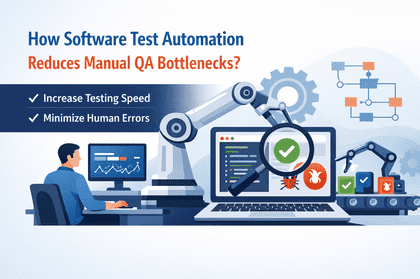
Manual testing has long been a critical part of quality assurance. However, as release cycles become shorter and applications grow more complex, manual QA often becomes a bottleneck. Delayed feedback, repetitive validation tasks, and limited testing bandwidth can slow down entire development pipelines.
This is where software test automation changes the equation. By systematically automating repetitive and high-risk validation tasks, teams reduce testing delays, improve release speed, and maintain consistent quality without expanding QA headcount.
This article explains how software test automation eliminates manual QA bottlenecks, improves delivery efficiency, and supports scalable engineering processes.
Before addressing solutions, it is important to identify where bottlenecks typically occur.
Manual QA teams often face:
Repetitive regression cycles after every release
Limited bandwidth to test growing feature sets
Delays in feedback to developers
Environment dependency issues
Inconsistent test execution quality
As applications scale across APIs, microservices, mobile clients, and web interfaces, the testing surface expands significantly. Manual testing alone cannot keep up with high-frequency deployments.
The result is predictable:
Longer release cycles
Increased risk of production defects
Overworked QA teams
Reduced developer productivity
Software test automation addresses these structural limitations directly.
One of the largest sources of QA bottlenecks is repetitive regression testing.
Every code change requires validation of previously working functionality. In manual workflows, testers must:
Re-run the same test cases
Validate identical scenarios across environments
Reproduce integration flows repeatedly
Automated tests eliminate this redundancy.
Once written, automated test suites can execute thousands of scenarios repeatedly without additional human effort. This ensures:
Consistent validation
Faster execution cycles
Reduced dependency on manual intervention
By removing repetitive manual work, QA teams can shift focus toward exploratory testing, usability validation, and edge case discovery.
Manual QA often operates in batches. Features are developed, merged, and then sent to QA for testing. This creates queue-based workflows, where testing begins only after development is complete.
Software test automation enables continuous testing within CI/CD pipelines.
Every commit triggers automated validation. Developers receive immediate feedback about:
Broken functionality
Integration failures
Performance regressions
Contract mismatches
This shift from batch testing to continuous validation eliminates waiting time between development and testing phases.
Instead of becoming a release checkpoint, QA becomes an integrated quality layer across the pipeline.
As products grow, regression suites expand. Manual execution time increases linearly with feature count.
Software test automation breaks this limitation.
Automated regression suites can run:
Overnight
In parallel
Across multiple environments
Execution time becomes infrastructure-dependent rather than workforce-dependent.
This means teams can scale releases without proportionally scaling QA headcount. Automation absorbs the complexity growth.
Manual testing is limited by time and human capacity. Under deadline pressure, teams often reduce coverage.
Automated suites expand coverage across:
API endpoints
Edge cases
Negative scenarios
Integration workflows
Data variations
Many test automation tools allow parameterized testing and parallel execution, increasing scenario coverage without increasing execution time.
Better coverage reduces escaped defects, which in turn reduces production incidents and emergency hotfixes.
This prevents reactive firefighting that typically overwhelms QA teams.
Manual QA frequently depends on shared staging environments. When environments are unstable or misconfigured, testing is delayed.
Software test automation supports:
Environment provisioning through infrastructure scripts
Containerized test execution
Mocking external dependencies
Service virtualization
These techniques allow test runs to execute independently of shared environment constraints.
Teams avoid scheduling conflicts and environment-related delays.
A major bottleneck in manual QA processes is strict separation between development and testing.
Automation encourages shared responsibility.
Developers can:
Write unit tests alongside feature code
Validate integration flows before merging
Run local automated suites
This reduces back-and-forth between developers and QA teams.
When defects are caught earlier, QA time is not spent rediscovering basic functional issues.
Instead, QA can focus on higher-value testing strategies.
Modern applications rely heavily on APIs and microservices. Manual testing of API interactions is time-consuming and error-prone.
Software test automation enables:
Automated API contract validation
Schema verification
Response validation
Integration dependency testing
Tools like Keploy, for example, are often used to capture real API interactions and generate test cases automatically. This reduces the manual effort required to write test scripts while ensuring realistic validation.
By automating backend validation, teams reduce reliance on UI-based testing, which is slower and more fragile.
Manual testing often occurs late in the development cycle.
Automation shifts defect detection earlier:
Unit tests catch logic errors
Integration tests catch service mismatches
End-to-end tests validate workflows
Earlier detection reduces defect resolution cost.
Fixing a bug during development takes minutes. Fixing it after deployment can require rollback, patching, and customer communication.
By preventing late-stage defect discovery, automation reduces emergency QA cycles and production support overload.
High-performing engineering teams deploy multiple times per week, or even daily.
Manual QA cannot keep up with this cadence without sacrificing quality.
Software test automation enables:
Automated pre-merge validation
Automated regression suites before deployment
Automated post-deployment smoke testing
This allows QA validation to scale with release frequency.
Without automation, fast releases would either increase risk or exhaust QA resources.
Manual testing is inherently inconsistent.
Two testers may interpret steps differently. Fatigue can affect attention to detail. Repetitive execution increases the risk of oversight.
Automated tests execute the same steps identically every time.
This improves:
Reliability of validation
Confidence in release decisions
Audit traceability
Consistency reduces ambiguity during release approvals.
When QA teams spend most of their time executing regression test cases manually, strategic quality improvements are neglected.
With software test automation in place, QA professionals can focus on:
Risk analysis
Test strategy optimization
Performance testing
Security validation
Exploratory testing
This elevates QA from repetitive execution to strategic quality engineering.
Distributed systems introduce additional complexity:
Multiple services
Asynchronous communication
Third-party integrations
Event-driven workflows
Manual validation across these layers is not sustainable.
Automation frameworks can orchestrate:
Multi-service validation
Contract testing
Parallel scenario execution
Dependency simulations
This ensures that scaling architecture does not proportionally scale manual effort.
The impact of software test automation can be measured through:
Reduced regression cycle time
Lower defect escape rate
Faster deployment frequency
Reduced QA backlog
Decreased production rollbacks
These metrics demonstrate how automation directly reduces bottlenecks rather than simply shifting workload.
Some teams hesitate to adopt automation due to:
Initial setup cost
Maintenance complexity
Learning curve
However, the cost of not automating grows over time.
As applications scale, manual bottlenecks become more expensive than automation investment.
When implemented strategically, automation pays for itself through:
Reduced incident cost
Faster releases
Improved developer productivity
Automation does not eliminate manual QA entirely.
The most effective strategy includes:
Automated regression and integration validation
Manual exploratory testing
Risk-based prioritization
Continuous improvement of test suites
This balanced model ensures that automation removes bottlenecks without sacrificing test depth.
Manual QA bottlenecks are not caused by lack of effort. They are caused by scale, complexity, and release speed.
Software test automation addresses these structural challenges by:
Eliminating repetitive regression work
Enabling continuous validation
Increasing test coverage
Reducing human error
Supporting high-frequency releases
When implemented strategically, automation transforms QA from a release gate into a continuous quality engine.
The result is faster delivery, lower defect rates, and sustainable growth without overwhelming QA teams.
In modern development environments, reducing bottlenecks is not optional. It is essential for maintaining velocity and reliability at scale.

© 2025 Crivva - Hosted by Airy Hosting Managed Website Hosting.