Chemical processing doesn’t usually fail because of one dramatic mistake. More often, it struggles under small, compounding inefficiencies-poor phase separation, unstable temperatures, or equipment choices that quietly limit reproducibility. These issues tend to surface not during early experiments, but later, when a process is pushed harder, run longer, or handed off between teams.
In research labs and pilot facilities, separation systems and reaction vessels sit at the center of this challenge. They rarely receive the same attention as catalysts or formulations, yet they influence yield, safety, and scalability in ways that are difficult to fix once a process is established.
Understanding how these systems affect day-to-day operations helps teams avoid costly redesigns and unexpected bottlenecks.
Separating immiscible liquids sounds straightforward on paper. In practice, it becomes one of the most sensitive steps in many chemical workflows.
Minor changes in viscosity, temperature, or impurity levels can disrupt phase clarity. Emulsions linger. Settling times stretch. Operators compensate with longer cycles or manual intervention, which introduces inconsistency.
In pilot environments, these issues are often handled with experience and judgment. At larger scales, the same assumptions break down. What worked in a beaker or small separator doesn’t always translate to stable, repeatable performance.
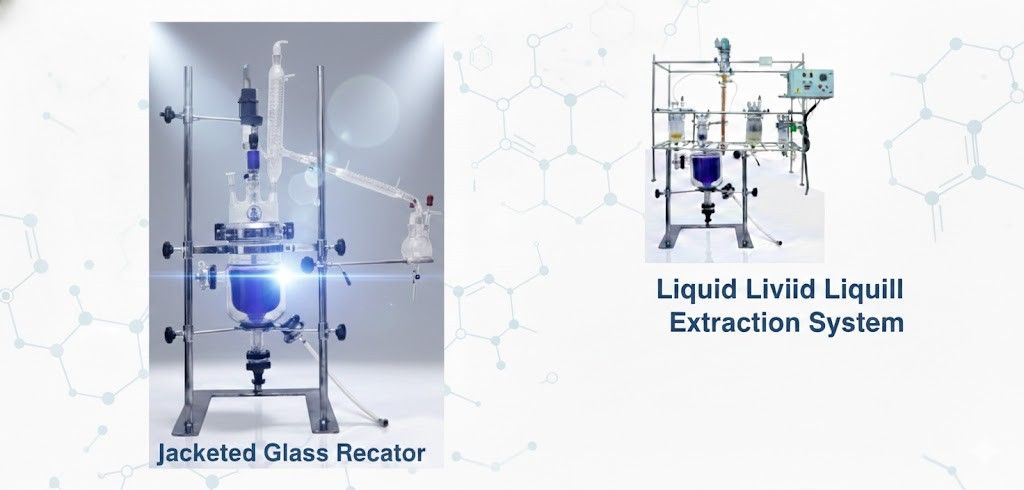
This is where the choice of a liquid extraction system becomes relevant-not as a headline solution, but as a way to standardize how phases interact and separate under controlled conditions. When separation behaves predictably, downstream steps become easier to manage.
Reaction temperature is usually monitored, but it isn’t always well controlled.
In many labs, temperature management relies on external baths or localized heating. These setups work until reactions become more exothermic, longer in duration, or more sensitive to gradients. Small temperature swings can alter reaction rates, solubility, and even separation behavior without triggering alarms.
The problem isn’t lack of measurement-it’s uneven heat distribution.
Once processes move beyond exploratory work, vessels that allow precise and uniform thermal control become more than a convenience. A jacketed glass reactor provides a clear example of how temperature stability supports consistency without changing the chemistry itself.
By controlling the environment around the reaction, rather than reacting to temperature shifts after they occur, teams gain better insight into what the process is actually doing.
One of the most common frustrations in scale-up is discovering that a process behaves differently outside the lab.
The chemistry hasn’t changed. The raw materials are the same. Yet yields drop, separation times increase, or impurities appear.
Often, the difference lies in how heat and mass transfer were handled during development. Informal setups hide limitations that only surface when volumes increase. Without consistent separation and thermal control, lab data can create false confidence.
Engineers reviewing these issues frequently trace them back to early equipment choices rather than reaction design. Decisions made for convenience during research can quietly constrain scalability.
Well-designed process equipment does more than perform a function. It reveals how a system behaves.
Transparent vessels, controlled interfaces, and repeatable operating conditions allow researchers to observe trends rather than guess at them. Separation times, phase ratios, and temperature responses become data points instead of assumptions.
This visibility matters when troubleshooting. It’s easier to adjust a process when variables are isolated and measurable. Without that clarity, teams end up changing multiple factors at once, hoping one of them solves the problem.
Safety discussions often focus on materials and protocols, but equipment design plays an equally important role.
Uncontrolled temperature rise, pressure buildup, or delayed separation can create conditions that stress both systems and operators. In research environments, these risks are managed informally. At pilot scale, they demand more structured control.
Using systems designed for steady operation reduces the need for improvisation. Fewer manual adjustments mean fewer opportunities for error, especially during long or unattended runs.
Standardization doesn’t mean rigidity. It means creating a stable baseline.
When equipment behaves consistently, experiments become easier to compare. Results from different operators or shifts align more closely. Knowledge transfers more smoothly between teams.
This matters in organizations where processes move from R&D to pilot plants, then to production partners. Each transition introduces uncertainty. Standardized separation and reaction setups help preserve intent as processes evolve.
Many development teams design for immediate needs. That’s understandable-budgets and timelines are real constraints.
The challenge is recognizing which shortcuts are harmless and which ones create long-term friction. Separation and thermal control tend to fall into the second category. They rarely break a process outright, but they quietly shape its limits.
Thinking ahead doesn’t require overengineering. It requires awareness of where variability hides and how it might surface later.
No single article or system answers every process challenge. What helps most is access to clear, practical references that explain how specific tools fit into broader workflows.
When teams treat separation and reaction equipment as supporting infrastructure rather than focal points, decisions improve. The chemistry stays central, but the systems around it stop working against it.
Resources that explain these roles in context-without sales pressure or exaggerated claims-are often the most useful ones on a lab engineer’s desk.
Yield and throughput dominate most discussions, but reliability deserves equal weight.
A process that delivers slightly lower output but runs predictably can outperform a higher-yield setup that demands constant attention. Stable separation and controlled temperature profiles reduce surprises, which in turn reduce downtime.
Over time, these factors influence not just production numbers, but team confidence and decision-making speed.
Processes evolve. Regulations change. Materials shift. Teams rotate.
Equipment choices that support observation, control, and repeatability tend to age better than improvised setups. They adapt more easily to new requirements because their behavior is understood.
Separation systems and controlled reactors rarely draw attention when they work well. That’s often the point. Their value lies in what they prevent as much as in what they enable.

© 2025 Crivva - Hosted by Airy Hosting Managed Website Hosting.