

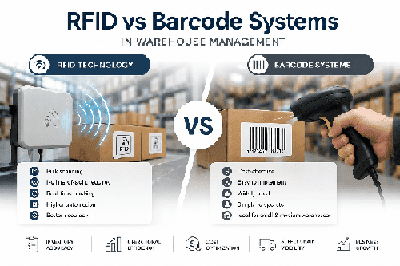
Modern warehouses are evolving rapidly with the adoption of smart technologies, automation, and real-time inventory tracking. As businesses aim to improve operational efficiency and reduce errors, choosing the right tracking technology becomes critical. Two of the most widely used solutions in warehouse operations are RFID technology and Barcode Systems.
Both technologies play a major role in improving inventory visibility, streamlining workflows, and enhancing warehouse management systems. However, they differ significantly in terms of speed, automation, cost, scalability, and accuracy.
In this blog, we will compare RFID vs barcode systems in warehouse management, explore their advantages and limitations, and help businesses determine which solution best fits their operational requirements.
Efficient inventory tracking is the backbone of every successful warehouse. Whether managing stock movement, order fulfilment, or supply chain visibility, businesses rely heavily on tracking technologies integrated with warehouse management software.
RFID (Radio Frequency Identification) technology uses radio waves to identify and track objects automatically. An RFID system typically consists of:
Unlike traditional scanning methods, RFID warehouse management solutions do not require direct line-of-sight scanning. RFID readers can scan multiple items simultaneously, making inventory tracking significantly faster and more accurate.
RFID technology is widely used in:
With real-time tracking capabilities, RFID helps businesses improve operational visibility and reduce inventory discrepancies.
Barcode Systems are one of the most common tracking solutions used in warehouses worldwide. Barcodes contain encoded product information that can be scanned using handheld or fixed barcode scanners.
There are mainly two types of barcodes:
Barcode Systems are commonly integrated into warehouse management systems to manage:
Compared to RFID technology, barcode systems are more affordable and easier to implement, making them ideal for small and medium-sized businesses.
Although both technologies serve the same purpose, their functionality and performance vary considerably.
One of the biggest advantages of RFID technology is its ability to scan multiple items at once without manual intervention.
RFID Advantages:
Barcode System Limitations:
For large warehouses handling thousands of products daily, RFID warehouse management solutions can dramatically improve operational speed.
Inventory accuracy is essential for avoiding stock shortages, overstocking, and fulfillment errors.
RFID Technology:
RFID provides real-time inventory visibility by continuously updating stock movement data within the warehouse management software.
Benefits include:
Barcode Systems:
Barcode Systems depend heavily on manual scanning. If employees miss scanning an item, inventory records can become inaccurate.
While barcode systems still offer reliable tracking, they are more vulnerable to operational mistakes.
Cost is often a deciding factor when choosing between RFID and barcode systems.
Barcode Systems:
Barcode implementation is relatively inexpensive because:
This makes Barcode Systems ideal for:
RFID Technology:
RFID implementation involves higher upfront investment due to:
However, many businesses achieve long-term ROI through:
Automation is becoming a major priority in modern warehouse management systems.
RFID Technology:
RFID supports advanced warehouse automation by enabling:
RFID warehouse management solutions integrate seamlessly with:
Barcode Systems:
Barcode Systems still require manual scanning, limiting full automation potential.
Although barcode-based warehouse management software improves efficiency, it cannot deliver the same automation level as RFID technology.
Warehouse environments can often be harsh, involving:
RFID Tags:
RFID tags are highly durable and can withstand rough conditions.
Barcode Labels:
Barcode labels may:
Frequent replacement and maintenance may increase operational costs for barcode systems.
As businesses grow, warehouse operations become more complex.
RFID Technology:
RFID systems are highly scalable and suitable for:
Barcode Systems:
Barcode Systems work efficiently for smaller operations but may become less efficient as warehouse size and inventory volume increase.
Businesses planning future expansion often prefer RFID warehouse management solutions for long-term scalability.
RFID technology offers several operational advantages that help businesses improve warehouse performance.
Faster Inventory Management
RFID allows warehouse staff to scan hundreds of items simultaneously, reducing inventory counting time significantly.
Real-Time Inventory Tracking
Businesses gain instant visibility into inventory movement, enabling better decision-making.
Improved Order Accuracy
Real-time scanning reduces picking and shipping errors.
Reduced Labor Costs
Automation minimizes manual work and improves workforce productivity.
Better Asset Tracking
RFID technology helps track high-value assets efficiently across warehouses and distribution centers.
Enhanced Warehouse Automation
RFID integrates with warehouse management software to support automated workflows and smart warehousing.
Despite technological advancements, Barcode Systems remain highly popular due to their simplicity and affordability.
Cost-Effective Implementation
Barcode systems are inexpensive to deploy and maintain.
Easy Employee Training
Warehouse staff can quickly learn barcode scanning procedures.
Reliable Product Identification
Barcodes provide accurate product-level information during shipping and receiving operations.
Suitable for Small Businesses
Small and medium-sized warehouses can efficiently manage inventory using barcode-enabled warehouse management systems.
Industry-Wide Adoption
Barcode Systems are universally accepted across retail, logistics, manufacturing, and healthcare industries.
Both technologies come with their own limitations.
RFID Challenges
High Initial Investment
RFID infrastructure setup can be expensive.
Complex Deployment
RFID implementation often requires specialized technical expertise.
Signal Interference
Metal surfaces and liquids can sometimes interfere with RFID signals.
Manual Scanning Dependency
Employees must scan each item individually.
Limited Automation
Barcode Systems cannot support fully automated warehouse operations.
Damaged Labels
Damaged or faded barcodes may become unreadable.
Slower Processing
Large-scale inventory scanning becomes time-consuming.
The right solution depends entirely on your warehouse size, operational goals, and budget.
Choose RFID Technology If:
RFID warehouse management solutions are ideal for enterprises seeking scalability and operational intelligence.
Choose Barcode Systems If:
Barcode Systems provide a practical and affordable solution for businesses that do not require advanced automation.
Modern warehouses rely heavily on Logistics software integration to streamline operations and improve data accuracy.
Whether using RFID technology or Barcode Systems, integrating tracking solutions with warehouse management software enables:
A connected warehouse management system ensures seamless communication between:
This integration helps businesses create a smarter and more efficient warehouse ecosystem.
Implementing advanced warehouse technologies requires the right technical expertise.
A professional logistics software development company can help businesses by offering:
Custom Warehouse Management Solutions
Tailored software based on warehouse size and operational requirements.
RFID Warehouse Management Solutions
End-to-end RFID system integration and deployment.
Barcode-Enabled Warehouse Management Software
Scalable barcode tracking systems for inventory management.
Automation and System Integration
Integration with ERP, CRM, transportation, and supply chain systems.
Ongoing Technical Support
Continuous maintenance, updates, and optimization services.
Working with an experienced logistics software development company ensures smooth implementation and long-term operational success.
Future of RFID and Barcode Systems in Warehousing
Warehouse technology continues to evolve rapidly with innovations in:
In the future, many businesses may adopt hybrid solutions combining RFID technology and Barcode Systems for maximum flexibility and cost efficiency.
Smart warehouses will increasingly rely on:
As supply chains become more complex, businesses investing in modern warehouse management software will gain a significant competitive advantage.
Both RFID technology and Barcode Systems play a crucial role in modern warehouse management. While barcode systems remain affordable and easy to implement, RFID offers advanced automation, real-time tracking, and improved scalability.
The choice between RFID vs barcode systems depends on several factors, including:
Businesses looking to improve efficiency, inventory accuracy, and warehouse automation should evaluate their long-term operational goals carefully before choosing a solution.
Partnering with a reliable logistics software development company can help organisations implement the right warehouse management system and achieve smarter, more efficient warehouse operations.

© 2025 Crivva - Hosted by Airy Hosting Managed Website Hosting.