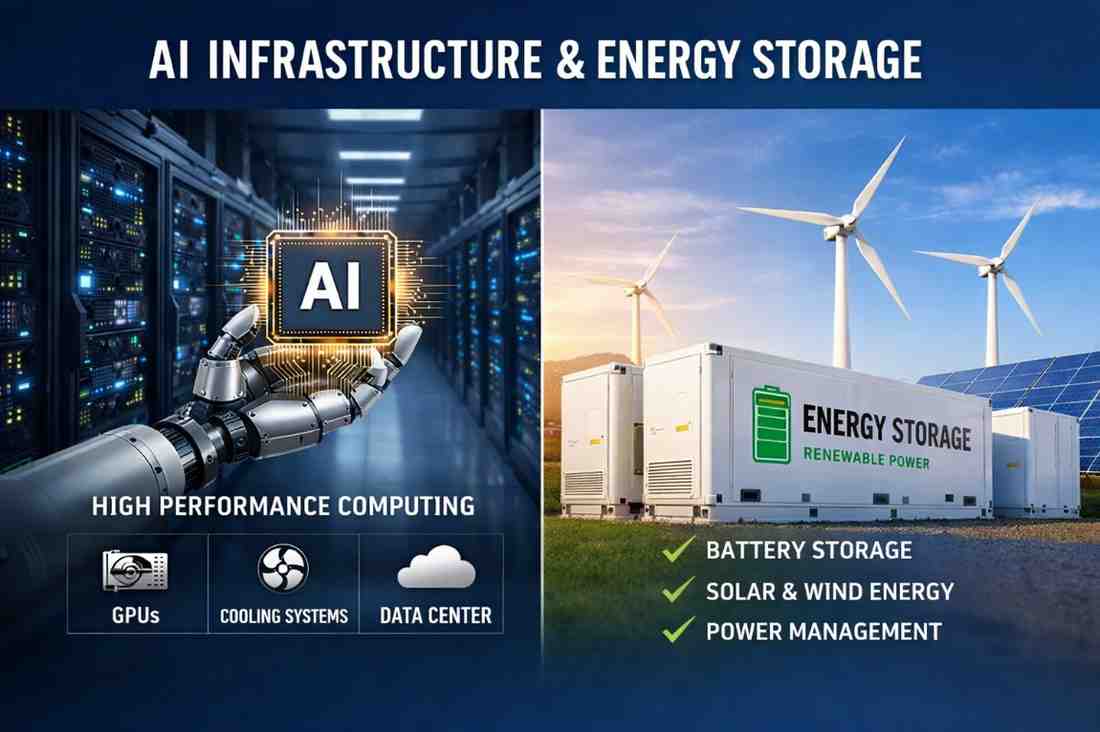
On January 29, 2026, Redwood Materials disclosed a historic $425 million Series E financing round, including Google as a strategic investor alongside Capricorn, Goldman Sachs, and existing investors. This is not a typical battery recycling program — it signals a major move into AI infrastructure energy storage, illustrating where smart capital is flowing in 2026.
Redwood Materials, founded by ex-Tesla CTO JB Straubel, has evolved far beyond battery recycling. Its new Redwood Energy division repurposes EV batteries into microgrids designed to power AI data centers and industrial facilities. With this round, Redwood’s total capital raised reaches $2.3 billion and its valuation surpasses $6 billion, placing the company at the intersection of climate tech and AI infrastructure — a prime focus of today’s venture ecosystem.
Why Energy Storage Bottlenecks AI Growth
AI data centers, manufacturing reshoring, and broader electrification are driving massive growth in electricity demand. Investors now see energy storage as essential infrastructure, not optional. It forms the foundation of the AI revolution. The International Energy Agency estimates that energy consumption by data centers will double by 2027, creating unprecedented demand for scalable, sustainable power sources.
This energy surge is reshaping venture capital investing in early stage startups. Startups that address the “power paradox” — providing AI-scale energy sustainably — are attracting priority attention from major venture capital firms. Founders capable of locating solutions at the AI-energy nexus are increasingly the focus of high-conviction investments.
Strategic Capital Meets Infrastructure
The inclusion of Google in Redwood’s Series E reflects a broader trend: strategic corporate venture capital firm investments in critical infrastructure. Strategic investors bring more than money — they provide offtake agreements, technical validation, and rapid deployment opportunities. This contrasts with traditional financial investors, who primarily offer capital.
For founders aiming to raise capital for startups in 2026, this trend signals a need to position businesses at the intersection of technology, corporate strategy, and distribution. Deals are no longer just financial transactions; they are partnerships that accelerate product deployment and market adoption.
Market dynamics are also shifting in deal structures. Redwood’s Series E, extended from an initial $350M close in October 2025, illustrates how “hot” rounds quickly attract follow-on capital. Early-stage firms now face both opportunity and pressure: new sources of funding are available for proven concepts, but the technical and commercial bar is higher than ever.
Evolve Venture Capital Perspective on Infrastructure Timing
At Evolve Venture Capital, we see infrastructure investment occurring in predictable waves. The overlap of AI compute demand, modernizing grids, and supply chain reshoring creates multi-decade opportunities in energy storage and management. We focus on startups developing chemistry-agnostic battery management systems, grid-edge software, and predictive maintenance AI for energy assets.
Success in this space requires balancing technical innovation with capital efficiency. Unlike consumer apps, infrastructure startups do not necessarily need enormous teams or massive upfront spending. Founders who approach fundraising strategically — viewing it as a tool to accelerate execution rather than a mere financial operation — are best positioned to attract meaningful investment.
Practical Guidance for Founders
Founders operating at the AI-energy intersection must prioritize three key strategies:
Position as AI Infrastructure Enablement – Seed-stage opportunities in AI-energy convergence are closing quickly. Investors are rewarding startups that provide direct infrastructure solutions for AI data centers rather than general climate or cleantech narratives. By aligning product design with AI operational requirements, founders increase their likelihood of securing funding from both corporate and financial venture capital firms.
Optimize Fundraising Timing – Infrastructure projects have longer sales cycles than software. Founders should plan fundraising around grid stress events or major AI capacity announcements, creating urgency for strategic investors. A target runway of 18 months allows sufficient time to deploy and scale energy solutions while maintaining investor confidence.
Leverage Regulatory and Strategic Advantages – Projects eligible for incentives like the Inflation Reduction Act, or located near grid-constrained AI data center clusters, have higher intrinsic value. Regulatory arbitrage, geographic proximity, and clear deployment potential enhance the attractiveness of startups to strategic and traditional venture capital firms alike.
The Role of Corporate Strategic Investors
The involvement of corporate investors such as Google is reshaping the venture landscape. These investors are not only providing capital but also offering immediate market access, validation, and technical collaboration. For startups aiming to raise capital for startups in AI infrastructure, securing a strategic investor can dramatically accelerate product-market fit and revenue generation.
The market is signaling that capital alone is insufficient. Founders must demonstrate that their technology can be integrated into enterprise-scale operations, validated by corporate partners, and scaled efficiently. Those who can articulate this dual value — financial and operational — are far more likely to succeed in fundraising rounds.
Venture Capital Investing in Early Stage Startups: Lessons from Redwood
Redwood Materials’ Series E highlights the evolving approach to venture capital investing in early stage startups. Investors are no longer content with speculative promises; they demand proof of execution, scalability, and measurable impact. Startups that deliver clear, quantifiable value — whether by lowering energy costs, improving reliability, or enabling AI growth — are positioned for success.
Founders should treat fundraising as a strategic capability. This means understanding investor priorities, presenting a coherent business model, and demonstrating how capital will be deployed to create tangible results. Infrastructure startups have the advantage of predictable, enterprise-aligned outcomes, making them attractive targets for sophisticated venture capital firms.
The Strategic Opportunity Ahead
The convergence of AI and energy infrastructure presents a generational investment opportunity. Entrepreneurs who can deliver sustainable, scalable solutions at this intersection are gaining priority access to both corporate and traditional venture capital. The bar for technical and commercial execution is high, but the reward is proportional — early investors in these sectors are positioning themselves to capture long-term value in a rapidly growing market.
For founders preparing to raise capital for startups, the key takeaway is clear: structure your business to solve real-world AI energy challenges, demonstrate measurable value, and align with both corporate and financial investor priorities. Success depends on execution, clarity, and strategic alignment, not speculation or hype.
Redwood Materials’ $425M Series E is more than a funding milestone; it is a roadmap for the future of venture capital investing in early stage startups at the AI-energy nexus. Strategic corporate investors, long-term infrastructure needs, and the rapid growth of AI data centers are shaping funding priorities in 2026. At Evolve Venture Capital, we focus on startups that combine technical innovation, capital efficiency, and clear market alignment, supporting founders as they navigate the evolving funding landscape.
Founders who understand this environment, align their operations with investor expectations, and leverage strategic opportunities will thrive. The AI-energy convergence is no longer an emerging theme — it is the central battlefield for venture capital in the coming decade.
Contact Information:

© 2025 Crivva - Hosted by Airy Hosting Managed Website Hosting.