

According to the latest research report titled “India Used Car Loan Market Size, Share, Trends and Forecast by Vehicle Type, Financier, Percentage of Amount Sanctioned, Tenure, and Region, 2026-2034” the report offers a comprehensive analysis of the industry, including market share, growth, trends, and regional insights.
How Is India’s Used Car Loan Market Performing?
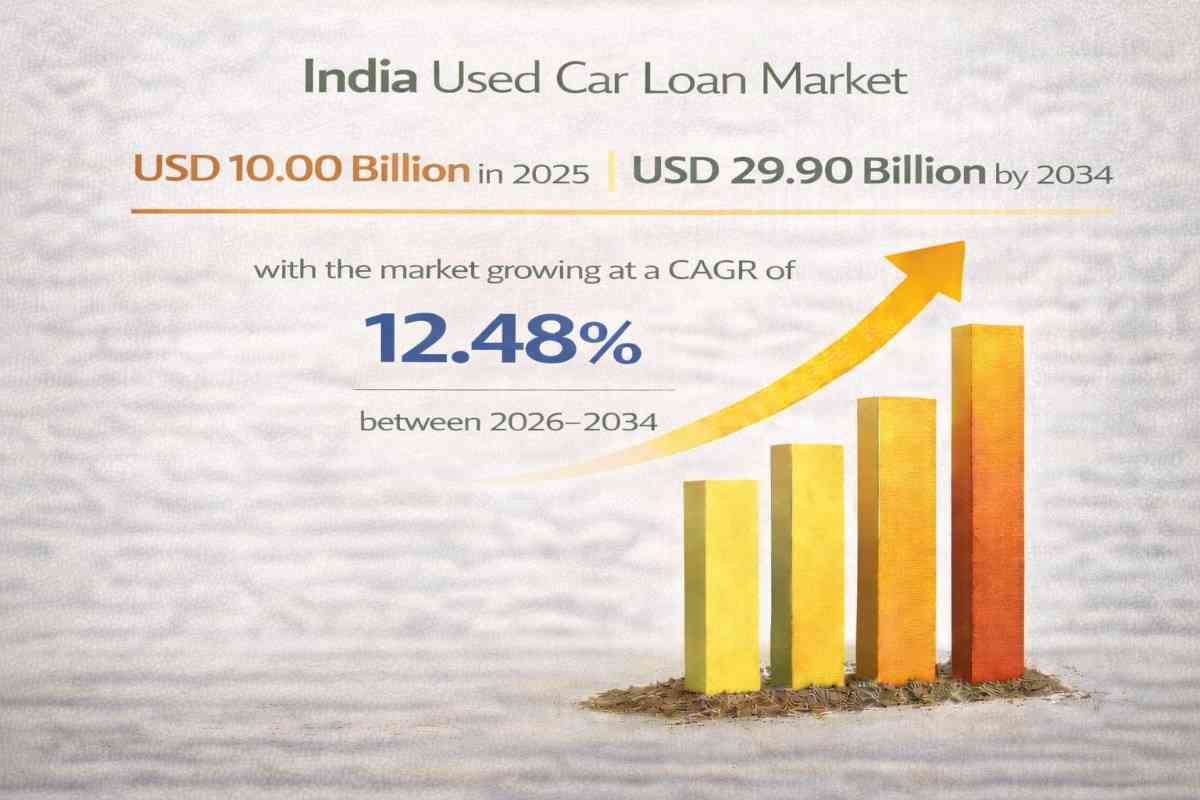
The used car loan market in India size reached USD 10.00 Billion in 2025 and is forecasted to reach USD 29.90 Billion by 2034, growing at a CAGR of 12.48% during the forecast period of 2026-2034. The growth is driven by the widening affordability gap between new and used cars, digitalization of used car loans, and NBFC expansions into tier 2 and tier 3 cities.
What Growth Factors are Driving the India Used Car Loan Market?
Widening price differential between new and used vehicles is the most fundamental driver of the used car loan demand․ Over a period of time‚ increasing number of customers are looking for an economical means of personal mobility without compromising on aspirational need․ Due to the continual upward pressure on new vehicle prices from input cost increases‚ regulatory requirements‚ and added content requirements‚ the used car is emerging as a viable alternative․
Counter-intuitively‚ higher levels of income and savings among the urban and semi-urban households are expanding the base of the creditworthy consumer pool which can access structured credit products․ The added affordability has triggered a virtuous cycle of increase in demand from affordability to income‚ as more consumers enter the market‚ lenders also expand their offerings to include more bespoke loan products․
The rise of Non-Banking Financial Companies and co-lending have enabled lenders to serve the unbanked and underbanked at scale․ Despite a good network of bank branches in India‚ banks and other formal players have remained hesitant to lend to borrowers from smaller towns or lower income segments‚ as they often have no or weak documentation․ This has resulted in a majority of financing for such loans taking place via non-banking financial companies (NBFCs)‚ which have faster and more flexible underwriting․
The RBI’s co-lending model‚ allowing banks to syndicate risk in 80:20 partnerships with NBFCs‚ helped formalize the practice‚ align incentives across participants‚ and direct more capital to tier-2 and tier-3 markets․ Additionally‚ growing formalization of payrolls is gradually increasing access to formalized loans from those lenders willing to lend against verified salaries․
Additionally‚ the rapid urbanization of tier-2 and tier-3 cities in India has created a demand from a new category of aspirant households‚ who view the ownership of a car as a requirement and a status symbol․ Additionally‚ important government investment in road and highway infrastructure is making cars more usable within these regions‚ making vehicle ownership more accessible and aspirational․
This growth in demand has also been matched by a rise in organized used car platforms․ Maruti True Value had over 1200 touchpoints in 2022․ Such platforms are expanding the supply of quality certified cars and making financing these vehicles easier by giving lenders more comfort in vehicle valuations and documentation․
What are the Latest Emerging Trends in the India Used Car Loan Market?
With a digital revolution taking place in the used car loan industry in India‚ the way the whole process works has become fast‚ convenient‚ and transparent․ For example‚ a company like CARS24 through its financial arm LOANS24 is able to approve used vehicle loans instantly at competitive interest rates starting from 10․99% per annum and sets new standards for customer expectations․ With the advent of digital technology‚ loans are now disbursed in minutes‚ without paperwork and a credit decision is also taken in real-time‚ which was impossible before․
The RBI’s Account Aggregator system and 2025 Digital Lending Directions allow financial information to be shared through consent‚ enabling almost instant credit checks and simple e-KYC․ This means that the time taken for paperwork and credit checks when applying for a loan or getting it disbursed has been greatly reduced․ As a result‚ financing an used car has become an entirely frictionless experience for digitally savvy consumers across income levels․
The partnerships between imbedded organized used car marketplaces and NBFC-fintech players have emerged as a key structural theme to transform the credit delivery in the used car space․ Leveraging the large scale distribution and trust of used car marketplaces with technological flexibilities and risk management of fintech lenders builds a better credit delivery model for the used car space․ By embedding financing options within the vehicle discovery and purchase process‚ these collaborations are aimed at reducing drop-off and lowering the barriers for consumers to go from vehicle shopping to vehicle ownership․
By digitizing the vehicle inspection process and incorporating it into the financing process‚ lenders can improve certainty of collateral and access deals with more advanced credit structures that are based on the asset and its condition rather than the credit profile of the borrower․ This is especially important for low income borrowers‚ where asset quality assurance can strengthen lender confidence․
There are two trends that are slowly but surely emerging in the India used car loan market․ One is the emergence of dedicated financing products for pre-owned electric cars․ This is an emerging but rapidly growing segment with certain characteristics that are distinct from conventional financing products․ Unlike customary used vehicle loans‚ loan to value and depreciation models for used electric vehicles need to consider factors such as battery health as well as technology obsolescence and the often fast-declining residual value of electric vehicles․
The development of these capabilities among the lenders and platforms is expected to create a substantial volume opportunity as EV penetration accelerates and a material secondary market develops․ The second trend‚ the growth of subscription and other flexible ownership offerings‚ is expected to create demand for short-tenure used car finance products․ Younger urban consumers have preferred more flexible models‚ with lower up-front cost‚ than long-term ownership of a vehicle․ These new models are bringing new borrowers into the formal used car finance market and thus expanding the reach of the used vehicle finance market to new customers․
What Opportunities Lie Ahead for the India Used Car Loan Market in the Coming Years?
The India Used Car Loan market should continue and even accelerate to grow‚ driven by a powerful combination of macroeconomic‚ demographic and technology tailwinds․ Economic growth at 8․2% in Quarter 2 FY 2025-2026‚ and the resulting growth in income and aspiration continues unabated across India‚ to be captured in the form of the demand for personal mobility and the finance products that support it․ With the growth of organized used car platforms and the development of data-based underwriting models by lenders‚ the addressable opportunity in tier-2 and tier-3 cities is expected to grow considerably in the coming years․
Lenders and lending platforms that invest in purpose-built digital infrastructure‚ embedded financing products‚ underwriting products for new-to-credit asset classes such as used electric vehicles‚ capitalize on RBI regulations to the fullest‚ deepen co-lending and fintech partnerships‚ and pursue a simple‚ convenient‚ and transparent digital journey to win customers’ trust will disproportionately win in this market․ Currently‚ used cars have very little formal credit penetration compared to new car financing‚ so growth is well ahead of us‚ but those who combine technology with best understanding of emerging Indian consumer will be winners in the end․
Evaluate Market Potential Before You Invest – Get the Report Sample
India Used Car Loan Market Key Players
How Is India’s Used Car Loan Market Segmented?
Vehicle Type
Financier
Percentage of Amount Sanctioned
Tenure
Regional Insights
Summary: West India is the dominant region holding a 30.4% market share in 2025 with the overall market expected to grow at a CAGR of 12.48% during 2026-2034.
India Used Car Loan Market Recent Developments & News
India Used Car Loan Market Key Highlights of the Report
About Us
IMARC Group is a global management consulting firm that helps ambitious changemakers create a lasting impact. The company offers comprehensive market assessment, feasibility studies, incorporation support, regulatory assistance, branding and strategy services, and procurement research.
Contact Us
IMARC Group
134 N 4th St. Brooklyn, NY 11249, USA
Email: [email protected]
Tel: (D) +91 120 433 0800
United States: +1-201971-6302

© 2025 Crivva - Hosted by Airy Hosting Managed Website Hosting.