According to IMARC Group’s report titled “India Saree Market Size, Share, Trends and Forecast by Type of Saree, Price Range, Distribution Channel, and Region, 2026-2034“, The report offers a comprehensive analysis of the industry, including industry growth, trends, share, and regional insights.
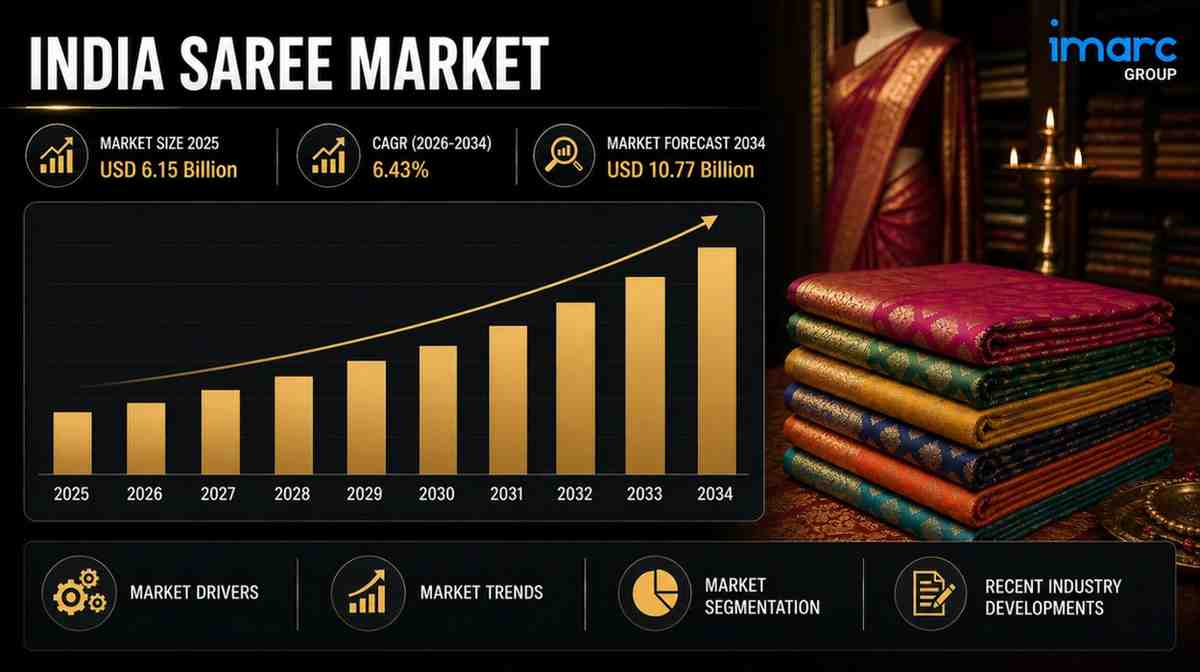
India’s saree market was valued at USD 6.15 Billion in 2025 and is projected to reach USD 10.77 Billion by 2034, growing at a CAGR of 6.43%. Rising women’s workforce participation, government handloom scheme investment increasing from INR 219.85 crore to INR 367.67 crore between 2020-21 and 2024-25, regional weaving revival, and digital platform expansion are collectively driving a market that uniquely combines cultural heritage with contemporary fashion evolution.
- Market scale: USD 6.15 Billion in 2025 → USD 10.77 Billion by 2034 at 6.43% CAGR.
- Workforce participation driving demand: India’s Female Labour Force Participation Rate climbed from 23.3% in 2017-18 to 41.7% in 2023-24 expanding professional saree demand as organizations and government institutions with traditional dress code preferences bring younger buyers into the category earlier.
- Export strength: India shipped cotton yarn, fabrics, made-up textiles, and handloom products valued at approximately USD 10.56 Billion in FY2025 reflecting global recognition of Indian textile craftsmanship.
- Designer innovation: In February 2025, designer Ridhi Mehra launched the ‘Ever After’ saree capsule collection featuring corset belts and jackets merging traditional elements with contemporary styling for modern urban consumers.
- Heritage authentication: In January 2025, Taneira launched a campaign promoting Silk Mark-certified handwoven sarees with celebrity endorsements building consumer trust in product authenticity while supporting artisan communities.
The Strategic Market Challenge: Navigating the Saree Market in India
India’s saree market faces structural substitution pressure from ethnic wear alternatives kurtis, anarkalis, and palazzo sets that offer comparable cultural appropriateness with significantly lower draping complexity, particularly appealing to urban millennials with time-constrained lifestyles. Maintenance requirements for premium fabrics and embellished sarees including dry cleaning and specialized storage create cumulative cost burdens that discourage frequent purchases, particularly in smaller metropolitan housing. Quality inconsistency across the market’s fragmented small-scale production base, combined with counterfeit products misrepresenting regional origin or material composition, undermines consumer confidence and disadvantages authentic producers who maintain genuine handloom standards and fair artisan compensation.
India’s Strategic Vision for the Saree Market:
- Government handloom scheme budget increase: Allocations rising from INR 219.85 crore in 2020-21 to INR 367.67 crore in 2024-25 directly support weaver welfare, cluster development, and market access sustaining the handloom production base that underpins India’s premium and export saree market.
- Geographical indication registrations: GI tags for regional weaves Varanasi Banarasi silk, Lucknow chikankari, Kanjivaram silk create protected market positions enabling premium pricing while safeguarding artisan livelihoods and preventing counterfeit misrepresentation.
- Silk Mark certification promotion: Programs like Taneira’s Silk Mark campaign receive government and industry support for authenticating genuine handloom products building consumer confidence in premium categories and differentiating authentic sarees from mass-produced synthetic alternatives.
- Textile ministry exhibition platforms: Government-organized exhibitions increase urban consumer visibility of regional weavers’ products combining cultural policy with commercial viability through direct artisan-buyer connection that strengthens both demand and artisan income stability.
➤ Access Industry-Focused Insights and Future Forecasts – Request Sample Report
Why Invest in the India Saree Market: Key Growth Drivers & ROI
- Women’s professional employment creating a new regular-use demand occasion: The Female Labour Force Participation Rate rising from 23.3% to 41.7% between 2017-18 and 2023-24 is converting sarees from ceremonial-only purchases into professional wardrobe staples driving demand for easy-care fabrics and workplace-appropriate designs among younger buyers who develop sustained wearing habits earlier in their consumer lifecycle.
- Economy segment at 55% providing volume stability: The economy saree segment’s dominance reflects consistent demand among middle and lower-income households who view sarees as essential wardrobe components with established wholesale distribution networks connecting textile hubs to smaller towns ensuring market penetration into India’s largest consumer geography without the margin risks of premium positioning.
- Digital platform expanding regional weave access beyond geography: E-commerce platforms like Chhunchi, The Needles Craft launched in November 2024 by Pune entrepreneur Purtika Choudhury are connecting region-specific weaves from across India directly with digitally engaged urban consumers, breaking the geographic barriers that previously restricted authentic regional saree access to proximity of production clusters.
- Fashion fusion creating premium segment growth: Designer collaborations bridging traditional weaving with contemporary silhouettes Ridhi Mehra’s corset belts and jackets with traditional sarees, fashion week platforms for master weaver-designer collaborations are expanding the premium addressable market beyond traditional ceremonial buyers toward urban professionals seeking versatile ethnic wear that integrates into modern lifestyle contexts.
India Saree Market Trends & Future Outlook:
- Cotton sarees lead at 23% type share, valued for moisture absorption, air circulation, and price-point versatility across climate zones, occasions, and economic segments with block printing and embroidery innovations sustaining design differentiation.
- AR visualization and AI recommendation are improving online saree discovery enabling consumers to assess draping styles, color accuracy, and fabric characteristics digitally before purchase, progressively reducing the physical evaluation advantage that sustains offline retail dominance.
- Jamdani, patola, and baluchari revival traditional weaving techniques adapted for lighter fabrics and contemporary silhouettes are attracting urban professionals seeking culturally authentic yet lifestyle-compatible saree options.
- Tier-2 and Tier-3 city expansion represents the primary volume growth frontier as rising disposable incomes in smaller cities where cultural affinity for traditional attire remains strong create new consumer segments for both economy and mid-range sarees.
- Sustainable and ethical production traceability is gaining institutional and consumer procurement weight with certification programs, direct weaver relationships, and fair compensation documentation becoming competitive differentiators among organized players targeting heritage-conscious buyers.
Regulatory Landscape & Policy Catalysts in India:
- Government handloom scheme budget (INR 367.67 crore in 2024-25) supporting weaver welfare and cluster development sustains the handloom production base that drives India’s premium saree domestic and export market positioning.
- GI tag framework protecting regional weave identities including Banarasi silk, Kanjivaram, and Lucknow chikankari creates legally enforceable premium positioning enabling authentic producers to command higher prices while deterring counterfeit misrepresentation.
- Public procurement preferences for handloom products in government institutions combined with mandatory traditional dress codes in educational and public service settings create institutional demand that expands beyond private consumer market cycles.
- Textile export promotion schemes supporting India’s USD 10.56 Billion handloom and fabric export base in FY2025 provide revenue diversification for domestic saree manufacturers with international sustainability fashion trends aligning with Indian handloom’s artisanal authenticity credentials.
- Digital commerce policy enabling e-commerce platform expansion into Tier-2 and Tier-3 cities is democratizing authentic regional saree access reducing the geographic retail infrastructure barrier that previously limited organized brand penetration in India’s largest cultural demand markets.
- Silk Mark and handloom certification programs backed by government and industry bodies are building consumer trust infrastructure essential for online saree market development where physical fabric evaluation is impossible and certification becomes the primary quality assurance mechanism.
➤ Explore the Complete TOC and Data Coverage – Get Full Brochure: https://www.imarcgroup.com/request?type=report&id=35333&flag=A
Market Segmentation Breakdown:
Type of Saree Insights:
- Cotton Sarees
- Silk Sarees
- Synthetic Sarees
- Linen Sarees
- Chiffon Sarees
- Georgette Sarees
- Designer Sarees
- Handloom Sarees
- Others
Cotton sarees dominate the market with a 23% share in 2025, driven by their breathability, versatility, and affordability, making them ideal for daily wear across diverse climates and income groups.
Price Range Insights:
- Economy Sarees
- Mid-Range Sarees
- Premium/Luxury Sarees
The economy segment leads with a 55% market share in 2025, reflecting strong price sensitivity among consumers seeking value-oriented sarees that balance quality and affordability for regular use.
Distribution Channel Insights:
Offline channels account for 65% of the market in 2025, as buyers prefer physical evaluation of fabric texture, drape, and color accuracy before making purchase decisions.
Regional Insights:
- North India
- South India
- East India
- West India
North India holds a 36% share in 2025, supported by high population density, strong cultural preference for traditional attire, and the presence of major textile production and retail hubs.
By the IMARC Group, the Top Competitive Landscape & their Positioning:
Covering an in-depth analysis of the competitive landscape, market structure, key player positioning, competitive dashboards, top winning strategies, and detailed profiles of all major industry participants you will gain access to all these exclusive insights within the full research report.
Note: If you need specific information that is not currently within the scope of the report, we can provide it to you as a part of the customization.
➤ Tailor the Research to Your Exact Business Needs – Request Customization: https://www.imarcgroup.com/request?type=report&id=35333&flag=E
Frequently Asked Questions (FAQs):
Q1: What is the current value and projected growth of the India Saree Market?
According to IMARC Group, the market was valued at USD 6.15 Billion in 2025 and is projected to reach USD 10.77 Billion by 2034, growing at a CAGR of 6.43%, driven by rising women’s workforce participation, handloom government support, regional weaving revival, digital platform expansion, and Tier-2 city disposable income growth.
Q2: Which saree type, price range, and distribution segments lead the market?
Cotton sarees lead type at 23% for versatility, breathability, and affordability across climate zones and income segments. Economy sarees lead price range at 55%, serving the majority consumer base seeking value-oriented daily wear. Offline leads distribution at 65% as consumers prefer tactile fabric evaluation for significant wardrobe investments.
Q3: How is rising women’s workforce participation reshaping saree market demand?
India’s Female Labour Force Participation Rate rose from 23.3% in 2017-18 to 41.7% in 2023-24. Organizations and government institutions with traditional dress code preferences are drawing younger women into saree-wearing habits earlier converting ceremonial-only purchases into regular professional wear investments and expanding demand for easy-care, workplace-appropriate fabrics.
Q4: What recent developments signal India’s saree market innovation direction?
In February 2025, designer Ridhi Mehra launched the ‘Ever After’ collection merging corset belts and jackets with traditional sarees for contemporary consumers. In January 2025, Taneira promoted Silk Mark-certified handwoven sarees via celebrity endorsements. In November 2024, Chhunchi, The Needles Craft launched as an online regional handloom discovery platform all confirming simultaneous premiumization and digital adoption momentum.
Q5: What are the primary growth opportunities and challenges through 2034?
Opportunities include professional wear demand expansion, Tier-2 city disposable income growth, digital platform democratizing regional weave access, GI tag premium positioning, and sustainable fashion export demand. Challenges are ethnic wear alternative substitution from kurtis and anarkalis, maintenance complexity reducing purchase frequency, quality inconsistency in fragmented production, and counterfeit products undermining consumer confidence in authentic handloom products.
Strategic Insight & Verdict
India’s saree market combines cultural necessity with evolving professional wear demand, government-backed handloom investment, and digital platform-enabled geographic expansion creating a multi-layered growth thesis beyond ceremonial occasion cycles. Based on our analysis, we at IMARC Group have observed that brands combining GI-certified authentic regional weaves, contemporary fusion design capability, and digital-first discovery platforms are best positioned to capture value as the market scales toward USD 10.77 Billion by 2034.
Verified Data Source: India Saree Market Report by IMARC Group
Written by: Tarang Chauhan (Insights Specialist @ IMARC Group)
View my full professional profile and connect with me at [https://www.linkedin.com/in/tarang-chauhan-31a82b265] for exclusive market research insights and B2B growth strategies.