


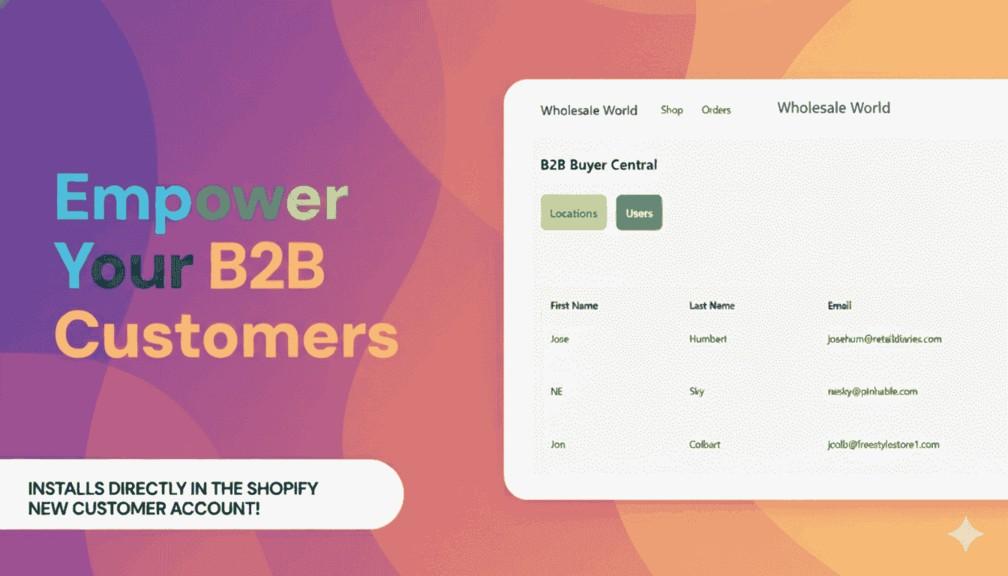
B2B commerce rarely fails because of effort. It fails because systems do not agree with each other. Pricing lives in one place, inventory in another, and orders pass through multiple hands before they ever reach fulfillment. Over time, teams patch the gaps with spreadsheets, emails, and manual checks just to keep things moving. This friction usually comes from a familiar source. ERP systems control the operational truth, while ecommerce platforms handle how customers buy. When those systems are not tightly connected, every order carries risk. Shopify’s new B2B portals address the buying experience side of the problem, but without proper ERP integration, the same backend issues remain. This guide explains how ERP systems and Shopify B2B portals work together, why integrations often struggle, and what a stable, scalable setup looks like in real-world B2B commerce.
ERP platforms exist for a reason. They manage inventory availability, contract pricing, customer credit limits, tax logic, and order fulfillment rules. These systems are built for accuracy and control, not speed or design. Shopify’s B2B portals focus on the opposite side of the equation. They give buyers clean interfaces, self-serve ordering, company-level accounts, and fast reordering. Buyers see only what applies to their business, including negotiated pricing and payment terms. When ERP and Shopify operate together, each system stays in its lane. The ERP remains the operational backbone, while Shopify becomes the customer-facing layer. Orders flow cleanly, data stays aligned, and teams stop compensating for system blind spots.
Most ERP systems were not designed for modern ecommerce. Many rely on batch updates, rigid schemas, or limited APIs. Shopify, by contrast, expects near real-time data and clean structures that can adapt quickly. This mismatch creates predictable issues:
These problems are not edge cases. They are symptoms of unclear integration strategy. When ownership of data is undefined, errors become routine.
Shopify has invested heavily in native B2B functionality. Company profiles, customer-specific catalogs, payment terms, and approval workflows are now built directly into the platform. For B2B sellers, this removes the need for separate wholesale portals or custom storefronts. Buyers log in, see negotiated pricing, and place orders without manual intervention. However, Shopify is not designed to replace an ERP. It does not calculate complex tax scenarios, manage manufacturing schedules, or control warehouse operations. That responsibility remains with the ERP, which makes integration essential rather than optional.
A strong integration prioritizes reliability over novelty. The goal is not to sync everything instantly, but to sync the right data in the right direction with clear rules. Most successful implementations include:
Middleware platforms, custom Shopify apps, or ERP-native connectors usually support this structure. The right choice depends on data complexity and long-term flexibility.
One of the most common integration mistakes is allowing multiple systems to act as the source of truth. This often happens unintentionally when teams rush to launch ecommerce features. Every data type must have a clear owner:
When both systems attempt to modify the same data, conflicts appear. Clear ownership prevents reconciliation issues and simplifies troubleshooting.
There is no universal integration model. Businesses choose different approaches based on scale and operational maturity. Some treat Shopify as the order intake layer. Orders are captured online and pushed into the ERP for validation and fulfillment. Others treat the ERP as the master, with Shopify reflecting ERP data in near real time. The right approach depends on:
What matters most is consistency. Once a pattern is chosen, all processes should support it.
B2B buyers expect accuracy, not novelty. They rely on negotiated pricing, historical orders, and predictable fulfillment timelines. One incorrect invoice or unavailable reorder damages trust far more than a slow page load. When ERP data and Shopify storefront data drift apart, buyers notice immediately. In B2B, integration quality directly affects customer retention and lifetime value. This is why ERP integration should be treated as part of the customer experience strategy, not just a backend task.
Before integrating systems, internal alignment is critical. Successful projects involve stakeholders from operations, finance, IT, and sales. Key preparation steps include:
Skipping these steps leads to brittle integrations that break under real-world load.
Connecting ERP systems to Shopify B2B portals requires more than technical knowledge. It requires understanding how data moves through the business. Professional Shopify integration services help define system ownership, map data correctly, and build safeguards that protect operations as volume grows. The result is not just a working connection, but a sustainable commerce foundation.
Shopify’s B2B portals give businesses a modern, flexible frontend. ERP systems provide the control and accuracy that B2B operations demand. Integration is what turns these two strengths into a single, reliable system. When done right, orders flow smoothly, buyers trust what they see, and teams stop compensating for system gaps. Growth becomes a process supported by systems instead of a constant workaround. The future of B2B commerce is not about adding more tools. It is about making the right ones work together, consistently and quietly, behind every successful transaction.

© 2025 Crivva - Hosted by Airy Hosting Managed Website Hosting.