If you’re searching this, chances are you already have artificial turf in your yard—or you’re planning to install it—and the big question isn’t about looks anymore. It’s about smell. It’s about hygiene. It’s about whether your backyard is going to turn into a permanent dog park situation.
I’ve worked on enough turf installations in pet-heavy homes to tell you this: artificial grass and dogs can absolutely coexist. But only if you manage waste properly. When clients skip maintenance thinking “it’s plastic, it’ll be fine,” that’s when the problems start.
So let’s break this down properly—how to clean pet waste from synthetic turf, how to prevent odor buildup, what most homeowners overlook, and how to build a routine that actually works.
Artificial grass doesn’t absorb urine the way natural soil does. That’s both good and bad.
High-quality systems use a permeable backing and a crushed stone sub-base (often decomposed granite) that allows liquids to drain. When installed correctly, water moves through at roughly 30 inches per hour or more. But urine contains ammonia, uric acid, and salts. Those compounds don’t just “rinse away” completely.
Here’s where things get interesting.
If your base layer wasn’t compacted properly—or if there’s poor slope for drainage—urine can pool. And once bacteria start feeding on that residue, the smell builds up fast, especially in warm climates.
According to guidance from the Environmental Protection Agency, ammonia-based compounds can volatilize more rapidly in heat. That’s exactly why summer odors feel worse even if your cleaning routine hasn’t changed.
In most projects I’ve seen, odor issues are rarely about the turf fibers. It’s usually the base system underneath that’s the weak link.
If you’re unsure whether your system was built correctly, it’s worth reviewing how professional turf installation works and what separates a long-lasting base from a problematic one.
Let’s keep this simple.
Remove solid waste immediately.
It sounds obvious, but a surprising number of homeowners wait until the end of the day—or even the weekend. That delay allows residue to break down and settle into the infill.
Best practice:
If you’re in a dry climate, rinsing matters more than you think. Without regular water flow, salts accumulate in the infill layer.
What surprises many clients is how much better their turf smells just from consistent rinsing alone. It’s not fancy. It just works.
If you have more than one dog, daily spot rinsing isn’t enough. You need a structured wash routine.
Understanding how synthetic turf is built helps explain why rinsing matters. If you’re unfamiliar with how drainage layers and infill systems work, this guide on synthetic turf for homeowners breaks it down clearly
Once per week:
Avoid pressure washers unless absolutely necessary. Too much force can disturb infill distribution or damage seams, and fixing seams is far more expensive than preventing smell.
In warmer regions, I typically advise rinsing twice per week during peak summer. Heat accelerates bacterial growth, plain and simple.
There’s a lot of advice floating around about vinegar, baking soda, dish soap, hydrogen peroxide—you name it.
Here’s my honest take.
Vinegar temporarily neutralizes odors, but it doesn’t eliminate the uric acid crystals that cause recurring smell. Baking soda? It’s better for carpets than outdoor turf. And soap residue, if not rinsed thoroughly, can actually attract more dirt.
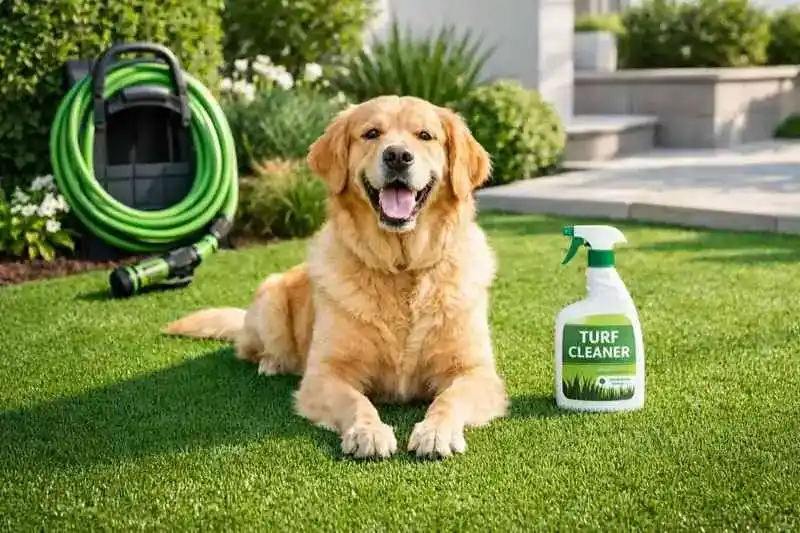
The better option is an enzyme-based turf cleaner.
Enzymatic cleaners break down the organic compounds in urine at a molecular level. That’s not marketing fluff. It’s basic chemistry. These solutions use biological agents to digest odor-causing bacteria rather than just masking it.
The Centers for Disease Control and Prevention emphasizes proper sanitation in pet environments to reduce bacterial exposure, and enzyme cleaners align well with that principle.
Apply enzyme cleaner:
Let it sit. Don’t immediately rinse it off. It needs time to work.
Not all infill is equal.
Standard silica sand works fine for drainage but doesn’t actively control odor. Some newer turf systems use antimicrobial infill or zeolite-based infill designed specifically for pet applications.
Zeolite, in particular, can trap ammonia molecules. That’s chemistry doing real work under your lawn.
If you’re planning a new install, choose pet-specific infill from the beginning. Retrofitting later is messy and expensive. Trust me, it’s not something you want to redo after the fact.
A properly installed pet turf system should include:
If you notice standing water after rinsing, that’s a red flag.
The real takeaway is this: odor problems usually trace back to installation shortcuts. A rushed contrctor might skip compaction steps or use improper materail thickness to save time. Six months later, you’re dealing with a smell you can’t figure out.
And yes, I’ve seen it more times than I’d like.
Already smelling something unpleasant? Don’t panic.
Start with a deep cleaning reset:
If odor persists, the infill may be saturated. In severe cases, partial infill replacement might be required. That’s rare but it does happen, especially in high-use dog runs.
In one backyard project, we discovered compacted base layer preventing drainage entirely. Once corrected, the smell issue vanished. Sometimes it isn’t surface-level problem.
Turf behaves differently across seasons.
Summer:
Heat amplifies smell. Increase rinsing frequency. Even a quick 5-minute spray every other day helps.
Winter:
Less evaporation means moisture can linger longer in cooler climates. Drainage checks are critical.
Rainy climates:
Ironically, natural rain can help flush urine salts—but only if drainage is adequate. Otherwise you’re creating puddles.
The National Association of Landscape Professionals often stresses maintenance planning as part of landscape lifecycle management. Artificial turf isn’t maintenance-free. It’s low-maintenance. Big difference.
For those wanting a straight summary:
That combination prevents most issues before they begin.
Odor is one concern. Sanitation is another.
Artificial turf doesn’t naturally filter bacteria like soil ecosystems can. That doesn’t make it unsafe—but it does mean you must manage it.
Routine rinsing reduces bacterial load. Enzyme cleaners break down organic residue. Occasional brushing keeps fibers upright and improves airflow.
If you have kids using the same yard, consistency becomes even more important. It’s not about paranoia, it’s about smart maintenance.
A few optional additions I sometimes recommend:
What most people miss is that turf is part of a system. Not just a surface.
Homeowners often ask if heavy pet use will shorten turf lifespan.
Short answer: yes, if poorly maintained.
High-quality artificial grass typically lasts 10–15 years. But when urine salts accumulate, backing layers can degrade faster. And once seams start separating, repair costs climb quickly.
A simple maintenance routine saves thousands in long-term cosntruction fixes. It’s boring advice, I know. But it’s accurate.
I’m a fan of artificial turf for pet owners. Still, it’s not perfect for everyone.
If you have:
Natural grass might perform better biologically, because soil microbes help break down waste naturally.
Every yard is different. Every owner’s routine is different too.
After managing dozens of pet-friendly turf projects, one pattern stays consistent: the homeowners who build simple routines early never struggle with odor.
The ones who assume it’s zero maintenance usually calls me later.
Artificial turf is durable, clean-looking, and pet-friendly when installed right and maintained with basic discipline. You don’t need complicated chemicals or expensive equipment. You just need consistency, proper drainage, and occasional enzyme treatment.
Do that, and your yard stays fresh. Skip it, and no amount of air freshener will fix it.

© 2025 Crivva - Hosted by Airy Hosting Managed Website Hosting.