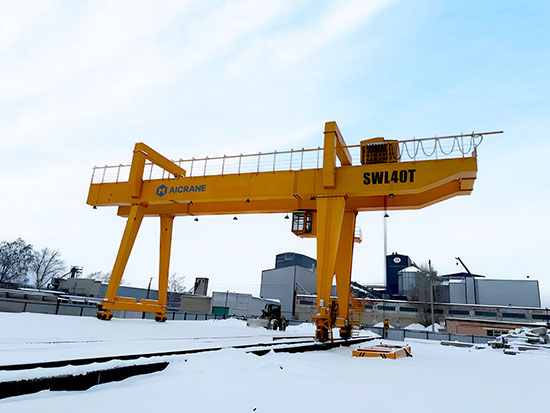
Gantry cranes are among the most essential material handling equipment in factories, warehouses, shipyards, and construction sites. Among them, 40-ton gantry cranes are widely used in medium- to heavy-duty operations, such as steel fabrication, precast concrete handling, railway loading, and port logistics. While the nominal capacity of 40 tons seems straightforward, there are many common misconceptions about their actual capacity and safe lifting limits. Misunderstanding these factors can lead to equipment damage, operational inefficiency, and serious safety hazards.
This article explores the most frequent misconceptions about 40-ton gantry crane capacity, explains the realities of safe lifting limits, and highlights best practices for ensuring safe and efficient crane operation.
One of the most common misunderstandings is assuming that a 40 ton gantry crane for sale can safely lift 40 tons under all conditions. In reality, the rated capacity is conditional and depends on several factors:
Lifting height: As the hook is raised, the stress on the crane structure changes, especially for double girder cranes with long spans.
Span width: The wider the span of the crane, the more the girders bend under load, which can reduce safe lifting capacity.
Cantilever length: Many 40-ton cranes have cantilever arms for handling loads at the ends. The longer the cantilever, the lower the lifting capacity at that point.
Load distribution: Uneven or eccentric loads can create torque and bending moments, reducing the actual safe lifting capacity.
Reality: The rated 40-ton capacity is defined under standard test conditions, typically with a centered load at nominal height. Lifting the same weight under different geometries or off-center positions can exceed structural limits.
Many operators believe that as long as the crane is rated for 40 tons, it can perform this lift repeatedly without consequence. This overlooks the duty cycle classification (A3–A8), which significantly influences safe lifting limits.
A3–A4: Light to moderate duty. The crane can occasionally lift close to the rated 40 tons but cannot operate continuously at full capacity.
A5–A6: Heavy duty. The crane can perform frequent lifts at or near 40 tons with moderate cycles.
A7–A8: Severe duty. Continuous heavy lifting is safe with high cycle frequency.
Reality: A crane rated for 40 tons but classified as A4 cannot safely lift 40 tons repeatedly over a long period. Operators must adhere to duty cycle guidelines to avoid fatigue, overheating, and structural damage.
Some assume that the lifting motor or hoist defines the crane’s maximum load. While the hoist is essential, the structural design of the crane governs overall lifting limits:
Girders: The double girder structure must resist bending and torsion. Excess load can cause permanent deformation.
End carriages: Wheels, axles, and rails experience high stresses under full load, especially on uneven tracks.
Brakes and drive motors: Overstressed components may fail before the hoist reaches its capacity.
Reality: Even if the hoist is capable of lifting 40 tons, other crane components may limit safe lifting capacity, particularly for uneven loads or extended operation.
Operators sometimes believe that exceeding the rated capacity slightly—by 5% to 10%—is acceptable. This is a dangerous misconception.
Short-term overloads: Can cause bending of girders, excessive wheel stress, or local deformation of the hoist frame.
Repeated minor overloads: Accelerate fatigue damage, leading to cracks, weld failure, or even structural collapse.
Safety systems: Overload sensors and limit switches may not activate in time to prevent damage in marginal overloads.
Reality: Rated capacity is the maximum safe limit under standard conditions, and exceeding it—even slightly—can compromise safety and reduce crane lifespan.
Another common misunderstanding is that a 40-ton crane purchased from one manufacturer is identical to a 40-ton crane from another.
Differences include:
Span length: Longer spans experience more bending, reducing effective capacity.
Duty cycle: Some cranes are rated for occasional lifts (A4), while others are designed for continuous operation (A7).
Hoist configuration: Single vs. dual hoists, rope reeving, and motor power can affect safe operation.
Structural design: Material grade, girder shape, and weld quality directly impact load-bearing ability.
Reality: Two cranes with the same nominal 40-ton rating may perform very differently. Always consider duty cycle, span, and manufacturer specifications.
Some operators overlook how rail alignment, floor levelness, or wheel condition affects lifting limits. In a gantry crane for sale, the wheels and rails carry the load to the foundation. Uneven rails or poorly maintained wheels can cause:
Uneven stress on girders and hoists
Reduced capacity due to load concentration on a single wheel
Increased risk of derailment under heavy loads
Reality: Even a 40-ton crane can be limited by its supporting structure. Ensuring proper rail alignment, wheel maintenance, and floor levelness is essential for safe lifting.
Outdoor cranes, including semi-gantry or full gantry cranes in ports or open yards, are sometimes used in wind, rain, or extreme temperatures. Many operators assume rated capacity remains unchanged.
Wind: Generates lateral forces, creating additional stress on girders and end carriages.
Rain or ice: Can reduce friction and stability on wheels or tracks.
Temperature extremes: Can affect steel elasticity and motor efficiency.
Reality: Safe lifting limits must account for environmental conditions. Some manufacturers reduce rated capacity under adverse weather.
Understanding the misconceptions above, operators and engineers should adopt best practices:
Always refer to the rated capacity tables for different spans, lifting heights, and duty cycles.
Review overload protection settings, hoist limits, and safe operating ranges.
Never exceed the rated capacity.
Consider dynamic factors, such as starting, stopping, and swinging loads, which temporarily increase stress.
Ensure rails are level and aligned.
Maintain wheels, bearings, and end carriage structures.
Inspect floors for cracks or uneven surfaces.
Understand whether the crane is designed for occasional (A3–A4) or frequent heavy-duty (A6–A7) operations.
Match crane usage to its duty cycle to prevent fatigue and overheating.
Train operators on correct load placement, centering, and lifting speed.
Implement load monitoring systems and alarms.
Conduct regular inspection and maintenance based on operating conditions.
The 40-ton gantry crane is a versatile and powerful piece of material handling equipment, but misconceptions about its capacity and safe lifting limits are widespread. Operators may overestimate its ability to lift under varied conditions, assume all 40-ton cranes are equivalent, or underestimate the importance of duty cycle, span, and environmental factors.
Understanding the realities behind rated capacity, safe lifting limits, duty cycles, structural considerations, and operational environment is critical for safety, reliability, and efficiency. Proper crane selection, operator training, and adherence to manufacturer guidelines ensure that 40-ton gantry cranes can perform safely and effectively for years, maximizing both productivity and safety in demanding industrial environments.

© 2025 Crivva - Hosted by Airy Hosting Managed Website Hosting.