

For quarry investors and construction contractors in Indonesia, equipment selection is never a simple decision. Among all questions, one stands out clearly: is a 200 TPH stationary rock crusher plant enough for local quarry projects operating only 8–10 hours per day? This question reflects real concerns about production targets, investment control, operating costs, and long-term business sustainability.
Indonesia’s quarry market is highly practical. Most projects serve local roads, housing developments, concrete batching plants, and regional infrastructure works. These projects value stable supply more than extreme capacity. Therefore, instead of blindly choosing large-scale equipment, many customers prefer a solution that matches daily output needs and local working conditions.
In this article, we will analyze this topic from both the customer’s point of view and the construction industry’s perspective. We will break down production logic, operating conditions, cost efficiency, and future expansion. Step by step, you will gain a clear answer to whether a 200 TPH stationary rock crusher plant is the right choice for your Indonesian quarry project.
Before making any investment decision, it is essential to understand what 200 TPH actually means in practice.
In simple terms, 200 TPH indicates that the crusher plant can process up to 200 tons of raw material per hour under standard conditions. This figure often comes from equipment testing and engineering calculations. However, real quarry operations involve many dynamic factors.
If a quarry runs 8 hours per day, the theoretical output reaches about 1,600 tons daily. If operations extend to 10 hours, output can reach approximately 2,000 tons per day. These numbers already meet the daily aggregate demand of many local construction projects in Indonesia.
However, smart investors do not stop at theoretical values. Instead, they look at how much of that capacity can be achieved consistently. Therefore, understanding real operating efficiency becomes the next key step.
Once the basic capacity is clear, it is necessary to connect it with Indonesia’s on-site conditions. These conditions often determine whether a stone crusher machine for sale can reach its expected output.
Indonesia’s quarry resources include limestone, andesite, basalt, granite, and river stone. Each material behaves differently during crushing.
Limestone and river stone usually allow higher throughput. Under these conditions, a 200 TPH stationary crusher plant can operate close to rated capacity. On the other hand, harder materials such as basalt or granite increase wear and reduce crushing speed slightly.
Even so, for most medium-hard rock applications, daily output still remains within the target range. As long as the plant design matches the material type, output stability stays high.
Another critical factor is feed size. Large and inconsistent feed material reduces crusher efficiency and increases downtime.
When excavators and feeders deliver uniform material, crushers work more smoothly. As a result, production becomes predictable and equipment stress decreases.
Therefore, a 200 TPH plant paired with proper feeding equipment often performs better than a larger plant with poor material control.
After analyzing material conditions, the next logical step is to compare production capacity with real market demand.
Most local quarry projects in Indonesia supply aggregates for concrete batching plants, road construction, drainage works, and small infrastructure projects. These projects usually consume between 600 and 1,500 tons of aggregates per day.
Under this demand range, a 200 TPH stationary rock crusher plant fits well. It covers daily needs without pushing equipment to extreme limits.
Moreover, when demand increases temporarily, operators can extend working hours. This flexibility gives quarry owners better control over production planning.
Working hours play a bigger role than many first-time buyers expect.
In Indonesia, many quarries operate only during daytime due to labor policies, environmental regulations, or community agreements. Under these conditions, equipment must achieve daily targets within limited time.
A 200 TPH stationary crusher plant usually runs efficiently within an 8–10 hour window. It operates within a safe load range, which reduces overheating, excessive vibration, and component fatigue.
As a result, the plant delivers stable output while maintaining a longer service life.
From a business perspective, capacity selection directly affects cost structure.
Larger crusher plants require higher initial investment. They also consume more power and need stronger foundations and larger installation space. For local quarry projects, these costs often exceed real needs.
In contrast, a 200 TPH stationary rock crusher plant offers a balanced solution. Initial investment remains reasonable, while production capacity meets daily demand.
Lower power consumption also reduces electricity or fuel expenses. Over time, this cost difference significantly improves profit margins.
Stable operation matters as much as production volume.
When equipment runs close to its maximum capacity every day, wear increases and failures become more frequent. This situation leads to unplanned downtime and higher maintenance costs.
A 200 TPH plant operating within 8–10 hours per day usually works under moderate load. This condition reduces wear on bearings, liners, and motors.
Consequently, maintenance schedules become predictable. Quarry owners can plan servicing instead of reacting to emergencies.
While current needs drive initial investment, future growth should not be ignored.
Many Indonesian quarry owners start with local supply and gradually expand to larger projects. In this case, flexibility becomes valuable.
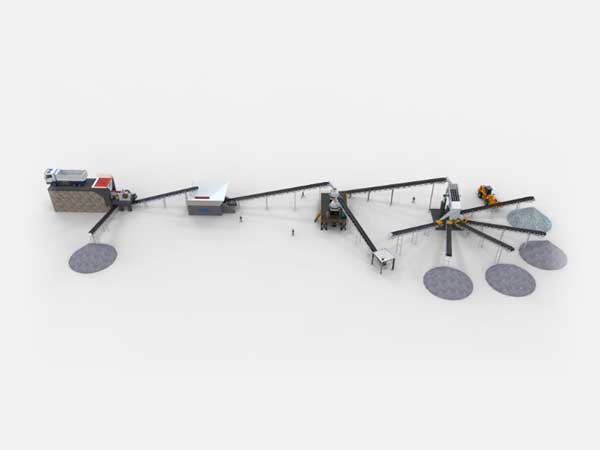
A well-designed 200 TPH stationary crusher plant allows future upgrades. You can add secondary or tertiary crushers, expand screening systems, or improve automation.
This modular approach avoids large upfront spending while keeping expansion options open.
Environmental impact increasingly affects quarry operations in Indonesia.
Smaller and well-matched crusher plants generate less noise, dust, and vibration compared to oversized systems. This advantage helps operators comply with local regulations.
Furthermore, stable operation reduces complaints from nearby communities. This social stability protects long-term quarry operations.
When we combine production calculations, local working hours, material conditions, cost efficiency, and operational stability, the conclusion becomes clear.
For most local quarry projects in Indonesia operating 8–10 hours per day, a 200 TPH stationary rock crusher plant is enough. It delivers reliable daily output without unnecessary investment pressure.
More importantly, it aligns with real market demand rather than theoretical extremes.
Choosing the right capacity is only one part of success. Choosing the right supplier matters just as much.
AIMIX has extensive experience in designing stationary rock crusher plants for Indonesian quarry conditions. We focus on real production scenarios, not just nameplate capacity.
Our engineering team customizes plant layouts based on material type, site size, and future expansion plans. This approach ensures that a 200 TPH solution truly performs as expected.
In addition, AIMIX provides strong after-sales support, including installation guidance, spare parts supply, and technical training. These services help quarry owners maintain stable production over the long term.
So, is a 200 TPH stationary rock crusher plant enough for your local quarry project in Indonesia? In most cases, yes—when the plant is properly designed and professionally supported.
If you are planning a new quarry or upgrading existing equipment, now is the right time to evaluate your actual production needs. Avoid overinvestment and focus on efficiency.
Contact AIMIX today to discuss your quarry project. Let our experts help you design a crushing solution that fits your site, your budget, and your future growth goals.

© 2025 Crivva - Hosted by Airy Hosting Managed Website Hosting.