


Choosing your first motorcycle racing suit is genuinely confusing without a clear framework. The market is full of gear that looks protective without being certified, suits that carry impressive-sounding labels without testing to back them up, and beginner advice that is either dangerously vague or too technical to act on. This guide cuts through all of that.
The good news is that once you understand the three things that actually matter, the decision becomes straightforward. Certification. Armor specification. Fit. In that order.
Most organized track days require a one-piece leather suit or a two-piece suit with a full 360-degree connecting zip. The connecting zip requirement exists because a two-piece that separates in a crash provides essentially the same protection as wearing a jacket and trousers with no connection at all. The zip keeps the garment working as a single unit throughout a slide.
Beyond construction type, certification matters practically and legally. FIM regulations for circuit racing specify that race suits must comply with EN 17092 at level AAA or AA as a minimum. Most track day organizers follow this framework, with novice sessions sometimes permitting CE AA where AAA is the recommendation for intermediate and advanced groups. Arrive with an uncertified suit and you will be turned away at scrutineering. That is not a theoretical risk. It happens at every well-run track event.
The practical starting point is simple. Buy a suit with EN 17092 certification clearly stated on the internal label at Class AA or higher, before worrying about anything else.
EN 17092 has three relevant classes for a race suit. Understanding what each one actually tests removes the confusion that most buyers carry into the shop.
Class A is the entry-level certification and appropriate for general road riding, but it falls below the minimum most organized track events require. Class AA demands more from the outer material, requiring abrasion resistance to hold for longer across a wider test area before the specimen is allowed to fail. It is the practical minimum for any organized track day. Class AAA is the highest achievable standard. The abrasion requirements apply simultaneously across all three risk zones of the suit, and it is what FIM mandates for competition use.
For a first suit, Class AA is acceptable if budget is a real constraint. Class AAA is always the better long-term choice because your riding will progress faster than you expect, and buying a suit you need to upgrade within a year is poor economics on a garment at this price point.
A one-piece suit is the correct choice for circuit riding. There is no connection point to fail, no gap to appear at the waist in a crash, and the geometry is built around the riding tuck. When you are crouched over a fuel tank with arms extended to handlebars, a one-piece fits correctly. When you are standing in a car park, it will feel awkward. That trade-off is intentional and not a defect.
A two-piece suit is acceptable if the connecting zip is a full 360-degree design rated to withstand the separation forces tested under EN 17092, and if the zip is fully engaged every single session without exception. For a first suit focused on track use, a one-piece removes the connection variable entirely and gives you one less critical check in an already busy pre-session preparation routine.
Most first-time buyers spend more time on color schemes than leather specification. That ordering is worth reversing.
Full-grain cowhide at 1.2 to 1.4mm thickness in Zone 1 areas such as the outer arms, seat, and knees is the standard for entry to mid-range race suits. Under EN 17092 AAA testing, Zone 1 material must withstand sliding at approximately 120km/h for a minimum of 4 seconds before the material is considered to have failed. Quality cowhide at the right thickness passes this consistently. The material also stretches 3 to 5% over the first several riding sessions, which means sizing slightly snug at purchase is the correct approach.
Kangaroo leather offers a higher tensile strength-to-weight ratio, breaks in faster, and is lighter. It carries a significant cost premium. For a first suit where the rider is still developing their track position and riding style, the performance difference between quality cowhide and kangaroo leather is difficult to notice. A cowhide suit at AAA certification is a better first purchase than a kangaroo leather suit at AA, all else being equal.
EN 17092 addresses abrasion and tear resistance only. It says nothing about what the impact armor inside the suit must achieve. That is governed separately by EN 1621-1 for limb protectors, which produces the Level 1 and Level 2 designations most riders have encountered.
CE Level 2 limb armor must transmit less than 20kN of impact force under the EN 1621-1 drop test, compared to less than 35kN for Level 1. That difference represents the energy transferred directly to your joint in a crash. For a first racing suit, CE Level 2 at shoulders, elbows, and knees is the only sensible specification. A suit marketed as track-ready with Level 1 armor is not providing the impact protection the environment demands.
Back protection is not required for EN 17092 garment certification, which is a genuine gap in the standard. For circuit riding, add a CE Level 2 back protector under EN 1621-2 regardless of what the suit includes. Level 2 must transmit less than 9kN under its drop test, compared to 18kN for Level 1. Falls on a circuit frequently involve the back contacting road or barrier. That protection difference at the spine is the one you do not want compromised.
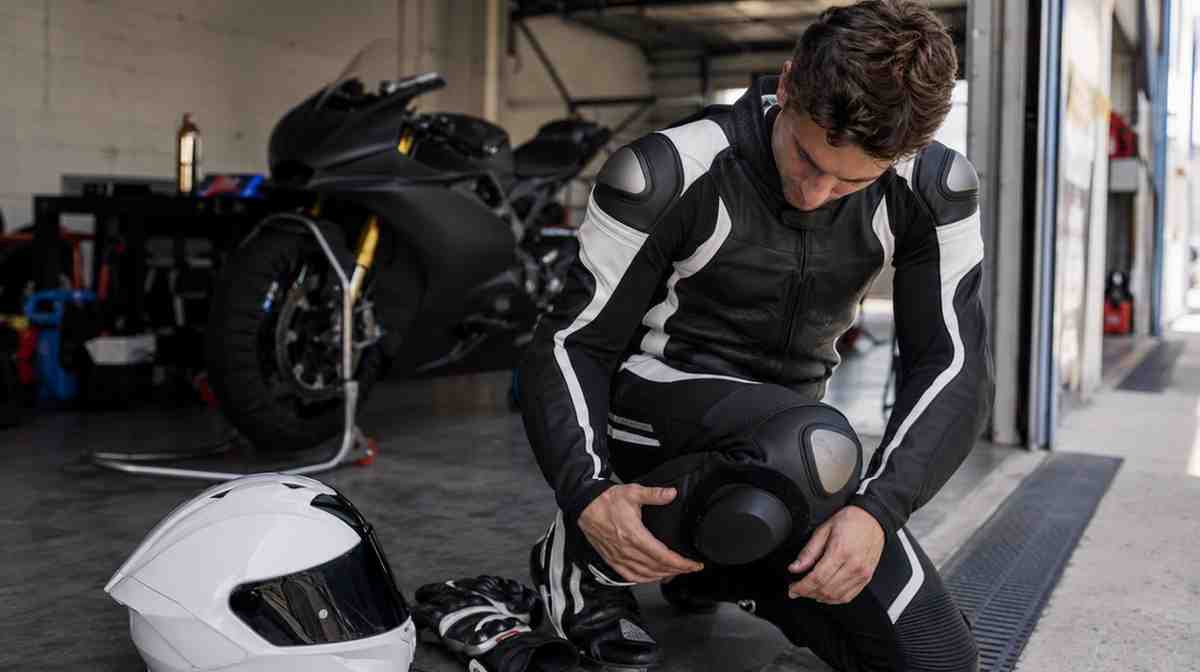
A race suit is cut for the riding position, not for standing upright. The pre-curved knees, forward torso lean, and articulated shoulders are all designed to place the suit into its correct protective geometry when you are in the tuck. Trying it on in a shop while standing tells you almost nothing useful about whether it will actually protect you on track.
The correct test is to sit on a bike or replicate the tuck posture and check that:
If the suit fails any of these checks in the riding position, it does not fit correctly for track use. A poorly fitted CE AAA suit protects you less than a correctly fitted CE AA suit. Armor that is not over the joint does not protect the joint.
The racing suit collection built for track use illustrates what proper race geometry looks like when a suit is designed around the riding position rather than showroom aesthetics. Made-to-order construction removes the sizing compromise that causes armor misalignment in standard off-the-shelf sizing.
CE AA suits with CE Level 2 armor start at approximately $500 to $700 at the entry point. CE AAA certified suits with full Level 2 armor typically start at $900 to $1,200. The difference between an $800 certified suit and a $3,000 custom is longevity, materials refinement, and fit precision, not baseline certified protection. Both pass scrutineering. Both protect to their labeled standard.
Where spending more makes a genuine safety difference is in reaching Level 2 armor at every position rather than accepting Level 1 at some joints, and in made-to-measure construction if your body proportions fall outside standard size blocks. Those two factors affect your actual protection in a crash more than any other variable at this stage of your riding career.
One last point. Check the label before you check the price. Some budget suits carry AAA certification and Level 2 armor while more expensive alternatives carry AA and Level 1. The label tells you what you are actually buying. The price tag does not.

© 2025 Crivva - Hosted by Airy Hosting Managed Website Hosting.