

Choosing the right asphalt plant size is not just a technical decision. It directly affects your project timeline, cost control, and long-term profitability. Many contractors focus only on plant capacity in tons per hour. However, real-world projects rarely run under ideal conditions. Weather, logistics, material supply, and crew efficiency all influence your daily output.
So, how do you match asphalt plant size with your actual daily tonnage requirements? In this guide, we will break down the logic step by step. You will learn how to calculate real demand, avoid common mistakes, and select a plant that truly fits your project needs.
Before choosing any asphalt plant, you need a clear picture of how much asphalt you must produce per day. This step sounds simple, but many buyers underestimate or overestimate their demand.
Start by analyzing your project scope. Look at total road length, width, thickness, and construction timeline. Then calculate the total asphalt volume required.
You can use this simple formula:
Total Asphalt (tons) = Road Length × Width × Thickness × Density
After that, divide the total tonnage by the number of working days.
Daily Tonnage Requirement = Total Asphalt ÷ Project Duration (days)
For example, if your project needs 30,000 tons of asphalt over 60 days, your daily demand is 500 tons.
At this stage, you already have a baseline. However, this number is not enough yet. Next, you must consider real operating conditions.
Now that you know your daily tonnage, the next step is to convert it into hourly plant capacity. This is where many decisions go wrong.
In theory, you could divide daily demand by working hours. But in practice, plants do not run at full capacity all day.
You need to account for several real-world factors:
Because of these factors, most asphalt plants operate at about 70%–85% efficiency.
Use this adjusted formula:
Required Plant Capacity (TPH) = Daily Tonnage ÷ Working Hours ÷ Efficiency Factor
Let’s continue the earlier example:
Required Capacity = 500 ÷ 8 ÷ 0.8 = 78 TPH
In this case, a plant around 80 TPH would be suitable.
However, choosing exactly 80 TPH may still be risky. Next, we explain why.
In real construction projects, uncertainty is normal. Therefore, selecting a plant that only meets your minimum requirement can create problems later.
You should always add a safety margin.
A higher capacity gives you flexibility in several situations:
As a rule of thumb, you can add 10%–30% extra capacity.
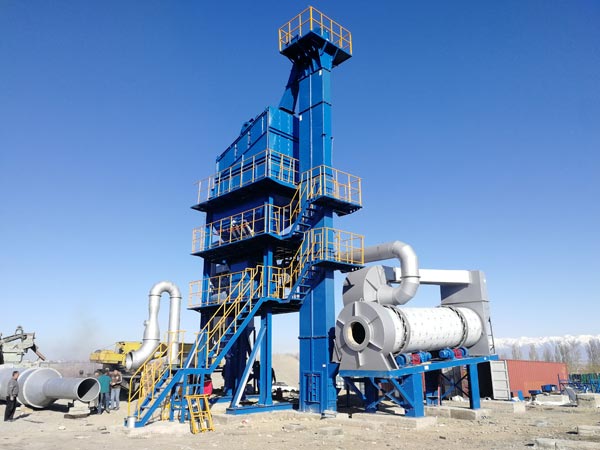
In the previous example, instead of choosing 80 TPH, you may select a 100 TPH asphalt mixing equipment. This decision helps you maintain stable output even under less-than-ideal conditions.
After determining capacity, the next step is to choose the right plant type. Different project scenarios require different solutions.
This is especially important in regions like Indonesia, where project environments vary greatly.
Stationary plants work best for long-term, large-scale projects. They offer stable production and high output.
If your daily demand exceeds 200–300 tons and the project duration is long, this option makes sense.
Mobile asphalt mixing plants for sale suit projects that require frequent relocation. They reduce transport costs and setup time.
For contractors working on multiple short-term projects, mobile plants provide flexibility.
Batch plants allow precise control of mix quality. Many contractors prefer them for urban roads and highways.
Drum plants offer continuous production and lower initial cost. They work well for large-volume projects with standard mix requirements.
Therefore, your plant type should align with both capacity needs and project conditions.
Even if your plant has enough capacity, poor logistics can limit actual production. Therefore, you must evaluate your supply chain.
This step often determines whether your plant can operate efficiently.
If aggregate supply is inconsistent, your plant will face frequent interruptions. This reduces effective output.
Choose a plant size that matches your material supply capability.
Insufficient bitumen storage can slow down production. Make sure your storage supports your daily demand.
Your trucks must handle the plant output. If transport capacity is limited, production will pile up and cause delays.
In short, plant size must align with the entire supply chain, not just production calculations.
Next, you need to consider environmental factors. These factors have a direct impact on plant performance.
In tropical regions like Indonesia, high humidity and frequent rain can reduce production efficiency.
Wet aggregates require more drying time. This increases fuel consumption and reduces throughput.
In some cases, production efficiency may drop by 15%–25%.
To handle such conditions, you can:
By planning for environmental factors, you avoid performance gaps during operation.
Finally, do not limit your decision to a single project. Asphalt plants are long-term investments.
If you plan to expand your business, your plant should support future opportunities.
If the answer is yes, choosing a slightly larger plant can bring long-term benefits.
Although the initial investment is higher, it can increase your competitiveness and revenue potential.
Choosing the right asphalt plant size requires more than simple calculations. You must consider daily tonnage, working efficiency, project conditions, logistics, and future plans.
In summary, follow this logic:
When you combine these factors, you can select a plant that works reliably and efficiently.
If you are planning a road construction project and feel unsure about plant size, you are not alone. Every project has unique requirements, and the wrong choice can increase costs and delay progress.
Our team can help you evaluate your daily tonnage, project conditions, and budget. We provide customized asphalt plant solutions that match real construction needs.
Contact us today to get a practical recommendation and move your project forward with confidence.

© 2025 Crivva - Hosted by Airy Hosting Managed Website Hosting.