

Understanding what lies beneath the ground is one of the most critical steps in planning any construction, infrastructure, or geotechnical project. Whether it’s a highway, bridge, foundation, industrial facility, or land development, the stability and safety of the structure depend entirely on the reliability of the subsurface data. This is where Seismic Refraction Survey, a proven and highly accurate geophysical technique, becomes essential. At Epitome Geotechnical Services, we deliver advanced Seismic Refraction investigations for clients across engineering, mining, environmental, and infrastructure sectors, ensuring every decision is backed by trusted and precise subsurface information.
Seismic Refraction is widely recognized for its reliability, cost-effectiveness, and ability to map subsurface layers with impressive accuracy. Using controlled seismic waves, the technique identifies the depth, density, velocity, and composition of soil or rock layers, making it extremely valuable for both shallow and deep geotechnical studies. Epitome uses modern instruments, expert execution, and smart interpretation techniques to convert raw seismic data into meaningful geotechnical insights.
Seismic Refraction is a geophysical method that uses the travel time of seismic waves to determine the subsurface profile. When seismic energy is generated—typically using a hammer, weight drop, or seismic source—it travels through different layers of the ground. As the wave encounters denser or harder layers, it refracts and changes direction. Sensitive geophones capture the returning signals, which are then analyzed to interpret the underground structure.
This method is particularly useful for:
Determining depth to bedrock
Identifying weathered rock layers
Mapping soil overburden thickness
Detecting rippability zones for excavation
Locating hard strata, fractured zones, and faults
Estimating material properties like velocity, density, and stiffness
For engineers, architects, geologists, and planners, Seismic Refraction offers a reliable, non-destructive approach to understanding ground conditions before investing in heavy construction. It minimizes risk, improves design accuracy, and ensures safer project execution.
At Epitome Geotechnical Services, our approach to Seismic Refraction is grounded in precision, field expertise, and advanced data interpretation. What sets us apart is our ability to blend cutting-edge technology with decades of practical experience in geophysical and geotechnical investigations.
We use industry-leading seismographs, multi-channel recorders, and high-sensitivity geophones to capture clean, high-resolution seismic signals. This ensures better clarity, reduced noise, and highly accurate velocity models.
Whether it’s soft soil, rocky terrain, hilly regions, industrial zones, or coastal environments, our team handles all geophysical challenges with ease. We adapt our methodology based on site conditions to achieve the most reliable outcomes.
Seismic data must be interpreted by skilled analysts to produce meaningful results. Our geophysicists and geotechnical experts use advanced software and velocity modeling techniques to deliver precise subsurface profiles.
Seismic Refraction is one of the fastest geophysical methods available. Epitome’s streamlined field procedures ensure quick data collection without disturbing the site or interrupting construction work.
Compared to extensive drilling or excavation, Seismic Refraction offers a cost-friendly alternative for understanding deep geological layers—especially in large-scale or remote areas.
One of the biggest advantages of Seismic Refraction is its wide application across industries. Epitome routinely conducts surveys for:
Before designing bridges, flyovers, highways, railways, and tunnels, engineers must know the depth and stability of the underlying bedrock. Seismic Refraction gives them that clarity.
For residential, commercial, and industrial structures, the method helps identify safe bearing layers and avoid construction on weak or unstable soils.
It is used to evaluate rock quality, rippability, depth to hard strata, and potential fracture zones—key elements in planning excavation.
Identifying bedrock depth, permeability zones, and fracture systems helps ensure safe dam design and long-term stability.
By mapping subsurface weaknesses, Seismic Refraction helps geologists predict potential failure zones and plan stabilization measures.
It supports groundwater studies, waste management projects, and environmental impact assessments by revealing the subsurface structure.
Our team analyses the terrain, ground conditions, and project objectives to determine the appropriate geophone spacing, spread length, and energy source.
Geophones are placed in a straight line and connected to a multi-channel seismograph. Cables, connectors, and triggering systems are checked for precision.
Seismic energy is introduced using a hammer or seismic source. The waves travel through the subsurface and get recorded by the geophones.
As waves return, our system records their travel times. We monitor the data to ensure clean signals, correct triggering, and minimal noise interference.
Using specialized software, we analyze the wave patterns to create velocity models. These models help determine:
Soil thickness
Weathered layer depth
Bedrock depth
Material stiffness
Subsurface layering
We deliver professional reports containing:
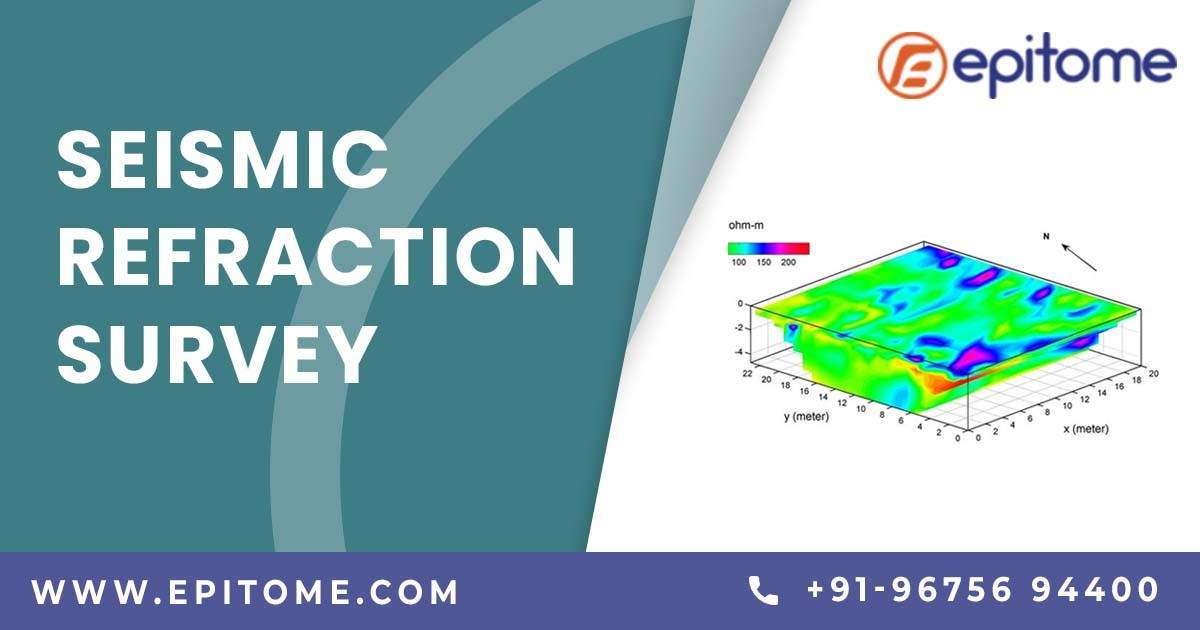
Velocity graphs
Cross-sectional profiles
Geological interpretations
Engineering insights
Recommendations for design and excavation
Our reports are tailored for engineers, planners, and project consultants, ensuring clarity and actionable guidance.
Clients across India trust Epitome Geotechnical Services because we consistently deliver precision, reliability, and efficiency. With a customer-centric approach, timely execution, and a commitment to accuracy, we support projects of all scales—from small foundation studies to multi-kilometer infrastructure corridors.
Our goal is simple: to provide the right data at the right time so your project starts with confidence.
A successful engineering project begins with a deep understanding of the ground. Seismic Refraction is one of the most dependable tools for revealing the structure beneath the surface, and Epitome Geotechnical Services ensures this method is performed with the highest level of precision and expertise. With our advanced technology, skilled team, and commitment to quality, we help clients build safely, efficiently, and confidently.
If you’re planning a construction, infrastructure, mining, or geotechnical project, Epitome’s Seismic Refraction Survey offers the clarity you need to make the right decisions.
📞 Contact: +91-96756 94400
🌐 Website: www.epitomegs.com
#SeismicRefraction #GeophysicalSurvey #EpitomeGeotechnical #GeotechnicalServices #Epitome

© 2025 Crivva - Hosted by Airy Hosting Managed Website Hosting.