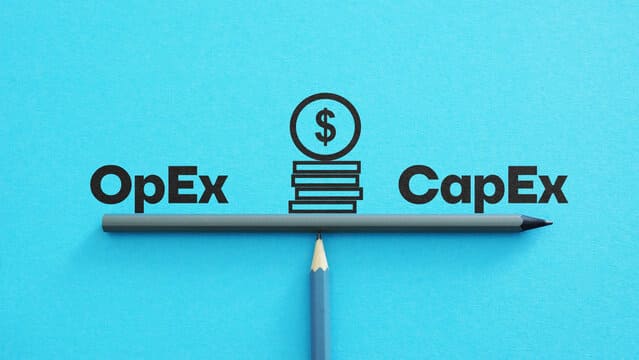
When startups fail, it is rarely because the idea was bad. Most often, it is because founders did not realise where the money is really going and how fast it is flowing away. The points where CAPEX and OPEX quietly determine the end: early, then late. Any credible Financial Feasibility Study begins with a lucid demarcation and long-term analysis of these two numbers.
CAPEX, or capital expenditure, refers to large, one-off costs incurred at the beginning to acquire a long-term asset. These are not monthly recurring numbers; rather, they define the startup’s long-term basis.
Typical areas where CAPEXapplies:
CB Insights estimates that 38% of startups run out of cash when CAPEX decisions delay revenue. Building the wrong product in the beginning will necessitate hasty, costly ‘cost blocking’ pivots. So the Financial Feasibility Study is the key to assessing these upfront costs before you put your money down.
OPEX (operational expenditure) is the cost of running the business day-to-day. These recurring numbers affect your monthly cash burn rate.
Typical areas of significant OPEX:
SaaS startups spend 65-75% of their cash on OPEX, with sales/marketing and salaries split equally. A well-crafted Financial Feasibility Study will forecast where revenue signups over 1-3 years can support the same rate of cash outflow.
Not just accounting differences-it’s a strategic choice.
Major differences include:
Over-investing in CAPEX at the beginning may close your startup early; under-investing in OPEX may make it hard to respond to change. This distinction is a vital component of any Financial Feasibility Study.
Risk is a function of time & size, not category.
CAPEX risks:
OPEX risks:
A typical YC startup with a 12-18-month runway will outperform the high-CAPEX counterpart in a sustained test of time. A Financial Feasibility Study goes through both paths in the best, worst and medium case scenarios.
It’s not that investors prefer startups to spend; they just want to see a rationale supporting the spend.
Investor focus:
Multiple VC reports indicate that startups that spend more than 30% of their initial dollar funding on CAPEX face a higher risk of follow-on funding rejection. This explains why an investor-approved Financial Feasibility Study is essential to secure capital.
Yes, they can and do.
Examples: switching from on-premise infra to cloud-hosting, from owning to leasing manufacturing facilities, from building custom in-house software to licensing SaaS add-ons.
Though this pivot improves agility, it may substantially increase long-term OPEX, which the Financial Feasibility Study carefully compares.
Here’s a side-by-side breakdown to highlight the core differences:
| Aspect | CAPEX (Capital Expenditure) | OPEX (Operational Expenditure) |
| Nature | One-time, upfront for long-term assets | Recurring, day-to-day operations |
| Examples | Machinery, servers, and infrastructure setup | Salaries, rent, marketing, cloud subscriptions |
| Accounting Treatment | Capitalised on the balance sheet; depreciated/amortized over years | Expensed immediately on the income statement |
| Cash Flow Impact | Large initial outflow; spreads via depreciation | Hits cash flow monthly/directly |
| Flexibility | Low—hard to reverse (sunk costs) | High—easy to scale, cut, or add |
| Risk Profile | Locks capital pre-product-market fit | Can drain the runway if uncontrolled |
| Startup Suitability | Best for asset-heavy models with moats | Ideal for asset-light, agile SaaS startups |
Taxes add another layer to the CAPEX-OPEX decision, influencing cash flow and profitability forecasts in your Financial Feasibility Study. Under standards like IFRS/GAAP (and India’s Income Tax Act, Section 32 for depreciation):
Over-investing in CAPEX early may close your startup early; under-investing in OPEX may make it hard to respond to change. This distinction—and its tax angles—is a vital component of any Financial Feasibility Study.
Que 1: What should be the ideal CAPEX-to-OPEX ratio for startups?
Ans: While there is no golden ratio, it is recommended that early-stage startups (with limited funds) keep CAPEX below 25-30% of their total funding to leave room for flexibility.
Que 2: Why is CAPEX more difficult to fix and correct than OPEX?
Ans: CAPEX commitment involves irreversible sunk costs, either in physical assets or permanent long-term arrangements, making corrections always expensive and difficult. While OPEX can be easily stopped or added.
Que 3: When should a Financial Feasibility Study be revised or updated?
Ans: Once every year or two, or on the occurrence of further funding, scaling or revising the pricing model.
Master the balance between CAPEX and OPEX. Learn how a Financial feasibility study prevents startup failure by managing cash flow, taxes, and investor risks.

© 2025 Crivva - Hosted by Airy Hosting Managed Website Hosting.