


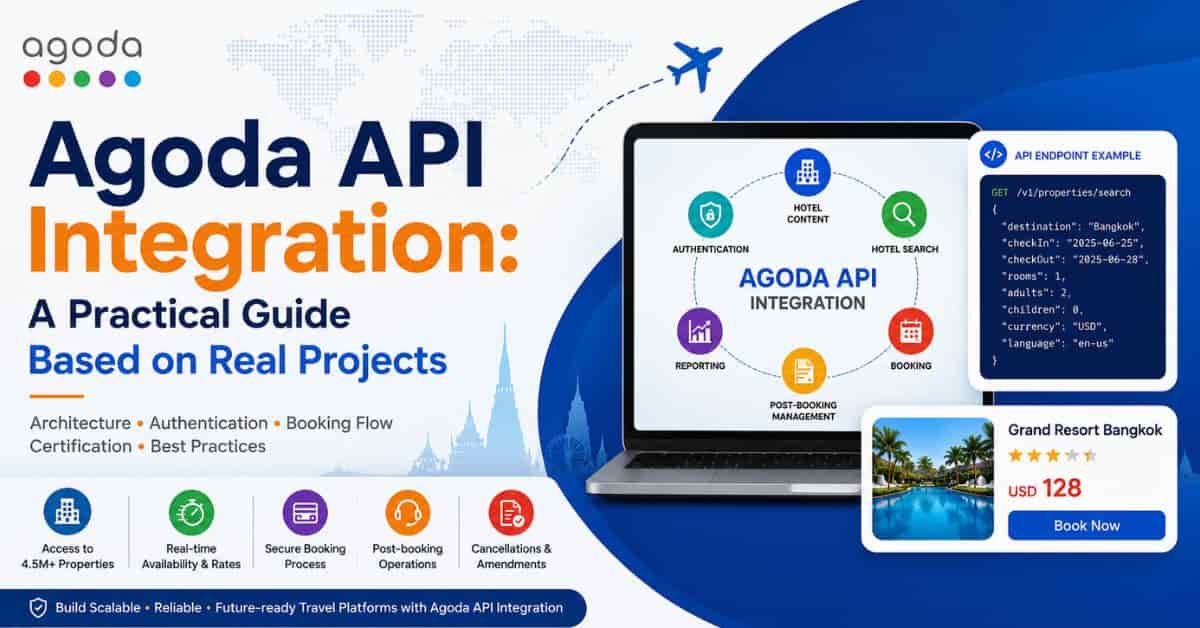
Agoda API Integration has become a common requirement for Online Travel Agencies (OTAs), B2B travel platforms, Destination Management Companies (DMCs), corporate travel platforms, and travel technology providers looking to access global hotel inventory through a single connectivity solution. The Agoda Demand API is one of the most widely used hotel distribution APIs in the travel industry, providing access to more than 4.5 million properties across 200+ countries and territories.
As part of the Booking Holdings ecosystem, Agoda has established a particularly strong presence across Asia-Pacific markets, where it often provides deeper accommodation coverage and competitive pricing compared to many global wholesalers. This makes Agoda an important supplier for travel businesses targeting destinations such as Thailand, Vietnam, Indonesia, Malaysia, Singapore, Japan, South Korea, India, and other high-demand tourism markets.
Unlike many traditional hotel wholesalers, Agoda operates a modern API-first distribution model that allows partners to integrate content, availability, pricing, bookings, cancellations, and amendments directly into their own platforms. Depending on the selected partnership model, businesses can either redirect users to Agoda for booking completion or manage the entire booking lifecycle within their own applications.
This Agoda API Integration Guide provides a detailed overview of Agoda API onboarding, authentication methods, content management, search architecture, booking workflows, certification requirements, operational considerations, and implementation best practices.
| Attribute | Details |
| Supplier Type | Hotel & Accommodation API |
| Parent Company | Booking Holdings |
| Inventory | 4.5M+ Properties |
| Coverage | 200+ Countries & Territories |
| Content Languages | 51+ |
| Strongest Markets | Asia-Pacific |
| Commercial Model | Commission-Based |
| Authentication | OAuth 2.0 |
| Integration Complexity | Medium |
| Typical Go-Live Timeline | 4–8 Weeks |
Agoda inventory includes:
In addition to Agoda’s direct supply, inventory may also include accommodation sourced through other supplier partnerships within the Booking Holdings ecosystem.
The Agoda API allows travel businesses to access Agoda’s accommodation inventory programmatically. Through Agoda API Integration, partners can search hotels, retrieve availability, access room rates, display property content, create reservations, manage cancellations, process amendments, and retrieve booking details through a centralized hotel connectivity platform.
The Agoda API supports multiple business models ranging from affiliate websites and metasearch engines to enterprise-level OTA platforms managing the entire booking lifecycle. One of the platform’s major strengths is its post-booking functionality, allowing partners to retrieve bookings, process amendments, handle cancellations, and support customer service workflows through API connectivity.
Through the API, partners can:
The API supports multiple business models ranging from affiliate websites and metasearch engines to enterprise-level OTA platforms managing the entire booking lifecycle.
One of Agoda’s major strengths is its post-booking functionality. While many suppliers primarily focus on availability and reservations, Agoda also provides APIs for booking retrieval, amendments, cancellations, and customer support workflows.
Before starting development, businesses must determine which partnership model best aligns with their operational requirements.
This model is designed for:
Partners only implement the Search API and display Agoda inventory. When users select an offer, they are redirected to Agoda to complete the booking.
In this model:
This approach allows businesses to maintain a branded booking experience without building extensive operational infrastructure.
Partner Fulfillment provides complete control over the booking lifecycle.
The partner:
This model is typically adopted by:
Unlike some hotel suppliers that provide instant sandbox access, Agoda requires commercial approval before API credentials are issued.
Typical requirements include:
Businesses should also prepare:
Having this information ready can significantly accelerate the onboarding process.
Understanding Agoda API architecture is an important part of any successful Agoda API Integration project. Agoda separates content, search, booking, reporting, and post-booking operations into dedicated API modules, allowing travel businesses to build scalable hotel booking platforms while maintaining flexibility across different business models and operational requirements.
The Agoda integration architecture consists of five major components:
Each component serves a specific purpose within the reservation lifecycle.
Responsible for:
Responsible for:
Responsible for:
Responsible for:
Responsible for:
Agoda is transitioning all partners to OAuth 2.0 authentication.
The authentication process follows a standard token-based workflow:
Access tokens remain valid for approximately one hour and should not be requested unnecessarily to avoid rate-limit issues.
Agoda separates static content from dynamic availability.
Includes:
This data is used to build the property catalog.
Includes:
This information changes frequently and must be retrieved through search APIs.
A common implementation pattern includes:
Used to:
Used to:
Proper synchronization significantly improves search accuracy and customer experience.
The Search API returns live rates and availability.
Successful implementations typically:
Special attention should be paid to:
These elements must be displayed transparently to avoid customer disputes and certification failures.
Agoda’s recommended booking workflow consists of three stages:
The traveler selects a room offer.
The system validates:
Precheck ensures that the selected offer remains available before booking.
Once validation succeeds:
A common implementation mistake is parameter inconsistency between Search, Precheck, and Book requests. Values such as dates, occupancy, room count, currency, and country information must remain identical throughout the workflow.

© 2025 Crivva - Hosted by Airy Hosting Managed Website Hosting.