

In today’s competitive business environment, companies need more than just a CRM system to manage customer relationships. As businesses grow, they often use multiple applications for sales, marketing, customer service, accounting, and operations. When these systems work separately, valuable data becomes scattered, processes slow down, and teams struggle to make informed decisions.
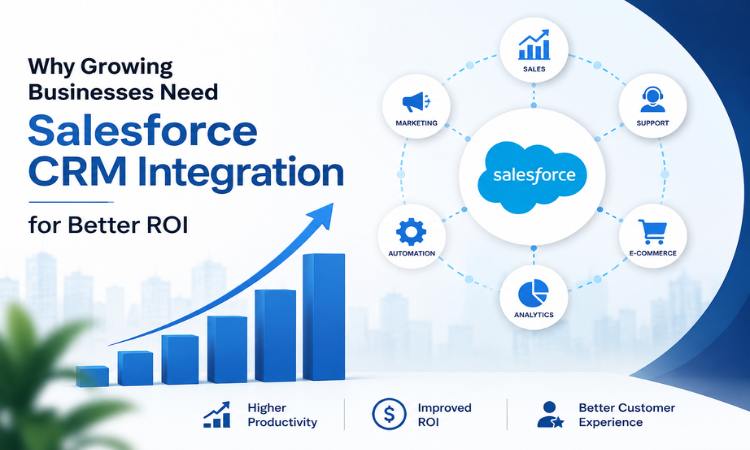
This is where Salesforce CRM Integration becomes essential. By connecting Salesforce with other business applications, organizations can create a unified ecosystem that improves productivity, enhances customer experiences, and drives better returns on investment (ROI).
In this guide, we’ll explore why growing businesses need Salesforce CRM integration, its key benefits, and how it can help companies scale efficiently.
Salesforce CRM integration is the process of connecting Salesforce with other software applications used within a business. These may include marketing platforms, ERP systems, accounting tools, e-commerce platforms, customer support solutions, and communication tools.
The goal is to allow data to flow automatically between systems, eliminating manual work and ensuring every department has access to accurate and up-to-date information.
Instead of switching between multiple applications, teams can work from a connected environment where information is synchronized in real time.
As businesses expand, they often adopt new tools to support different functions. While these tools solve specific problems, they can create operational challenges when they aren’t connected.
Common challenges include:
Duplicate customer records
Manual data entry errors
Delayed reporting
Poor visibility across departments
Inconsistent customer experiences
Reduced employee productivity
These issues can directly impact revenue growth and profitability. A disconnected technology stack often leads to missed opportunities and higher operational costs.
One of the biggest productivity killers in growing organizations is manual data management.
Employees often spend hours transferring information between systems, updating records, and correcting errors. This not only wastes valuable time but also increases the risk of inaccurate data.
With Salesforce integration, information automatically syncs between platforms. Sales teams can focus on closing deals instead of managing spreadsheets, while marketing and support teams gain instant access to updated customer information.
The result is improved efficiency and lower operational costs.
Data is one of the most valuable assets for any business. However, if customer information exists in multiple systems, it becomes difficult to determine which data is accurate.
Salesforce CRM integration centralizes information from different platforms and provides a complete view of customers.
Benefits include:
Better decision-making
More accurate forecasting
Improved reporting
Enhanced collaboration between teams
When everyone works from the same data, businesses can respond faster to opportunities and challenges.
Modern customers expect personalized and consistent interactions across every touchpoint.
When customer data is fragmented, teams may lack the information needed to deliver relevant experiences.
Integrated Salesforce environments allow businesses to:
Track customer interactions across channels
Personalize communications
Resolve issues faster
Anticipate customer needs
A better customer experience often leads to higher retention rates, increased loyalty, and more repeat business, all of which contribute directly to ROI.
Sales teams perform best when they can act quickly on opportunities.
Salesforce integrations can automatically capture leads from websites, marketing campaigns, social media platforms, and third-party applications.
Instead of manually entering lead information, sales representatives can immediately begin nurturing prospects.
This reduces response times and increases conversion rates.
Integrated systems provide a complete picture of the sales pipeline.
Managers can monitor:
Lead progress
Opportunity stages
Revenue forecasts
Team performance
This visibility helps businesses identify bottlenecks and optimize their sales processes for better results.
Marketing teams rely heavily on customer data to create targeted campaigns.
When Salesforce is integrated with marketing automation platforms, businesses can:
Segment audiences more effectively
Track campaign performance
Measure ROI accurately
Automate follow-up activities
Marketers gain valuable insights into customer behavior, allowing them to create more relevant campaigns that generate higher engagement and conversions.
Customer service plays a major role in long-term business growth.
When support teams have access to complete customer histories, they can resolve issues faster and provide more personalized assistance.
Salesforce integrations help support teams:
Access customer records instantly
Track support cases efficiently
Improve response times
Increase customer satisfaction
Satisfied customers are more likely to remain loyal and recommend your business to others.
Growing businesses need accurate insights to make strategic decisions.
Without integrated systems, generating reports often requires collecting data from multiple sources and manually compiling information.
Salesforce CRM integration enables real-time reporting by automatically gathering data from connected applications.
Business leaders can access dashboards that provide visibility into:
Sales performance
Customer engagement
Marketing effectiveness
Revenue trends
Operational efficiency
Faster access to insights allows organizations to make data-driven decisions that improve profitability.
Every growing business wants to maximize efficiency while controlling costs.
Disconnected systems often require:
Additional administrative work
Manual reporting
Data correction efforts
Duplicate software processes
Integration reduces these inefficiencies by automating workflows and minimizing repetitive tasks.
As a result, businesses can accomplish more with existing resources while lowering overall operational expenses.
Technology should support growth, not limit it.
As organizations expand, they need systems that can adapt to increasing customer demands, larger datasets, and more complex processes.
Salesforce integration provides the flexibility needed to scale operations efficiently.
Businesses can add new applications, automate additional workflows, and support growing teams without disrupting existing processes.
This scalability ensures long-term value from technology investments.
Successful integration requires careful planning.
Businesses should consider:
Identify the specific challenges you want integration to solve.
Examples include:
Improving lead management
Enhancing reporting
Automating workflows
Increasing customer retention
Focus first on integrating the platforms that have the biggest impact on business performance.
Common integrations include:
ERP systems
Marketing automation platforms
Customer support tools
Accounting software
E-commerce platforms
A well-planned integration ensures data accuracy, security, and long-term success.
Businesses looking for professional Salesforce Integration services often partner with experienced providers to create customized solutions that align with their growth objectives.
As businesses grow, disconnected systems can create inefficiencies that slow progress and reduce profitability. Salesforce CRM integration helps organizations eliminate data silos, automate processes, improve customer experiences, and gain deeper business insights.
By connecting Salesforce with critical business applications, companies can improve productivity, make smarter decisions, and maximize ROI. Whether you’re looking to streamline operations, enhance customer engagement, or support future growth, a well-executed Salesforce integration strategy can deliver significant long-term value.
For growing businesses aiming to stay competitive in an increasingly digital marketplace, Salesforce CRM integration is no longer a luxury—it’s a strategic investment that drives measurable business results.
Salesforce CRM Integration connects Salesforce with other business applications such as ERP systems, marketing platforms, customer support tools, and accounting software to create a unified workflow and improve operational efficiency.
By automating manual processes, reducing data errors, improving customer experiences, and increasing employee productivity, Salesforce CRM Integration helps businesses lower costs and generate more revenue.
Salesforce can integrate with ERP software, marketing automation platforms, e-commerce solutions, accounting tools, customer support systems, and many third-party applications.
Yes. Small and growing businesses can benefit from Salesforce CRM Integration by improving efficiency, streamlining operations, and creating a scalable foundation for future growth.
The timeline depends on the complexity of the integration, the number of systems involved, and business requirements. Simple integrations may take a few weeks, while complex projects can take several months.

© 2025 Crivva - Hosted by Airy Hosting Managed Website Hosting.