


India’s infrastructure sector has moved fast over the last decade. Highways, industrial corridors, ports, and railway lines are being built at a pace that would have seemed unrealistic fifteen years ago. But speed brings its own set of problems, and one that doesn’t get talked about enough is ground stability.
Contractors and site engineers are increasingly running into soil conditions that weren’t accounted for during initial planning. Loose fill, expansive clay, waterlogged low-lying areas – these aren’t rare exceptions anymore, they’re becoming routine challenges on project after project.
A lot of infrastructure design still happens at a desk, based on soil reports that may be years old or taken from a handful of test points across a large site. By the time construction crews reach the actual ground, conditions can look very different from what the drawings predicted.
This mismatch shows up most clearly during monsoon season. Sites that looked stable in a dry-season survey suddenly deal with waterlogging, slope movement, or subgrade softening once the rains hit. Projects that don’t build in margin for this end up with delays, cost overruns, or worse – structural issues that surface months or years after handover.
Engineers who’ve worked across multiple states in India will tell you the same thing: soil behavior is local. What works in the black cotton soils of Maharashtra doesn’t necessarily hold up in the sandy coastal stretches of Gujarat or the alluvial plains of the Gangetic belt. Treating ground preparation as a standardized checklist item, rather than a site-specific problem, is where a lot of early-stage mistakes happen.
Erosion control is one of those things that’s easy to skip when budgets tighten. It doesn’t show up in a ribbon-cutting photo, and its absence doesn’t cause immediate visible damage. The consequences show up later – in the form of washed-out embankments, undermined foundations, or drainage systems that silt up faster than expected.
The irony is that erosion control is usually far cheaper to build in upfront than to fix after the fact. Once a slope has failed or a road shoulder has washed away, repair costs multiply quickly, and traffic disruption adds a whole separate layer of cost that doesn’t always make it into project budgets.
Some of this comes down to how project timelines are structured. Erosion control and ground stabilization work often sit at the end of a construction schedule, right when contractors are under the most pressure to finish and hand over. That’s exactly the wrong time to be cutting corners on something that determines long-term durability.
Ground stability and water management are tied together more closely than most non-engineers realize. Poor drainage doesn’t just cause surface flooding – it saturates subgrade layers, reduces load-bearing capacity, and accelerates erosion along slopes and embankments.
In a lot of Indian infrastructure projects, drainage planning happens almost as an afterthought, added in after the main structural design is finalized. That sequencing causes problems. Retrofitting proper subsurface drainage into an already-built structure is far harder and more expensive than designing it in from the start.
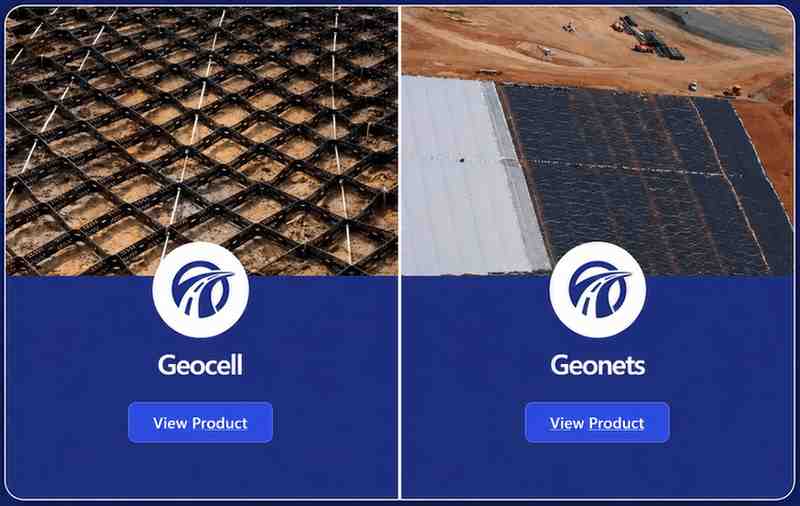
Geosynthetics have quietly become a bigger part of how engineers solve this. Materials designed for confinement and drainage give project teams a way to manage both slope stability and water movement without relying purely on traditional earthworks, which take longer and require far more material volume. Teams working on retaining structures often turn to a geocell system when they need to confine loose or weak soil without the cost and time of a full concrete solution, particularly on slopes or embankments where traditional grading isn’t practical.
There’s a generational shift happening in how site engineers approach ground preparation. The older approach leaned heavily on brute-force solutions – more concrete, more excavation, more manual labor to compact and grade. It worked, but it was slow and expensive, and it didn’t always hold up well against India’s monsoon intensity.
Younger engineering teams, especially those working on NHAI and state highway projects, are looking more seriously at engineered solutions that reduce both material volume and construction time. This isn’t about chasing trends – it’s a practical response to tighter project timelines and rising material costs.
Subsurface water management is a good example of where this shift shows up. Instead of relying only on open drains, which take up space and require ongoing maintenance, teams are looking at compact drainage systems that can be integrated directly into the structure. A properly specified geonet geosynthetics layer, for instance, gives designers a way to manage subsurface water flow without the footprint and maintenance burden of open channel drainage, which matters a lot on space-constrained urban and semi-urban sites.
Ground failures rarely happen in isolation. A slope failure on a highway project doesn’t just mean local repair work – it triggers traffic diversions, safety inspections, contractor liability disputes, and sometimes regulatory scrutiny. The downstream cost is almost always higher than what would have been spent on proper ground preparation in the first place.
There’s also a reputational cost that project teams underestimate. In a sector where repeat contracts depend heavily on track record, a visible ground failure – even a minor one – can affect how a contractor is viewed in future tender evaluations.
None of this means every project needs an elaborate ground engineering solution. Plenty of sites have straightforward soil conditions that don’t require anything beyond standard practice. But the sites that do have complex conditions – steep gradients, poor native soil, high water tables – need honest assessment early, not optimistic assumptions carried through to construction.
The practical takeaway for anyone involved in infrastructure planning is simple: soil and water conditions deserve the same level of scrutiny as structural design, not less. A site survey done once, early in the process, and treated as a formality, isn’t enough for projects with any real ground complexity.
Bringing in geotechnical input at the design stage, rather than after problems appear during construction, tends to save both time and money over the life of a project. It also reduces the number of change orders and disputes that come up when ground conditions don’t match what was assumed on paper.
Infrastructure in India isn’t slowing down. If anything, the pace is likely to increase over the next decade as more states push forward with highway expansion, industrial corridors, and port connectivity projects. The teams that build in proper ground assessment and water management from day one are going to spend a lot less time dealing with avoidable failures down the line.

© 2025 Crivva - Hosted by Airy Hosting Managed Website Hosting.