Communication is one of the most fundamental human capacities — it helps us form connections, express our thoughts and emotions, and engage with the world. For many children, though, speech and language development does not follow a typical trajectory. That’s where speech therapy plays a life-changing role. At IIAHP in Chandigarh, children with speech delay or communication disorders receive world-class, evidence-based therapies tailored to their unique needs.
Why Children Struggle with Speech
Speech delay can stem from a variety of underlying causes. In some cases, it’s related to structural issues—like problems with the tongue or lips. In others, it’s more deeply rooted in brain organization. Disruptions in neurological development, poor coordination between different brain regions, or even sensory integration issues can make it difficult for a child to speak clearly or meaningfully. This is precisely why IIAHP’s approach is so powerful: they don’t just treat the symptom (difficulty speaking), they address the root neurodevelopmental causes.
Who Can Benefit from Speech Therapy at IIAHP
IIAHP offers speech therapy for a wide age range — from 2 to 17 years old. Their program is not one-size-fits-all; after a thorough diagnosis, the team of expert speech therapists works closely with each child and their family to design a customized plan.
Some of the common indications for speech support at IIAHP include:
- Delays in reaching speech milestones (e.g., not saying first words by age 2
- Inability to combine words into phrases
- Difficulties in understanding or using age-appropriate language
- Communication challenges related to neurodevelopmental or behavioral disorders, such as ADHD
- Articulation problems, poor voice clarity, or phonetic awareness issues
A Holistic, International Approach
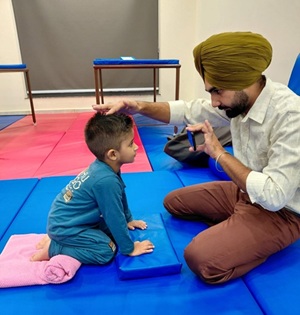
IIAHP’s speech therapy is far more than just talking exercises. Their multidisciplinary model integrates foreign techniques, and they bring in international therapists to train the local staff. This ensures that children benefit from the latest, research-backed therapies from around the world.
Here are some of the therapies offered as part of the speech program:
- Brain Gym Therapy — leveraging movement to enhance neurological integration
- Floor Program (Gymnastic Program) — to stimulate vestibular and motor systems
- Listening Therapy (AIT) — auditory integration to balance the sound processing system
- Reflex Integration Therapy — integrating primitive reflexes for better motor and speech coordination
- Audio-Visual Therapy — improving sensory processing and integration
- Ora-Facial and Logotherapy — working on facial muscles, tongue, jaw to enhance articulation and clarity
- Handle Therapy — to boost motor planning, coordination, and self-regulation
- Art & Sensory Integration — using creative expression and sensory play to build communication skills
- Balance Board — to strengthen core systems which support speech and posture
- Neuro-Structural Therapy, Archetype Movements, Music Therapy, Respiratory Patterning, and more — for a well-rounded neurological and sensory foundation.
Time, Patience & Partnership: What to Expect
One of the most important things to understand as a parent is that speech therapy is a journey — not a quick fix. How long it takes depends on a number of factors:
- The nature and severity of the speech challenge
- How frequent the therapy sessions are
- The child’s age and level of neurodevelopment
- The involvement of parents — this can be a game-changer. At IIAHP, they emphasize that when parents actively participate, progress tends to be faster.
Early Warning Signs Parents Shouldn’t Ignore
Recognizing possible speech delay early can make a big difference. Some of the signs IIAHP highlights include:
- By 12 months: not using gestures (like pointing or waving)
- By 18 months: trouble imitating sounds
- Difficulty in understanding simple verbal requests
- By 2 years: only saying a few words, repeating sounds, or not combining words
- Unusual voice quality, or speech that is difficult to understand even for familiar people
- Any regression in speech — if a child starts losing previously acquired sounds or words
If you see any of these, it’s worth consulting a specialist.
Why Choose IIAHP for Speech Therapy
Here are some key reasons parents often pick IIAHP:
- International Expertise: They bring foreign therapies and train their staff continuously via international experts.
- Holistic & Non-Invasive Techniques: The therapies are natural, non-drug-based, and focus on brain-body integration.
- Safety & Transparency: Their centre is fully air-conditioned, under CCTV surveillance, and parents are allowed to view footage — offering peace of mind.
- Parental Involvement: They provide home-plans for families who live far away or abroad, so therapy isn’t limited to in-clinic hours.
- All-Round Development: Beyond speech, IIAHP offers reading, math, and intellectual enrichment programs — making their approach very comprehensive.
- Support Beyond Therapy: They also guide families on nutrition, supplements, and diet, understanding that development is deeply tied to health.
The Impact: Why Speech Therapy Matters
When a child learns to communicate better:
- Their confidence grows — they can express needs, ideas, and feelings.
- Their social interactions improve — they feel more connected to peers and family.
- Their learning journey becomes smoother — clearer speech often correlates with better academic performance.
- Their quality of life improves — both for them and for their caregivers.
Speech therapy at IIAHP isn’t just about words. It’s about unlocking potential, building bridges of connection, and empowering children to find their voice.
Getting Started with IIAHP
If you think your child might benefit from speech therapy:
- Reach out: You can call IIAHP at +91-74195 02101 for more details or to book an assessment.
- Assessment: An initial evaluation will help their team understand your child’s needs.
- Customized Plan: Based on the assessment, they will design a therapy plan tailored to your child.
- Parental Role: Be ready to be involved — your role at home will significantly influence therapy success.
- Track Progress: With consistent therapy and monitoring, you could start seeing improvements over time.
Final Thoughts
Speech is more than just talking—it’s a gateway to connection, learning, and self-expression. For children who struggle with speech delays, finding the right support can feel overwhelming, but IIAHP offers a deeply caring, scientifically grounded, and globally informed solution.
Through their speech therapy program, they’re not just helping kids speak; they’re helping them be heard. If you’re a parent wondering whether your child needs help, it’s worth exploring what IIAHP has to offer.