

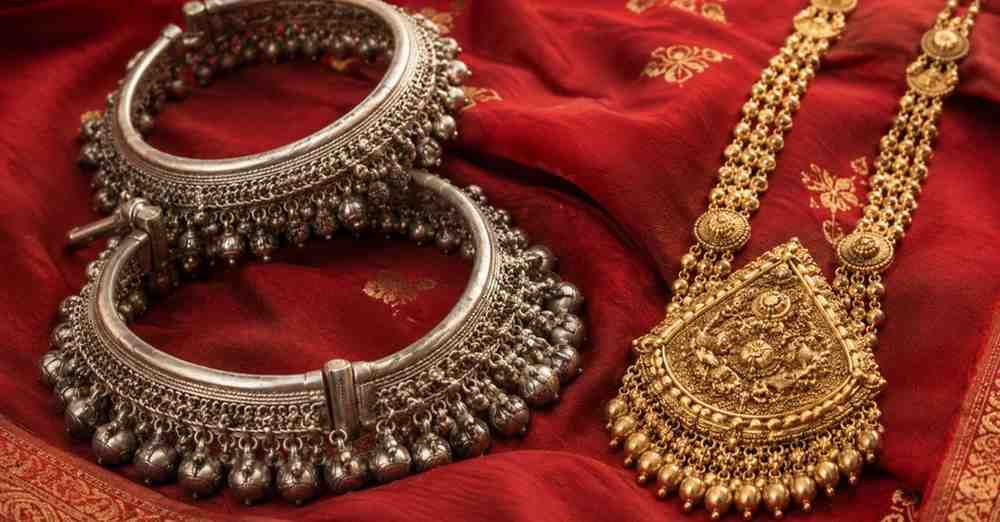
There’s a woman in Jammu right now, probably in her 60s, who owns a Naulakhia Haar. Nine strings of gold, heavy enough that you feel it before you see it. She doesn’t wear it anymore. Hasn’t for years. It sits wrapped in red cloth somewhere in the back of a steel almirah, waiting for a wedding that will probably dress the bride in something from Sarojini Nagar instead.
That’s the situation with Dogri jewellery. The pieces still exist. The knowledge of what they mean is quietly leaving.
So before it goes entirely, here’s what you need to know.
Before you look at any individual piece, you need to understand one rule: gold above the waist, silver below.
This isn’t aesthetic preference. Gold is the metal of Goddess Lakshmi. Wearing it below the waist is considered disrespectful. So every ankle ornament, every toe ring worn by a traditional Dogra woman is silver. Always has been. The artisans who made those silver payals understood the theology before they touched the metal.
Keep that in mind as you read through each piece.
The headgear of a traditional Dogra bride was an architecture project. Pieces like the Chak, Samosas, Chumber Suiyaan, the crescent-shaped Ardhchandrama, and the Shinghar Patti were all distinct ornaments, each sitting at a specific point on the head and hair.
Most of this is gone now. Replaced by the Maang Tikka, which is fine, but it’s one piece doing the work of five.
The old headgear communicated things the Tikka can’t: which family you married into, how much wealth was being transferred, what your status was in the household. When it vanished from daily use, that visual vocabulary went with it.
Jhumkes, Ballians, the bell-shaped dangling earrings with their filigree detail. These made it through modernization mostly intact.
One thing that didn’t survive: Nantian, the earrings worn by men of status. Prominent Dogra men historically wore these to signal social standing. You’d be hard-pressed to find a Dogra man doing this today.
|
Piece |
What it looked like |
What it meant |
|
Naulakhia Haar |
Nine strings of gold |
The pinnacle of Dogra female aspiration. “Naulakha” means nine lakhs, the approximate value. |
|
Rani Haar |
Long regal necklace |
Literally “queen’s necklace.” Royal lineage emulation. |
|
Bugdian with Houldali |
Gold beads on silk thread, with a central pendant |
The everyday version. More common, still meaningful. |
The Bugdian is mostly replaced by the Mangalsutra now. That replacement is worth sitting with for a second. The Mangalsutra is pan-Indian, carried here by television and cinema. The Bugdian was specific to this region, to this community. When one replaced the other, something irreplaceable left the frame.
The Chura is bridal bangles. You’d recognize the concept even if you didn’t know the name. The Chura signals recent marriage, and that signal is still legible today.
Less known: the Nant, an upper armlet worn during specific religious observances. Particularly the Nant Chodyya fast. The connection between jewellery and religious calendar in Dogra culture is tighter than most people realise.
Gokhru and Muride are heavy cuffs, gold or silver depending on placement. Worn on the forearms.
The ankle and toe pieces, Payals, Gobhichain, Basantians, Karrians, Torey, Shallians, were all silver. No exceptions.
Two things these ornaments did that modern jewellery mostly doesn’t: they made sound, and they were believed to ward off negative energy from the ground up.
The sound was functional, not incidental. A woman entering a room announced herself. Her movement had a sound signature. That’s a different relationship with the body than we have now.
The joint family system was the infrastructure that maintained large caches of heirloom jewellery. When families split into nuclear units, the economics changed. Nobody can afford to store and insure pounds of gold and silver for a piece that gets worn once every 20 years.
The shift from agrarian to urban life did the rest. Heavy traditional pieces made sense at village fairs, at outdoor melas. In an office, in a city flat, they don’t.
The Dogra Art Museum in Jammu holds some of what’s left, royal pieces and commoners’ pieces both. Worth visiting if you want to understand the scale of what’s been quietly archived away from living use.
You’re not obligated to wear every traditional piece to be a Dogra bride. That would be an unrealistic ask.
But knowing what the Naulakhia Haar was, what the Bugdian meant, why silver was chosen for the ankles, that knowledge is yours. It belongs to you by inheritance. And it changes how you make choices about the pieces you do wear.
At Talla Jewellers, the conversations we have with brides often start here: what do you already know, and what do you want to understand before you decide? Book your free Shaadinama consultation.
Because once you understand the vocabulary, choosing becomes personal instead of just aesthetic.
What is the most important piece of traditional Dogri jewellery? The Nath holds that position for the wedding day, but for overall daily significance, the neck pieces like the Bugdian historically carried the most weight as markers of marital status and family wealth.
Why is silver used for ankle jewellery in Dogra tradition? Gold is associated with Goddess Lakshmi and is considered disrespectful to wear below the waist. Silver is used exclusively for all ankle and toe ornaments in traditional Dogra custom.
Is the Naulakhia Haar still made by jewellers in Jammu? Some traditional jewellers in Jammu can still craft pieces in this style, but it’s custom order territory now, not stock inventory.
What happened to the traditional Dogra headgear? The elaborate multi-piece headgear (Chak, Samosas, Chumber Suiyaan) has mostly disappeared from everyday and even ceremonial use, replaced by the single Maang Tikka. The Dogra Art Museum in Jammu preserves examples of original headgear.

© 2025 Crivva - Hosted by Airy Hosting Managed Website Hosting.