

You work hard to bring customers in the door, but how do you get them to come back? That’s the exact question that loyalty programs were built to answer. Whether you run a small coffee shop or a growing e-commerce brand, the right loyalty program can turn one-time buyers into lifelong fans. But here’s the thing: not all loyalty programs are built the same. Choosing the wrong type can feel like throwing money at a wall and hoping something sticks. This guide breaks down the top 5 types of loyalty programs, how each one works in the real world, and the benefits that actually move the needle for American businesses.
When businesses talk about building customer loyalty, they’re usually referring to one or a smart combination of these core program structures. Each fits different industries, customer behaviors, and business goals. Let’s walk through them.
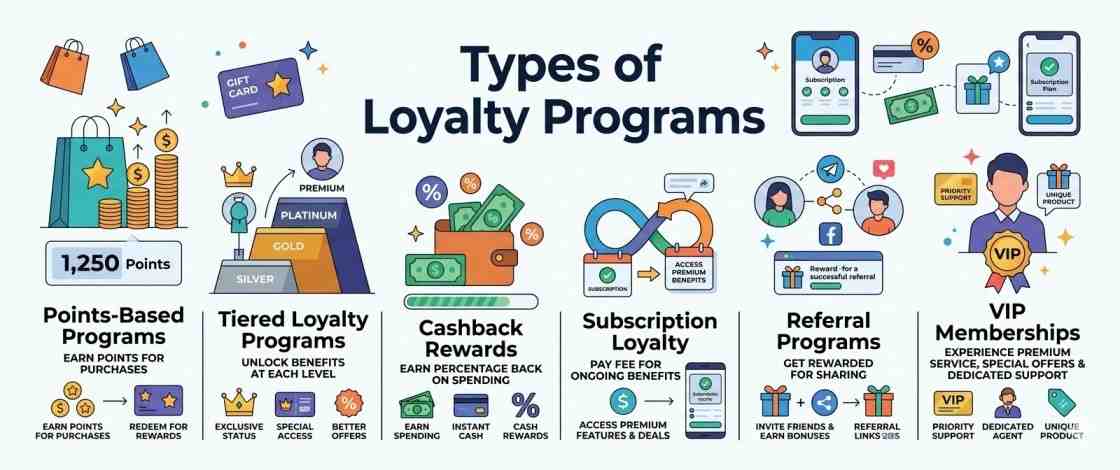
Points-based programs are the backbone of customer retention in the U.S. The concept is simple: customers earn points for every dollar spent (or specific action taken), then redeem those points for discounts, free products, or exclusive perks. Think Starbucks Rewards, you earn “stars” every time you order, and eventually those stars unlock free drinks.
What makes this type so popular is how naturally it fits into everyday purchasing habits. Customers don’t have to think too hard. They just buy what they were already going to buy and watch the rewards add up. For businesses, it’s a reliable way to track purchase frequency and increase average order value, because customers will often spend a little more just to hit the next reward threshold.
Points programs also create a sense of momentum, psychologists call it the “endowed progress effect.” Once someone has 80 points toward a 100-point reward, they’re highly motivated to close that gap. That’s genuine behavioral science working in your favor.
Tiered programs take the points model a step further by sorting customers into levels, usually Silver, Gold, and Platinum, or similar. The higher the tier, the better the perks. Delta SkyMiles and Marriott Bonvoy are classic American examples of this structure done well.
The real power here is aspiration. Customers who have reached “Gold” status don’t just feel rewarded, they feel recognized. And the ones who are still at “Silver”? They’re motivated to spend more to climb the ladder. Tiered programs are especially effective for industries with high-frequency purchases or where status carries genuine social meaning (travel, hospitality, beauty).
For businesses, tiered programs make it easier to identify your most valuable customers and give them a reason to stay loyal. When your top-tier customers know they’d lose their status if they switched to a competitor, that’s serious retention power.
Amazon Prime might be the most famous loyalty program in the world, and it’s paid. Customers pay a monthly or annual fee in exchange for benefits like free shipping, exclusive pricing, or early access to sales. Costco’s membership model works similarly.
At first glance, charging people to be loyal customers might seem counterintuitive. But it works because the moment someone pays for membership, they have a financial incentive to get their money’s worth. Amazon Prime members spend significantly more per year than non-members, not because Amazon forces them to, but because they want to justify the subscription cost.
Paid programs also generate upfront, predictable revenue for businesses and typically attract customers who are already highly motivated buyers. The key is making sure the benefits feel worth far more than the fee. If the value is obvious, the churn rate on these programs tends to be remarkably low.
Here’s a type of loyalty program that doesn’t get enough credit: value-based programs. Instead of rewarding customers with discounts or free stuff, this model ties loyalty to something the customer actually cares about, such as donating a portion of their purchases to a charity of their choice, planting trees, or supporting social causes.
The outdoor brand Patagonia is a well-known example of a business that built deep customer loyalty through shared values around sustainability. Body and Sole, a small running shoe shop, or a local bakery might do this by donating to a local food bank with every purchase. Customers don’t just come back because of a coupon; they come back because buying from you means something to them.
This type of loyalty program is especially powerful right now. American consumers, particularly Millennials and Gen Z, increasingly make purchasing decisions based on brand values. If your business has a genuine mission, a value-based program is an authentic way to communicate it while building lasting customer relationships.
Coalition programs pool multiple businesses together so customers can earn and redeem rewards across a shared network. Think about how airline miles can be earned on a credit card, spent at partner hotels, and redeemed for car rentals all under one umbrella. In the U.S., programs like Chase Ultimate Rewards work this way.
For smaller businesses, partnering with complementary local brands to create a shared loyalty system is a savvy move. A yoga studio, a smoothie shop, and a wellness store might all participate in a single app where customers collect points regardless of which business they visit. Everyone benefits from the shared network.
The key advantage is reach. Instead of building a loyalty audience from scratch, you’re tapping into an existing pool of loyal customers from partner businesses. It also gives customers more flexibility in how they earn and spend, which is a major driver of long-term engagement.
|
Program type |
Best for |
Core benefit |
Effort to launch |
|
Points-based |
Retail, food, e-commerce |
Repeat purchases |
Low–Medium |
|
Tiered |
Travel, hospitality, beauty |
Customer status & retention |
Medium |
|
Paid/subscription |
High-frequency buyers |
Upfront revenue + spend lift |
Medium–High |
|
Value-based |
Mission-driven brands |
Emotional loyalty |
Low (if authentic) |
|
Coalition |
Local biz & niche markets |
Expanded reach |
Medium (partnership req.) |
There’s no one-size-fits-all answer for the different types of loyalty programs. The best program for your business depends on your industry, your customers’ habits, and what you can realistically sustain long-term. Points-based programs are a safe, proven starting point for most businesses. Tiered programs work beautifully when status matters to your customers. Paid memberships make sense when your benefits are genuinely compelling. Value-based programs resonate deeply when your brand has a mission worth rallying around. And coalition programs open doors for businesses that want to grow through partnerships.
The most important thing? Pick a structure that feels natural to your brand, keep the rewards meaningful, and make it easy for customers to participate. A loyalty program that customers actually use is worth a hundred times more than one that looks good on paper but sits untouched.
The most common types are points-based, tiered, paid subscription, value-based, and coalition programs. Points-based and tiered structures are by far the most widely used across the U.S. retail and service industries.
For most small businesses, a points-based or value-based program is the easiest and most cost-effective to launch. They require minimal technology investment, are easy for customers to understand, and can be run through simple apps like Stamp Me, Belly, or even a punch card system.
Yes, when designed well. Research consistently shows that loyal customers spend more, buy more frequently, and are less likely to switch to a competitor. The key is making sure the rewards are perceived as genuinely valuable, not just token gestures.
A points-based program rewards customers for individual transactions (e.g., earn 1 point per dollar spent). A tiered program sorts customers into levels based on their total spending or engagement, unlocking bigger perks as they move up to Bronze, Silver, and Gold status. Many programs combine both elements.
Start by asking: how often do my customers buy from me, and what motivates them to return? High-frequency buyers (coffee, grocery, beauty) respond well to points programs. Status-conscious buyers (travel, luxury) prefer tiered programs. Mission-driven customers respond to value-based models. Match the program structure to what your specific customers actually care about.

© 2025 Crivva - Hosted by Airy Hosting Managed Website Hosting.