


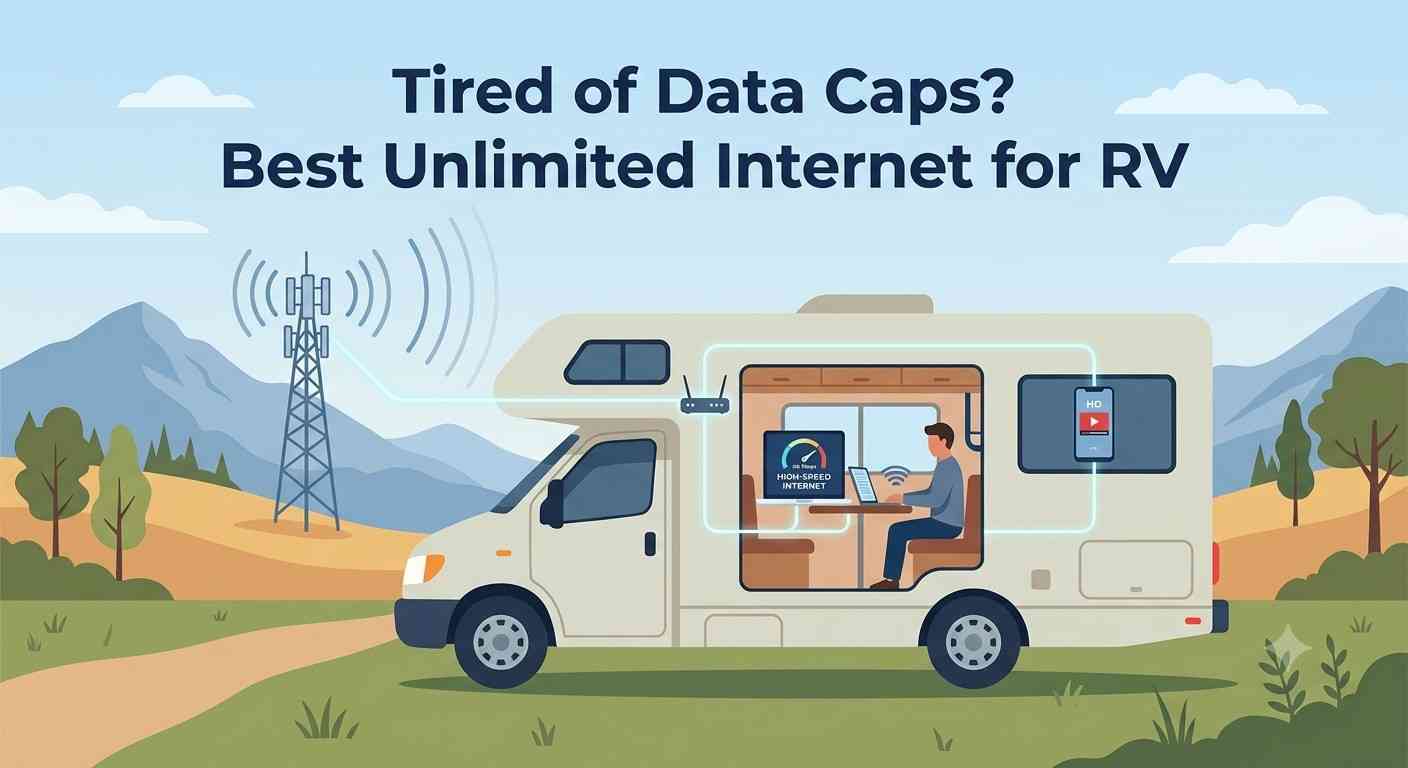
You’re finally parked at that campsite you’ve been planning for weeks, mountains in the background, coffee in hand, zero neighbors, and then your video call freezes, your hotspot spins, and your boss is watching a pixelated version of your face stutter into oblivion. Sound familiar? Finding the best unlimited internet for RV travelers isn’t just about picking a plan; it’s about understanding why most “unlimited” options quietly fail you the moment you need them most.
Here’s the thing nobody puts in the headline: unlimited doesn’t mean unrestricted.
Almost every major carrier buries a deprioritization threshold in the fine print, typically somewhere between 30GB and 100GB, after which your speeds get throttled down to the kind of performance that makes loading a webpage feel like an achievement. For a weekend camper, that might be fine. For a full-timer running Zoom calls, uploading files, and streaming in the evenings, you’ll burn through that threshold faster than you think.
The words to watch for in any plan’s terms are “network management” and “data deprioritization.” Those phrases are doing a lot of heavy lifting. They mean your carrier can legally slow you down whenever towers get busy, which, at a packed summer campground, is basically always.
True best unlimited internet for RV use means consistent, usable speeds even after heavy usage, even when towers are loaded, even when you’re three hours from the nearest city.
Most people start here, and it makes sense that you already have the phone, the plan exists, and it works fine at home. But RV life exposes every weakness a phone hotspot has.
First, carrier plans frequently cap hotspot speeds separately from your phone’s data. You might have “unlimited” overall data, but your hotspot portion gets throttled to 5–15 Mbps after just 15GB, sometimes less. Second, phone hotspots aren’t built for sustained all-day use across multiple devices. Laptops, tablets, a smart TV, maybe a partner working the load remotely, add up fast.
Third, and most importantly: phone plans are optimized for where people live, not where RVers roam. Coverage along Interstate 90 through Wyoming or down Highway 1 through rural California is a completely different story than what a coverage map wants you to believe.
This is the foundation of most RV internet setups, and for good reason. Cellular plans using LTE and 5G towers are portable, relatively affordable, and available across most of the country. A dedicated mobile hotspot device or a cellular router lets you share that connection across all your devices without the limitations of a phone-based hotspot.
The catch is congestion. Popular camping areas, like Lake Powell in July, or any national park in peak season, have hundreds of rigs all hammering the same tower. Even a solid plan with generous data slows down under that kind of load.
Multi-carrier setups (carrying SIMs from multiple networks) have become the standard workaround for serious travelers. If one network is overwhelmed, you switch to another. It adds complexity, but it also adds reliability.
Satellite internet for RVs has genuinely matured as an option. A few years ago, it meant high latency and unreliable speeds. Today’s low Earth orbit satellite technology has changed that equation significantly. Latency has dropped, speeds have improved, and the coverage footprint is hard to argue with.
The trade-offs are real, though. Hardware costs are substantial upfront. You need a clear, unobstructed view of the sky, which is tricky under tree cover. And during high-demand periods, speeds can fluctuate unpredictably. For boondockers who regularly camp far beyond any cell tower, satellite internet is often worth every dollar. For travelers who stick to campgrounds near towns, it may be more hardware than you need.
This one doesn’t get nearly enough attention in the RV community. Rural wireless providers specifically build their networks around tower infrastructure in low-density areas, agricultural stretches, small-town corridors, and routes that major carriers quietly underserve. UbiFi offers the best unlimited internet for RV travelers who spend meaningful time off the main highway grid, with plans designed around rural coverage rather than recycled urban capacity. If your routes regularly take you through farming country, smaller states, or less-traveled roads, rural wireless deserves a serious look.
Before you commit to anything, run every option through these filters:
Not the marketing headline, the real number in the terms of service. Anything under 100GB is worth scrutinizing if you’re a heavy user.
Some plans are SIM-locked to handsets only. If you want a mobile router that distributes a signal across your whole rig, confirm the plan explicitly supports that.
Download the app, cross-reference with RV community forums, and read reports from people who drove the same roads, not the carrier’s marketing map. Coverage maps are aspirational documents.
Your internet needs in a Montana summer are different from your needs parked outside Tucson in February. Month-to-month flexibility matters more for RVers than for anyone else.
Some plans only throttle during peak congestion and recover when towers clear. Others hard-cap you for the rest of your billing cycle. That’s a significant difference if you’re parked in a busy spot for two weeks.
The most consistently connected full-timers don’t rely on one plan. They build a small stack, usually a primary cellular plan for everyday use, a rural wireless or satellite option for the stretches where towers disappear, and occasionally a campground WiFi booster when the park offers a signal worth capturing.
It sounds like more work than just picking one “best” plan, but the reality is that no single provider covers the full range of places an RVer actually goes. Redundancy isn’t paranoia, it’s just how road life works.
The search for the best unlimited internet for RV living comes down to one honest truth: there’s no perfect single solution, but there are smarter combinations. Understanding what “unlimited” actually means in the fine print, knowing which technology fits your travel style, and building in some backup for the inevitable coverage gaps, that’s what separates consistently connected travelers from the ones refreshing a loading screen in frustration. The infrastructure has improved dramatically, the options are genuinely better than they were a few years ago, and with the right setup, staying connected on the road is absolutely doable. You just have to choose with your eyes open.
There’s no universal answer, but most full-timers find that a combination of a primary cellular data plan and a rural or satellite backup gives the most consistent coverage. Single-carrier plans almost always have gaps somewhere along a long-haul route.
Most unlimited phone plans throttle hotspot speeds separately and at a much lower threshold than the overall data limit. After a certain amount of hotspot usage (sometimes as little as 15GB), speeds drop significantly. A dedicated mobile data plan or cellular router typically handles this better.
It varies by lifestyle. A solo traveler doing casual browsing uses roughly 20–40GB. A remote worker with regular video calls, cloud syncing, and evening streaming can easily hit 150–250GB. Couples or families with multiple remote workers often go higher. Know your real usage before choosing a plan.
It depends on the park and the provider. Many national parks have limited or no cellular coverage within park boundaries. Rural wireless and satellite options tend to perform more reliably in these areas than standard carrier plans, which prioritize coverage in populated zones.
For travelers who frequently boondock in remote areas with no cell signal, the performance and coverage improvements make it a serious option despite the upfront hardware cost. For RVers who mostly stay at developed campgrounds near towns, cellular-based plans are usually more cost-effective and often faster in practice.

© 2025 Crivva - Hosted by Airy Hosting Managed Website Hosting.