

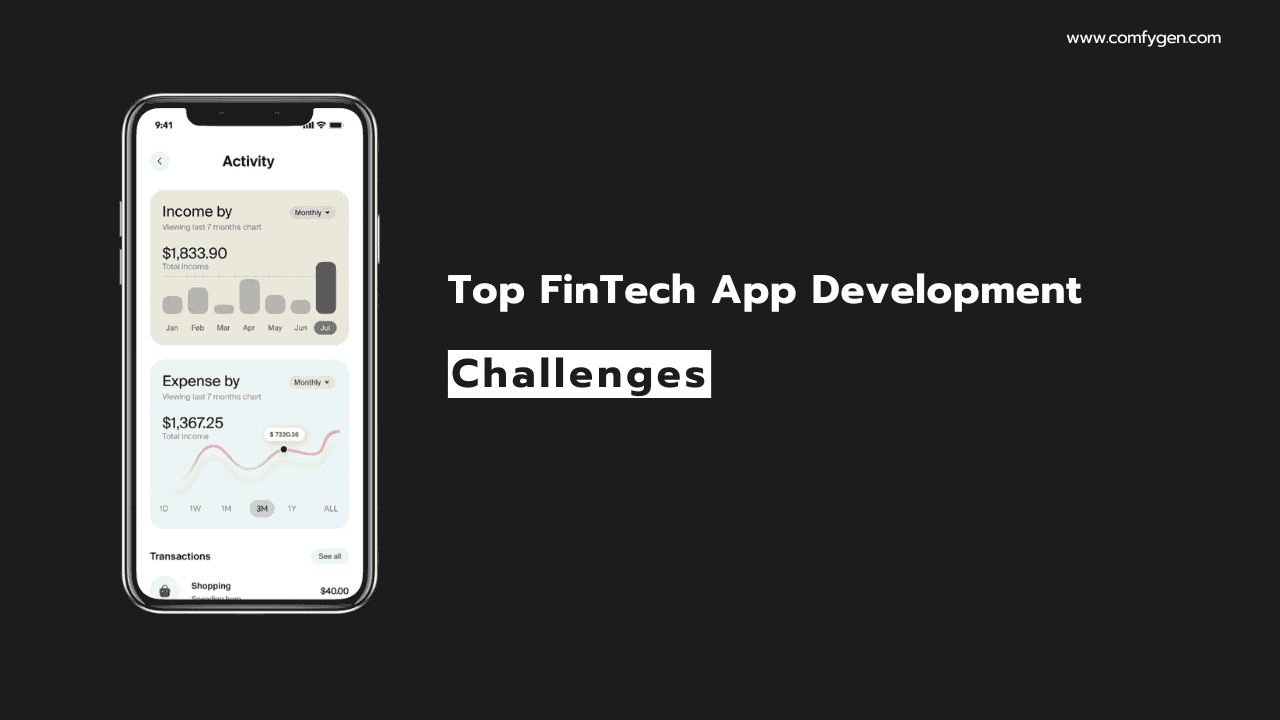
The financial technology (FinTech) industry is revolutionizing how people manage, invest, and transfer money. From digital banking and peer-to-peer payment apps to cryptocurrency wallets and robo-advisors, FinTech solutions are driving global financial inclusion. However, building a robust FinTech application is not without hurdles. Developers and businesses often encounter several FinTech app development challenges that can impact user trust, compliance, scalability, and overall performance.
In this article, we’ll explore the top challenges in FinTech app development and discuss how to overcome them effectively.
FinTech apps handle vast amounts of sensitive user data — from banking credentials to transaction histories. Developers face challenges like ensuring encryption, preventing data breaches, and maintaining compliance with privacy regulations like GDPR and PCI DSS. Hackers continuously target FinTech platforms, making data security a primary concern for users and businesses alike.
Solution:
Use advanced end-to-end encryption, multi-factor authentication, and regular security audits. Integrate AI-driven fraud detection systems and adhere to compliance frameworks. Partnering with a reliable FinTech app development company experienced in cybersecurity ensures user trust and regulatory safety.
Regulatory compliance stands as one of the most critical and complex aspects of FinTech app development. Financial applications must operate within a web of constantly evolving global and regional regulations such as KYC (Know Your Customer), AML (Anti-Money Laundering), GDPR, PSD2, and CCPA.
Each jurisdiction — whether the U.S., Europe, or Asia — enforces unique compliance frameworks, data handling rules, and licensing requirements. Failure to meet these standards can result in hefty fines, user trust loss, or permanent bans from financial markets.
Moreover, balancing innovation with regulation often slows down deployment, as developers must ensure that every feature, API, and data transaction aligns with compliance mandates.
For startups, this can also lead to higher operational costs and longer go-to-market timelines.
Solution:
To address these challenges effectively, businesses should integrate RegTech (Regulatory Technology) solutions within their FinTech app architecture.
RegTech automates compliance tasks like identity verification, transaction monitoring, and audit reporting using AI, machine learning, and blockchain-based transparency.
Collaborating with legal compliance experts and financial consultants helps ensure region-specific adherence to evolving laws. Developers can also incorporate automated KYC/AML APIs, biometric authentication, and encrypted data storage to secure user information.
Maintaining open communication with local financial authorities and conducting regular compliance audits further minimizes risks.
Partnering with a trusted FinTech app development company experienced in global financial regulations ensures that the app remains secure, compliant, and ready for cross-border scalability.
One of the toughest hurdles in FinTech app development is integrating new digital solutions with existing legacy banking systems.
Most traditional banks still rely on decades-old core systems built on COBOL or other outdated technologies. These systems lack flexibility, standardized APIs, and real-time data exchange capabilities.
As a result, connecting modern FinTech applications to these infrastructures leads to compatibility issues, delayed data processing, and limited scalability.
Additionally, maintaining synchronization between multiple data sources while ensuring security and compliance can significantly slow down innovation and time-to-market.
Solution:
To overcome these barriers, developers can implement API gateways, middleware layers, and microservices-based architectures that act as bridges between new and legacy systems.
Utilizing cloud-based integration platforms such as AWS, Azure, or Google Cloud helps ensure scalability and reliability. Adopting Open Banking standards (like PSD2) enables secure data sharing between financial institutions and FinTech apps.
Gradually modernizing the backend using containerization and service-oriented architecture (SOA) can help banks achieve real-time processing, enhance performance, and support future technological upgrades without full system replacement.
Gaining user trust is crucial in the FinTech app market where users share financial data. Any small security lapse or poor UX design can cause users to abandon your platform. Transparency in data use and transactions is key to customer retention.
Solution:
Use clear privacy policies and provide transparency in how user data is stored and processed. Offer real-time transaction tracking, instant support, and consistent communication.
As FinTech apps grow, handling high transaction volumes, API requests, and concurrent users becomes challenging. Poor scalability can lead to crashes, delays, and reduced customer satisfaction. Ensuring smooth performance across platforms is essential for growth.
Solution:
Adopt cloud-native architectures, load balancing, and database optimization techniques. Use AI-based performance monitoring tools to detect bottlenecks early. Regular scalability testing ensures the FinTech app remains stable as user demand increases.
The FinTech sector evolves rapidly with trends like AI-powered finance apps, blockchain, and open banking. Falling behind in innovation may make your product obsolete. Keeping up with emerging technologies while maintaining stability is complex.
Solution:
Invest in continuous development and technology research. Collaborate with tech partners skilled in AI, blockchain, and ML. Implement modular development approaches so your FinTech app can easily adopt new technologies without major redesigns.
FinTech apps must balance functionality with simplicity. Complicated interfaces can confuse users, especially when dealing with financial data. Accessibility and intuitive navigation are often overlooked in FinTech app design.
Solution:
Conduct user research and usability testing. Implement minimalist UI/UX principles, ensuring smooth navigation and real-time feedback. Personalization features and AI-driven UI suggestions enhance engagement and retention.
Developing a custom FinTech app requires significant investment in advanced technologies, robust security frameworks, compliance certifications, and seamless integrations with financial systems.
Budget constraints can impact app scalability, performance, and long-term maintenance. High costs often arise from implementing data encryption, multi-layer authentication, and cross-platform support.
Proper financial planning, adopting an MVP approach, and leveraging open-source tools can effectively control expenses without compromising quality or compliance standards.
Solution:
Adopt agile development methodologies and prioritize MVP (Minimum Viable Product) launches. This approach allows early testing and user feedback. Partnering with a top FinTech app development company helps optimize costs without compromising quality.
Developing a secure, scalable, and compliant FinTech app is complex yet achievable with the right approach. Overcoming these FinTech app development challenges ensures your solution is competitive, user-friendly, and future-ready. By focusing on data protection, legal compliance, and innovation, businesses can build financial apps that truly transform digital banking experiences.

© 2025 Crivva - Hosted by Airy Hosting Managed Website Hosting.