


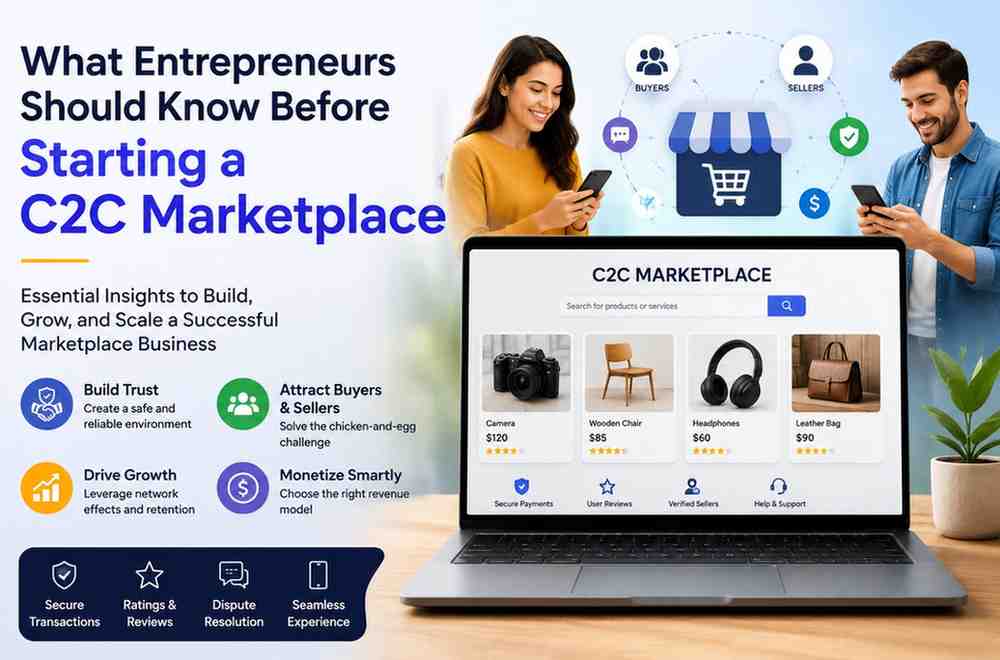
The rise of digital platforms has created new opportunities for entrepreneurs to build businesses that connect people directly with one another. From handmade products and second-hand goods to freelance services and community-driven exchanges, consumer-to-consumer marketplaces continue to reshape how people buy and sell online.
However, starting a marketplace is often more complex than many founders initially expect. Success isn’t determined solely by launching a website or attracting users. Building trust, achieving liquidity, and creating sustainable value for both buyers and sellers are equally important.
For entrepreneurs exploring this business model, understanding the realities of launching a marketplace can help reduce costly mistakes and improve long-term decision-making.
Unlike traditional ecommerce businesses, marketplaces serve two different groups: buyers and sellers.
This creates what is often referred to as the “chicken-and-egg” problem. Sellers want access to active buyers, while buyers expect a wide variety of listings and reliable sellers. Without one side of the marketplace, attracting the other becomes significantly more difficult.
Entrepreneurs should think carefully about how they plan to acquire and retain both audiences during the early stages of growth.
Questions worth considering include:
The answers to these questions often influence every aspect of marketplace development.
Trust is one of the most important foundations of any successful marketplace.
Consumers are more likely to participate when they feel confident that transactions will be secure, disputes will be addressed fairly, and information shared on the platform is reliable.
Features that support trust may include:
Successful C2C marketplaces such as eBay and Etsy demonstrate how niche focus, transparent policies, and trust-building mechanisms can contribute to long-term growth and user loyalty.
Many founders assume that launching the platform itself is the biggest challenge. In reality, ongoing marketplace management often determines whether businesses succeed or struggle.
Before investing heavily in development, entrepreneurs should understand the operational side of running a C2C marketplace, including feature planning, monetization strategies, user acquisition tactics, and long-term scalability considerations.
Thoughtful planning can help founders make more informed decisions about platform requirements while reducing friction as the business grows.
Successful marketplaces often benefit from network effects, where increased participation creates additional value for everyone involved.
According to Harvard Business Review, businesses that benefit from strong network effects can establish powerful competitive advantages over time. However, long-term success depends on more than simply attracting users. Entrepreneurs must also focus on governance, trust, and the creation of meaningful interactions that keep both buyers and sellers engaged.
Entrepreneurs should avoid assuming that scale alone guarantees success. Building healthy interactions between users often matters just as much as expanding the user base.
A marketplace without a sustainable revenue model may struggle to support future growth.
Common monetization approaches include:
Entrepreneurs should evaluate which model best aligns with their audience expectations and overall business objectives.
Choosing the right approach early can support both profitability and user satisfaction.
Every marketplace faces operational complexities.
As platforms expand, founders may encounter challenges involving:
Recognizing these realities before launch allows businesses to establish stronger processes and allocate resources more effectively.
Preparation often becomes a competitive advantage.
Today’s consumers expect digital experiences that are intuitive, efficient, and trustworthy.
Even the strongest business idea may struggle if users encounter confusing navigation, slow loading times, or complicated transaction processes.
Entrepreneurs should continuously evaluate:
Entrepreneurs looking to refine the customer journey can also explore marketplace UX best practices to better understand how navigation, onboarding, checkout experiences, and vendor interactions influence user satisfaction and long-term marketplace engagement. Insights from UX-focused resources highlight the importance of reducing friction and creating intuitive experiences for both buyers and sellers.
Starting a marketplace offers exciting opportunities for entrepreneurs willing to navigate its unique challenges. While technology plays an important role, long-term success often depends on trust, strategic planning, operational readiness, and a deep understanding of user needs.
Entrepreneurs who approach marketplace development strategically are often better positioned to overcome early challenges, create meaningful user experiences, and foster communities that generate lasting value. From defining a sustainable monetization model to prioritizing customer trust, every decision made during the early stages can influence the platform’s future trajectory.
The goal isn’t simply to launch a marketplace. It’s to build an ecosystem where people feel confident engaging, returning, and contributing over time. Businesses that focus on creating value for all participants are often the ones that transform promising ideas into thriving marketplace communities.
A C2C marketplace is an online platform that enables consumers to buy and sell products or services directly with one another. Examples include peer-to-peer selling platforms, resale marketplaces, and community-driven service exchanges.
One of the most common challenges involves attracting enough buyers and sellers simultaneously to create meaningful activity on the platform.
Many marketplaces generate revenue through transaction fees, subscriptions, featured listings, advertising opportunities, or premium services.
Trust encourages participation. Users are more likely to engage with platforms that provide secure transactions, transparent policies, and accountability mechanisms.
Yes. Many successful marketplaces begin by focusing on specific niches and gradually expanding as communities grow and engagement increases.
Common C2C marketplace features include user profiles, search functionality, secure payment systems, reviews and ratings, messaging tools, dispute resolution mechanisms, and mobile responsiveness.

© 2025 Crivva - Hosted by Airy Hosting Managed Website Hosting.