

Attachment hardware rarely receives the same attention as modules, inverters, or mounting rails.
Yet on many rooftop solar projects, attachment design becomes one of the most important decisions made before installation begins.
Contractors often face a practical question during system planning:
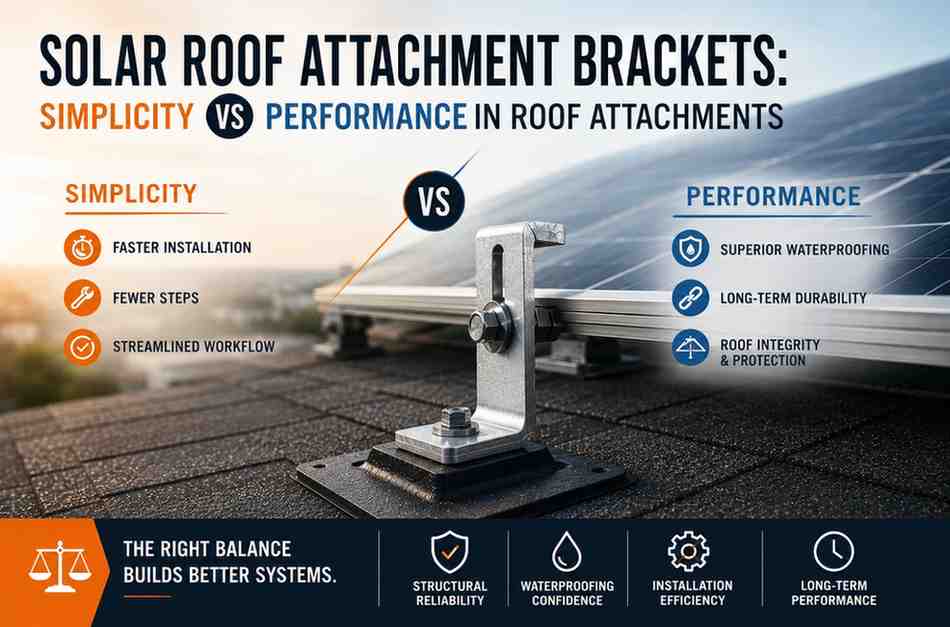
Should the attachment strategy prioritize installation simplicity, or should it prioritize long-term performance?
At first glance, the answer appears straightforward. Every project team wants an attachment system that installs quickly and performs reliably.
The challenge is that those goals don’t always carry equal weight across every project.
A residential reroofing project may prioritize waterproofing and roof integration. A production-driven installation team may place greater emphasis on installation efficiency. Long-term system owners often focus on durability and lifecycle performance.
This is why attachment design is usually evaluated through the lens of project requirements rather than product specifications alone.
Most roof attachment systems perform the same fundamental task.
They connect the solar mounting system to the building structure.
What separates one approach from another is how effectively it balances competing project priorities.
A well-designed attachment system should support:
Improving one area may influence another.
For example, a design optimized for installation speed may not always address long-term serviceability in the same way a more integrated attachment strategy might.
That doesn’t automatically make one solution better than another.
It simply means attachment systems are often evaluated based on how they align with project goals.
Experienced installers rarely compare attachment systems based on product dimensions alone.
Most evaluations focus on how the attachment performs once it becomes part of the roofing system.
Several factors typically guide the conversation.
How effectively does the attachment work with the roofing assembly?
Does the design support long-term moisture protection and flashing performance?
Can crews maintain productivity without creating unnecessary installation complexity?
Will the attachment support project-specific load requirements?
How well will the attachment perform after years of exposure to weather, maintenance, and rooftop service work?
These practical considerations often influence buying decisions more than individual hardware specifications.
Rather than comparing specific products, many contractors compare attachment philosophies.
|
Evaluation Area |
Simplicity-Focused Approach |
Performance-Focused Approach |
|
Installation Steps |
Fewer |
Moderate |
|
Initial Installation Speed |
Higher |
Moderate |
|
Waterproofing Integration |
Project Dependent |
Typically Prioritized |
|
Long-Term Durability Focus |
Moderate |
High |
|
Serviceability Considerations |
Variable |
Typically Considered |
|
Lifecycle Performance |
Moderate |
High |
The comparison highlights an important reality.
The best attachment strategy often depends on what the project values most.
A contractor focused on installation efficiency may view the tradeoffs differently than a building owner planning to operate the system for decades.
When contractors evaluate a self-flashing base mount solution, they are usually assessing more than attachment hardware.
They’re evaluating how the product contributes to the overall roofing and mounting strategy.
RT Mini II is often considered on projects where attachment planning must balance:
Rather than reviewing the product in isolation, many project teams evaluate how RT Mini II supports the broader objectives of the installation.
Questions often include:
These are often the same questions that drive attachment selection decisions in the field.
Every rooftop project presents different challenges.
Roof age varies.
Building use varies.
Maintenance expectations vary.
Future reroofing requirements vary.
This is why attachment selection is rarely based on one feature alone.
Organizations such as the National Roofing Contractors Association (NRCA) continue to emphasize the importance of roof-system integrity, proper flashing practices, and long-term weather resistance when evaluating rooftop installations.
Those same considerations frequently influence how contractors compare solar attachment systems.
For many project teams, the most effective attachment solution is not necessarily the simplest or the most complex. It is the one that best balances installation efficiency, waterproofing performance, durability, and long-term serviceability for the specific project.
Not necessarily.
A simpler attachment design can help improve installation efficiency and reduce time spent on the roof, but long-term performance depends on more than installation speed alone.
Experienced contractors typically evaluate roof attachment systems based on a combination of factors, including waterproofing reliability, structural performance, roof integration, maintenance requirements, and durability under real-world weather conditions.
In many cases, the most effective solution is neither the simplest nor the most complex design. The attachment system provides the right balance between installation efficiency and long-term rooftop performance for the specific project.
The discussion around roof attachments is rarely about hardware alone. It is about how the attachment design supports the project’s broader goals.
For contractors evaluating solar roof attachment brackets, the strongest solutions are often those that balance installation simplicity with long-term performance, helping support both efficient project execution and reliable rooftop performance over time.
Solar roof attachment brackets are components that connect solar mounting systems to the building structure while supporting load transfer and roof integration.
Different attachment designs can affect installation efficiency, waterproofing performance, maintenance accessibility, and long-term durability.
RT Mini II is commonly evaluated on projects where roof integration, waterproofing performance, and installation efficiency are important considerations.
No. Simpler installation workflows can offer advantages, but durability, waterproofing, and lifecycle performance remain important factors in evaluation.
Environmental exposure, roof conditions, waterproofing design, installation quality, and maintenance practices can all influence long-term performance.
Roof attachment systems are expected to perform for decades. Long-term durability affects maintenance requirements, roof protection, and overall system reliability.

© 2025 Crivva - Hosted by Airy Hosting Managed Website Hosting.