

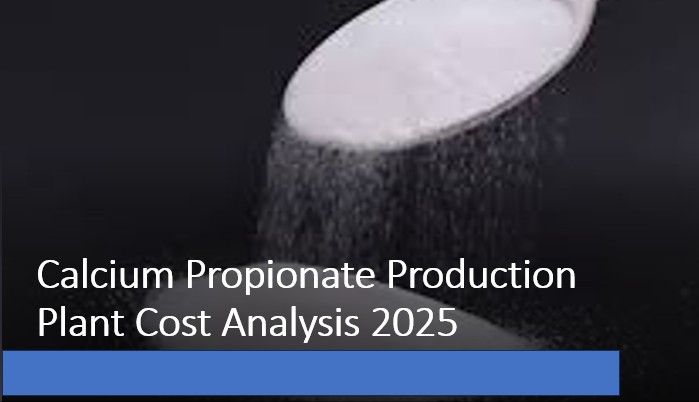
Setting up a calcium propionate production facility necessitates a detailed market analysis alongside granular insights into various operational aspects, including unit processes, raw material procurement, utility provisions, infrastructure setup, machinery and technology specifications, workforce planning, logistics, and financial considerations.
IMARC Group’s report titled “Calcium Propionate Production Cost Analysis Report 2025: Industry Trends, Plant Setup, Machinery, Raw Materials, Investment Opportunities, Cost and Revenue” offers a comprehensive guide for establishing a calcium propionate production plant, covering everything from product overview and production processes to detailed financial insights.
Request For a Sample Report: https://www.imarcgroup.com/calcium-propionate-manufacturing-plant-project-report/requestsample
What is Calcium Propionate?
Calcium propionate is the calcium salt of propionic acid, appearing as a white crystalline powder or granular substance with a slight characteristic odor. It is produced through the neutralization reaction between propionic acid and calcium hydroxide or calcium carbonate. Calcium propionate functions primarily as a food preservative and mold inhibitor, approved for use in numerous countries under food additive codes E282 (Europe) and INS 282 (Codex). The compound demonstrates excellent antimicrobial properties, particularly against mold and rope-forming bacteria, while having minimal impact on yeast activity, making it ideal for baked goods preservation. Its effectiveness increases in acidic conditions, and it is generally recognized as safe (GRAS) by regulatory authorities. Beyond food applications, calcium propionate is used in animal feed as a preservative and nutritional supplement, in pharmaceuticals as an excipient, and in various industrial applications including agricultural products and personal care formulations. The compound’s ability to extend shelf life without affecting taste, texture, or nutritional value makes it invaluable in the food industry, particularly for bread, rolls, baked goods, processed cheese, and other perishable products.
What is Driving the Calcium Propionate Market?
The calcium propionate market is being driven by the expanding global bakery industry, which represents the largest end-use segment due to increasing consumption of packaged bread, cakes, pastries, and other baked products. Growing urbanization, changing lifestyles, and rising demand for convenience foods with extended shelf life are significant growth catalysts. Additionally, heightened consumer awareness about food safety and quality, coupled with stricter regulations on food preservation, is accelerating adoption of approved preservatives like calcium propionate. The animal feed industry is emerging as a strong growth driver, as calcium propionate serves dual purposes as both a preservative and calcium supplement in livestock nutrition. Expansion of the processed food sector, particularly in emerging markets across Asia-Pacific and Latin America, is creating substantial opportunities. Increasing global trade in bakery products and the need for longer distribution chains are further boosting demand for effective preservation solutions. Technological advancements in food processing and formulation techniques are improving the efficacy and application methods of calcium propionate. Furthermore, the shift away from synthetic preservatives toward naturally derived and GRAS-certified additives, along with growing demand for clean-label products, is supporting market expansion as manufacturers seek safe and effective preservation alternatives.
Key Steps Required to Set Up a Calcium Propionate Plant
The report provides insights into the landscape of the calcium propionate industry at the global level. The report also provides a segment-wise and region-wise breakup of the global calcium propionate industry. Additionally, it also provides the price analysis of feedstocks used in the production of calcium propionate, along with the industry profit margins.
Detailed information related to the process flow and various unit operations involved in the calcium propionate production plant project is elaborated in the report.
These include:
The report provides a detailed location analysis covering insights into the plant location, selection criteria, location significance, environmental impact, and expenditure for calcium propionate production plant setup. Additionally, the report also provides information related to plant layout and factors influencing the same. Furthermore, other requirements and expenditures related to machinery, raw materials, packaging, transportation, utilities, and human resources have also been covered in the report.
Machinery and Equipment
Raw Material Costs
Utilities and Overheads
A detailed analysis of the project economics for setting up a calcium propionate production plant is illustrated in the report. This includes the analysis and detailed understanding of capital expenditure (CAPEX), operating expenditure (OPEX), income projections, taxation, depreciation, liquidity analysis, profitability analysis, payback period, NPV, uncertainty analysis, and sensitivity analysis.
Capital Expenditure (CAPEX)
Operating Expenditure (OPEX)
Revenue Projections
Taxation
Depreciation
Financial Analysis
Uncertainty Analysis
Sensitivity Analysis
Economic Analysis
The report also covers critical insights into key success and risk factors, which highlight the aspects that influence the success and potential challenges in the industry. Additionally, the report includes strategic recommendations, offering actionable advice to enhance operational efficiency, profitability, and market competitiveness. A comprehensive case study of a successful venture is also provided, showcasing best practices and real-world examples from an established business, which can serve as a valuable reference for new entrants in the market.
About Us:
IMARC is a global market research company offering comprehensive services to support businesses at every stage of growth, including market entry, competitive intelligence, procurement research, regulatory approvals, factory setup, company incorporation, and recruitment. Specializing in factory setup solutions, we provide detailed financial cost modelling to assess the feasibility and financial viability of establishing new production plants globally. Our models cover capital expenditure (CAPEX) for land acquisition, infrastructure, and equipment installation while also evaluating factory layout and design’s impact on operational efficiency, energy use, and productivity. Our holistic approach offers valuable insights into industry trends, competitor strategies, and emerging technologies, enabling businesses to optimize operations, control costs, and drive long-term growth.
Contact Us:
IMARC Group
134 N 4th St. Brooklyn, NY 11249, USA
Email: [email protected]
Tel No:(D) +91 120 433 0800
United States: (+1-201971-6302)

© 2025 Crivva - Hosted by Airy Hosting Managed Website Hosting.