

You’ve built a product people want to use, great. But if your billing setup is a mess of manual invoices, failed charges, and zero visibility into churn, you’re leaving real money on the table every single month. SaaS billing is one of those things that feels like a backend detail until it isn’t: one leaky dunning flow or the wrong pricing model can cost you a meaningful chunk of monthly recurring revenue before you even notice. So let’s break down exactly what SaaS billing is, how it works under the hood, which model fits your business, and what to look for when choosing the right tooling without the fluff.
SaaS billing is the system through which software-as-a-service companies charge their customers, typically on a recurring basis. Unlike a one-time purchase, a SaaS billing model is built around ongoing relationships: monthly or annual subscriptions, usage-based charges, seat counts, or some combination of all three.
What makes SaaS billing different from regular invoicing is the complexity underneath it. You’re not sending a PDF to a client once. You’re managing automatic renewals, proration when a customer upgrades mid-cycle, free trials that convert to paid plans, failed payment retries, and tax calculations across different regions all at scale, ideally without manual intervention.
Think of SaaS billing as the financial engine running behind your product. When it works well, it’s invisible to your customers. When it doesn’t, they notice, and they churn.
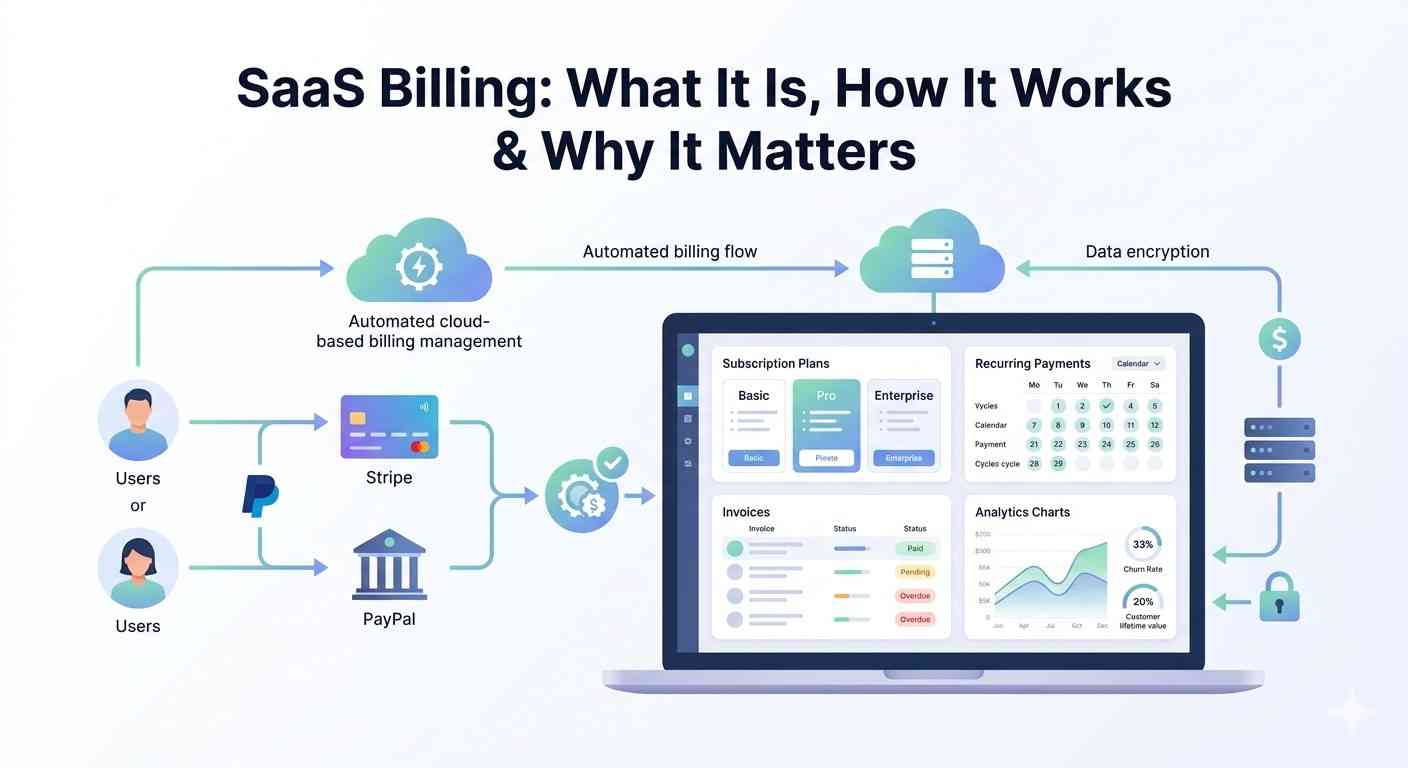
A SaaS billing system connects your product’s pricing logic to your payment processor and your customer records. Here’s how the flow typically works in practice:
You define your pricing tiers, billing intervals (monthly, quarterly, annual), and any usage metrics you want to track. This configuration sits at the top of the billing stack and drives everything downstream.
When a customer signs up, the system creates a subscription record, triggers an initial charge (or starts a trial), and schedules all future billing events. Upgrades, downgrades, pauses, and cancellations each trigger their own logic, especially proration, which calculates the credit or charge owed when a plan changes mid-cycle.
The system attempts to charge the customer’s payment method on the renewal date. If the charge fails due to an expired card, insufficient funds, or a network error, a good billing system doesn’t just give up. It follows a dunning sequence: retrying the charge at set intervals, notifying the customer, and eventually marking the subscription as past due or canceled if nothing works.
Every charge feeds into your revenue dashboards: MRR (monthly recurring revenue), ARR, churn rate, and expansion revenue. A mature SaaS billing system makes this data accessible in real time, so finance and leadership aren’t waiting until month-end to know how the business is performing.
There’s no single right answer here. The best SaaS billing model for your business depends on your product, your customer base, and how value is delivered. Here are the most widely used approaches:
Choosing a model isn’t just a pricing decision; it’s a product decision. Usage-based billing, for instance, removes the barrier to entry but requires robust metering infrastructure. Tiered pricing is simpler to operate but can frustrate customers who feel boxed in by plan limits.
This is where many early-stage companies either get lucky or waste months. The right SaaS billing software handles the complexity so your engineering team doesn’t have to build it from scratch and so your ops team isn’t manually reconciling spreadsheets every month.
Here’s what actually matters when evaluating options:
Can it handle mid-cycle plan changes with accurate proration? Can you pause subscriptions, apply coupons at the line-item level, or set custom billing dates per customer? These edge cases are rare until they’re not, and rebuilding billing logic later is painful.
Failed payments are a silent revenue killer. Good SaaS billing software includes configurable retry schedules, automated customer communications, and in-app prompts for card updates. Some platforms report recovering 10–20% of otherwise-lost MRR through smart dunning alone.
MRR movement (new, expansion, contraction, churned), cohort retention, and plan-level analytics should be first-class features, not something you cobble together in a data warehouse. If you’re asking “how is the business doing?” and the answer requires a SQL query, something’s missing.
Selling internationally? SaaS tax rules vary wildly by country and product category. Look for billing software that either handles tax calculation natively or integrates cleanly with a dedicated tax engine.
SaaS subscription billing lives at the intersection of your product, your CRM, your accounting software, and your customer support tools. A billing platform with a solid API and native integrations saves an enormous amount of duct-tape engineering down the road.
Here’s the honest version: billing is boring until it costs you. An underbuilt billing setup creates problems that compound quietly: revenue that doesn’t get collected, customers who churn because of payment friction, finance teams spending hours reconciling manually, and pricing experiments that take weeks to ship because the billing logic isn’t flexible.
The flip side is also true. Companies that invest early in solid SaaS subscription billing infrastructure tend to grow faster, not because billing is a growth lever in itself, but because it removes friction from expansion. When upgrades are seamless, when dunning works automatically, when pricing changes can be tested and shipped without an engineering sprint, those compounds too, just in your favor.
At its core, a well-designed SaaS billing model reflects how well you understand your customers’ relationship with your product. Charge them in a way that feels fair and aligned with the value they get, and you’ve built a foundation for long-term retention.
SaaS billing is far more than a payment checkbox. It’s the infrastructure that connects your pricing strategy to your revenue reality. Whether you’re just picking your first billing model or evaluating whether your current SaaS billing system can actually scale with you, the decisions you make here have a direct line to ARR, churn, and customer experience. It also plays a key role in supporting loyalty incentive programs that help retain customers and increase lifetime value. Get the fundamentals right, choose tooling that grows with you, and treat billing as a product, not an afterthought.
Traditional billing is typically one-time or project-based: you deliver something, you send an invoice, you get paid. SaaS billing is built around recurring relationships. It handles automatic renewals, mid-cycle changes, usage metering, and subscription lifecycle events like trials, pauses, and downgrades. The complexity scales with your customer base, which is why dedicated SaaS billing software exists.
Tiered pricing is the most common starting point for B2B SaaS startups because it’s easy to communicate and simple to operate. Usage-based billing can be a strong fit if your product’s value scales directly with consumption, but it requires more infrastructure. If you’re unsure, start with flat-rate or tiered pricing, ship quickly, and iterate on your model as you learn how customers actually use and value your product.
Proration is the calculation that accounts for a plan change mid-billing cycle. If a customer upgrades from a $50/month plan to a $100/month plan halfway through the month, they should be charged $25 for the remaining half on the new plan (after receiving a $25 credit for the unused portion of the old plan). Good SaaS billing systems handle this automatically, so customers pay only for what they use at each price point.
The essentials: subscription lifecycle management (creation, upgrades, downgrades, cancellations), automated dunning and recovery for failed payments, accurate prorating, revenue reporting with MRR and churn metrics, tax handling for the regions you operate in, and a solid API for integration with your product and other tools. Beyond the basics, look for flexibility in pricing configuration; you don’t want to have to run an engineering sprint every time you want to test a new pricing structure.

© 2025 Crivva - Hosted by Airy Hosting Managed Website Hosting.