

Ask a contractor what causes the most frustration during a solar installation, and you’ll probably hear a familiar answer. It’s usually not the panels. It’s everything that happens before the panels go on.
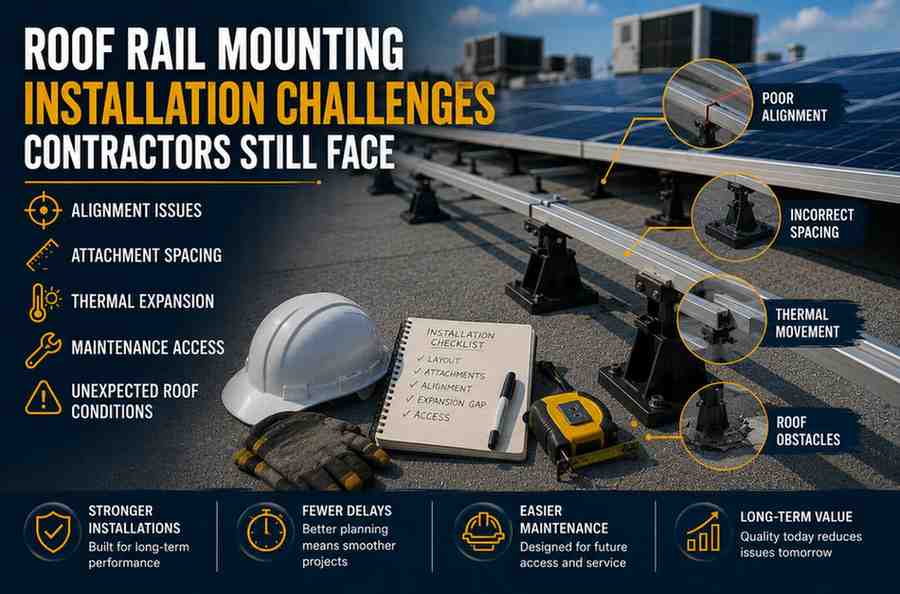
Layout adjustments. Attachment placement. Rail alignment. Unexpected roof conditions. Small details that look manageable on paper can become much bigger challenges once crews are working on an active roof.
A properly designed roof rail mounting system helps create a stable framework for the solar array, but successful installations still depend on planning, roof conditions, and field execution. Even experienced crews run into obstacles that require adjustments along the way.
This article looks at some of the most common rail-system installation challenges contractors encounter in the field, why they happen, and what lessons tend to emerge after years of working on rooftops.
This article focuses on installation realities and field observations. It does not cover structural engineering calculations or electrical design requirements.
One of the more surprising realities of solar construction is that many rail-system issues begin before a single rail is unloaded.
The problem often starts with assumptions. Assuming the roof is perfectly square.Assuming attachment locations will line up exactly as planned. Assuming every roof section is consistent from one end of the building to the other. Contractors quickly learn that real-world conditions rarely match drawings perfectly.
That’s why experienced crews spend time verifying measurements, reviewing roof conditions, and checking structural details before installation begins.
The installation may happen in a few days. The consequences of poor planning can last for decades.
Few roofs are truly uniform. Commercial rooftops often include subtle elevation changes, drainage components, equipment curbs, and previous repair areas that can affect layout planning.
What looks perfectly straight from ground level may tell a different story once installers begin laying out rail runs. One contractor described spending half a day troubleshooting what appeared to be a rail alignment issue.
The rail wasn’t the problem. A slight variation in the roof plane was creating the visual inconsistency. Situations like that happen more often than many people realize.
A small measurement error may not seem significant at first.
An attachment placed slightly off the layout. A missed reference line.A rushed adjustment to stay on schedule. Individually, these decisions may seem minor. Across multiple rows, they can compound into alignment challenges that require additional labor to correct.
What installers often discover is that the placement of attachments influences almost everything that follows.
When the foundation of the layout is accurate, the rest of the installation tends to move much more efficiently.
Metal expands. Metal contracts. Every installer knows this. Yet thermal movement continues to surprise crews working on large projects.
A contractor installing a roof rail mounting system in Phoenix may approach expansion planning very differently from a crew working in Minneapolis.
Long rail runs exposed to seasonal temperature changes exhibit different behavior over time.
Ignoring expansion requirements can create stress throughout the mounting assembly and introduce alignment issues that weren’t visible during installation. The rail isn’t failing. It’s responding to the environment.
Interestingly, many installation issues don’t show up in engineering documents.
They show up in the field.
Experienced crews often notice:
These aren’t product failures.
They’re examples of real-world construction conditions influencing installation outcomes.
The best contractors don’t eliminate every challenge. They anticipate them.
If there’s one place where installation quality becomes obvious, it’s during re-roofing work.
Contractors removing older solar arrays often get a clear view of decisions made years earlier. One roofing crew working on a commercial re-roofing project noticed something interesting.
The rail system remained structurally sound. The challenge came from access limitations created by the original layout. Routine maintenance tasks required significantly more labor because future serviceability hadn’t been considered during installation.
That experience reinforced an important lesson. Installation decisions shouldn’t only support construction. They should support maintenance as well.
A solar installation is a collection of interconnected components. Rail systems, attachments, clamps, flashing assemblies, and accessories all work together.
Rail systems, attachments, clamps, flashing assemblies, and components that support flexible rail-based solar layouts are often planned together to improve installation efficiency and simplify future maintenance. When layout decisions are coordinated early, crews typically avoid many of the adjustments that create delays later in the project.
When cable routing is addressed early, crews typically avoid many of the service challenges that appear later. Clean installations tend to stay manageable long after construction is complete.
If you’re evaluating rail systems, it’s worth considering how today’s decisions may affect maintenance access, re-roofing projects, inspections, and future upgrades.
The fastest installation isn’t always the one that delivers the best long-term outcome.
The National Roofing Contractors Association (NRCA) has consistently emphasized the importance of proper planning, installation practices, and long-term roof system performance.
Roofing professionals understand that attachment details, support structures, and installation quality often influence how roof-mounted systems perform over time.
That perspective closely matches what contractors encounter in the field. Long-term performance is usually the result of many small decisions working together rather than a single product determining success or failure.
A contractor working on a distribution center in Phoenix may prioritize thermal expansion and high rooftop temperatures.
A contractor installing a similar system in Minneapolis may spend more time evaluating snow loads, attachment spacing, and seasonal weather conditions.
The finished installation may look similar from the ground. The planning behind it often isn’t.
That’s one reason experienced installers adapt their approach to local conditions rather than relying on the same process for every project.
Most installation challenges don’t start with the rail system itself. They start with the conditions surrounding it.
A properly planned roof rail mounting system can help support alignment, maintenance access, structural performance, and long-term reliability. But even the best products depend on thoughtful planning and quality installation practices.
Before focusing solely on installation speed, it’s worth taking a closer look at the details happening underneath the modules. That’s usually where long-term success begins.
Many challenges stem from roof conditions, attachment placement, and layout accuracy rather than from the rail system itself.
Yes. Roof elevation changes, drainage features, and structural variations can all influence alignment.
Accurate attachment placement helps support alignment, load distribution, and installation efficiency.
Yes. Rail systems expand and contract with temperature changes, making expansion planning an important part of the installation process.
Absolutely. Layout, access routes, and cable management decisions can influence maintenance efficiency for years.
Removing modules and rails often exposes layout choices and serviceability limitations that aren’t visible during normal operation.

© 2025 Crivva - Hosted by Airy Hosting Managed Website Hosting.