

A colleague of mine brought back six ornaments from Jerusalem the year he turned fifty.
He had gone alone, a pilgrimage he had planned for years. He bought the ornaments on his last day, from a small workshop near the Church of the Holy Sepulchre, where a craftsman was shaping pieces on a low workbench. A cross. A fish. A dove. A star. A nativity silhouette. A menorah. He watched each one wrapped in paper by the craftsman himself.
They have been on his tree every Christmas since. He told me recently they are the first ornaments he puts up and the last he takes down. Not because they are the most visually impressive things on the tree. Because of what they are and where they came from.
When his daughter got married and started her own household, she asked if she could have one. He said no. He helped her find her own instead. That search is where he discovered how many olive wood ornament listings get the essential things wrong.
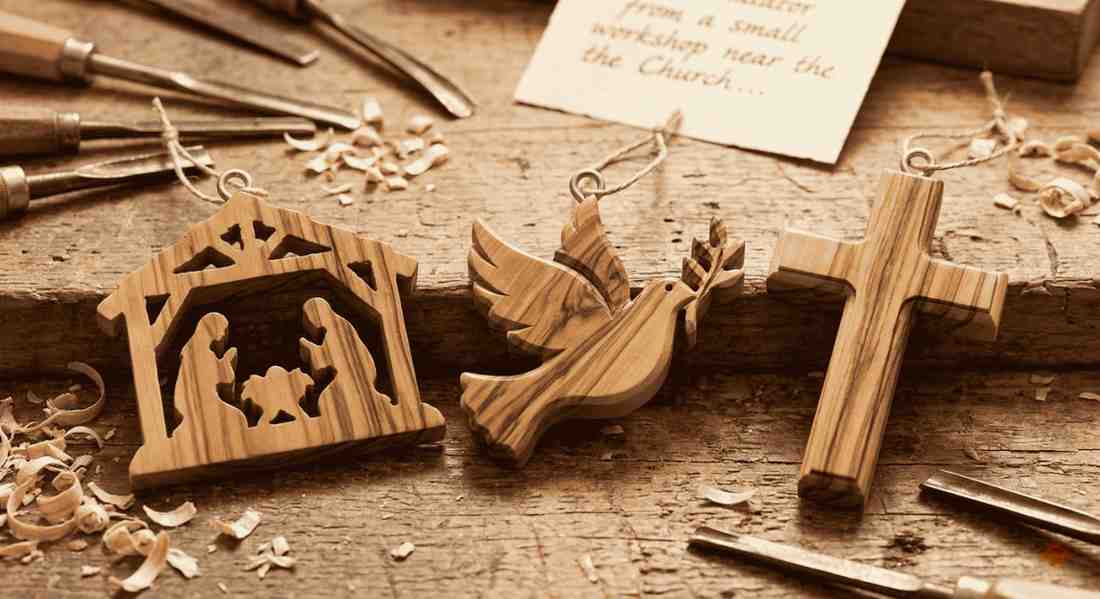
Before going into the specific problems, take a few minutes with these olive wood ornaments made by craftsmen in the Holy Land. Seeing what genuine craftsmanship looks like makes every problem below immediately recognizable in the wider market.
Olive wood ornaments that are not made from olive wood are not a niche problem. They are common.
The ornament market on general platforms is full of products described as olive wood that are made from MDF, pressed wood, or resin with a printed wood-grain surface. These materials are lighter and cheaper to produce. They also do not age the same way and do not carry the natural character of real olive wood grain.
Real olive wood has a specific density. An ornament made from it has noticeable weight for its size. The grain varies across the surface with darker streaks running through lighter sections in a pattern no printing process replicates accurately. In a product photo, the difference is not obvious. In your hands, the weight is the immediate tell. An ornament that feels too light for its size is almost certainly not solid olive wood.
Ask specifically: is this solid olive wood or a wood composite? Where was the wood sourced? A seller working with genuine Holy Land olive wood will answer directly. A vague answer about natural materials or artisan techniques without naming the specific wood is not a sufficient answer.
This is the detail that separates an olive wood ornament worth keeping for thirty years from one that looks similar the first December and disappointing every one after.
A cross or a fish or a dove cut into olive wood by a craftsman has depth. The edges of the symbol catch light differently from the surrounding surface. Running a fingertip across it, there is a physical transition. The symbol was created by removing material, not by applying color to a surface.
Many ornaments sold as carved or engraved have the symbol screen-printed or laser-etched to a minimal depth that reads as a surface marking rather than a real carving. It looks similar in a product photo. It does not look similar in hand or on a lit tree where light and shadow are part of how the ornament reads.
Look for product photos taken from an angle that shows depth of the symbol relative to the surrounding surface. A close-up shot from the side tells you more about carving depth than any front-facing product image. If the seller does not have this photo, ask for it.
This sounds like a problem that should not exist. It exists regularly.
Some olive wood ornaments arrive with a hanging loop that is too small for any standard tree branch, too fragile to survive being hung and retrieved repeatedly, or positioned so the ornament hangs at an awkward angle. Some arrive with no hanging mechanism at all despite being described as ornaments.
For a piece that comes out of a box once a year and gets hung, handled, and packed away again, the hanging mechanism needs to be solid and well-positioned. Check whether the product description mentions the hanging loop. If it does not, ask. The loop should be metal, not thin cord, centered on the top of the piece, and large enough for a standard tree hook.
Olive wood ornaments typically carry specific biblical or religious motifs: the cross, the fish, the dove, the Star of David, the menorah, the nativity silhouette, the olive branch, the pomegranate. Each has a specific history and meaning within the tradition it comes from.
According to the Jewish Virtual Library on symbols in Jewish and biblical tradition, religious symbols in the Hebrew and Christian traditions carry specific theological content that extends well beyond their visual appearance. The menorah is not simply a candelabra. The fish is not simply an aquatic animal. Each carries centuries of meaning embedded in the tradition that produced it.
A set chosen because the shapes are appealing without knowing what each represents is a missed opportunity. The olive branch carries peace and covenant meaning from Genesis through the entire biblical narrative. The pomegranate carries abundance and righteousness rooted in the agricultural symbolism of the Land of Israel. Knowing this requires reading one paragraph per symbol before choosing which ones to bring home.
An olive wood ornament from the Holy Land is a genuinely meaningful gift. Most of the time it is given without the sentence that makes it meaningful.
This is a cross carved from olive wood by a craftsman in Jerusalem. The wood comes from a tree grown in the same land where the story the cross represents actually happened.
That sentence is not decorative. It is the content of the gift. Without it, the recipient has a beautiful wooden ornament. With it, they have something that connects the object in their hands to a place and a history that gives it weight no ordinary ornament carries.
Write the note. If you are giving a single ornament, two sentences is enough. If you are giving a set, a slightly longer note about what each symbol represents and where the wood comes from is worth the three minutes it takes.
|
Problem |
What Gets Lost |
What Fixes It |
|
Wood substitute sold as olive wood |
Material authenticity and weight |
Ask specifically for solid olive wood confirmation |
|
Printed symbol instead of carved |
Depth and character on the lit tree |
Request a side-angle close-up photo of the motif |
|
Hanging loop too small or fragile |
Ornament cannot be used year after year |
Confirm loop material, size, and positioning |
|
Symbol chosen without knowing its meaning |
Decorative choice instead of intentional one |
Read what each symbol represents before choosing |
|
Gift given without context |
Beautiful object without weight or story |
Write two sentences about the wood and the place |
Those six ornaments go on the tree first every year because they mean something specific. Each one came from a craftsman’s hands in Jerusalem. Each one carries a symbol with a history longer than the tree they hang on.
Confirm the material is real olive wood. Check the carving depth before ordering. Verify the hanging mechanism is solid. Learn what the symbol represents. And if you are giving them as a gift, write the sentence that makes the gift what it actually is
Weight is the first indicator. Genuine solid olive wood has density that composite or resin materials lack. An ornament that feels surprisingly light for its size is unlikely to be solid wood. The grain also tells the story: real olive wood grain varies across the surface with natural color differences. A perfectly uniform surface with a repeating pattern is printed, not natural.
Olive wood ornaments need basic care: keep away from heat and humidity, store wrapped in soft cloth, and apply mineral oil lightly every few years. Avoid chemical cleaners.
Common symbols on Holy Land olive wood ornaments include the cross, fish, dove, Star of David, menorah, nativity silhouette, olive branch, and pomegranate, each carrying significant religious meanings
Yes, when the motifs are appropriate. Ornaments with the Star of David, menorah, olive branch, or pomegranate are meaningful for Jewish households and can be displayed year-round rather than specifically at Christmas. A set of olive wood ornaments with these motifs makes a meaningful Hanukkah or housewarming gift for a Jewish family.
Absolutely. Olive wood pieces with hanging loops work on a wall, from a window latch, on a decorative branch arrangement, or hanging in a kitchen or prayer room. Many people keep their olive wood ornaments out year-round in a dedicated display rather than limiting them to December.
Yes, a single ornament becomes meaningful when accompanied by the story of its origin and symbolism, making it more impactful than a generic set

© 2025 Crivva - Hosted by Airy Hosting Managed Website Hosting.