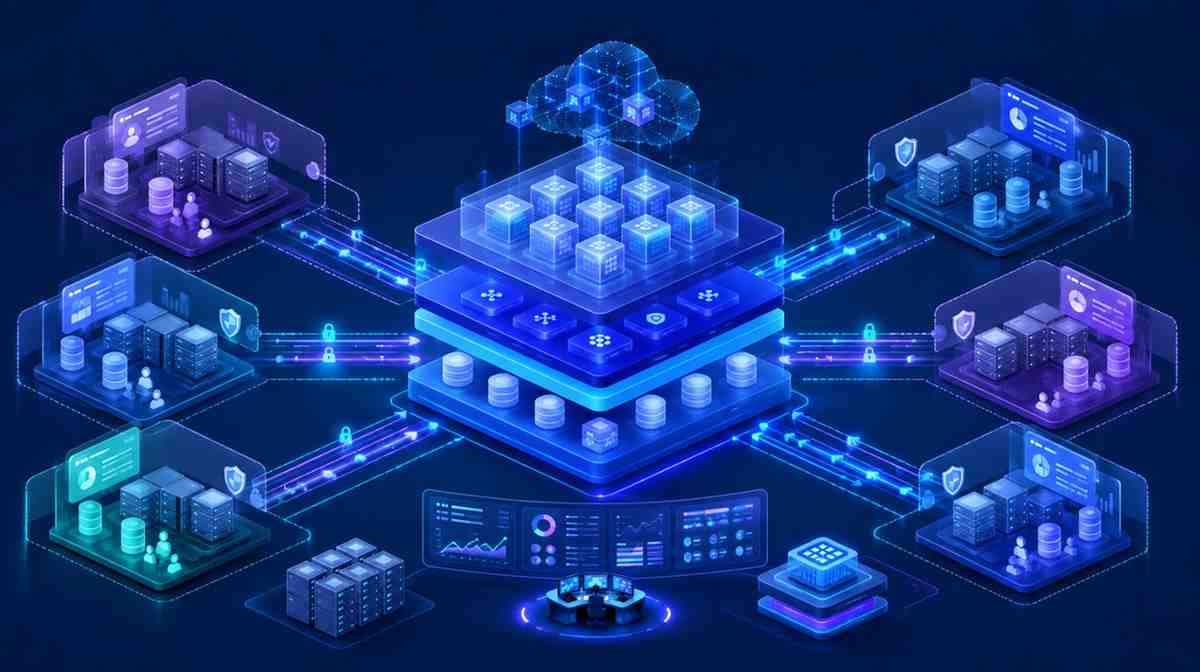
Here’s a scenario that keeps engineering leaders awake: your SaaS product just gained three enterprise clients, each with thousands of users, varied compliance needs, and strict data leak policies. Your old monolithic, single-tenant system is now struggling. How can you scale without starting over? More urgently, how do you keep one tenant’s data separate? A multi-tenant backend architecture addresses this challenge. It’s a strategic choice shaping your platform’s growth from 50 to 50,000 customers without high infrastructure costs. This article discusses models, trade-offs, security, and best practices.
A Multi-Tenant SaaS application is a software system in which a single deployed instance serves multiple customers, known as tenants, simultaneously. Each tenant sees the application as their own, complete with their own data, settings, and often custom branding. However, the underlying compute, codebase, and infrastructure are shared.
This core principle drives successful SaaS products like Salesforce, Workday, and ServiceNow. Multi-tenancy shares infrastructure costs, lowering expenses for web teams without reducing capabilities. However, it raises engineering challenges: maintaining tenant separation to prevent performance issues and onboarding new clients without redeployment.
This is where architectural choices become crucial. The isolation model you select affects your cost structure, security, compliance readiness, and operational complexity. There is no one correct answer; only trade-offs.
Every tenant’s data resides in the same tables, differentiated only by a tenant_id column. This model is the most resource-efficient and operationally simple. Creating a new tenant is a metadata operation; no schema migrations or new database setups are required.
The risk lies in concentration. A missing WHERE tenant_id =? A clause in any query can lead to a data breach. Row-level security (RLS), enforced at the database level (PostgreSQL’s RLS policies are very good), significantly reduces this risk, but it requires a strict code-review culture and automated query audits. For any backend development company that builds products sensitive to compliance, this model requires additional controls, such as audit logging, encryption at rest per tenant, and thorough penetration testing.
Each tenant receives its own schema (or namespace) within a shared database instance. Tables are isolated at the schema level, which greatly lowers the risk of cross-tenant data leaks while still sharing the database engine’s resources.
This model strikes a good balance between isolation and efficiency for mid-market SaaS products. Schema-level migrations become more complicated as you scale; running ALTER TABLE across 500 schemas is not easy. However, tools like Flyway or Liquibase with multi-tenant migration runners make this manageable. Connection pooling tools like PgBouncer are usually necessary to prevent exhausting database connections as the tenant count increases.
This is the highest-isolation and highest-cost option. Every tenant gets its own dedicated database instance or even a dedicated cluster for large enterprise accounts. This architecture is ideal when tenants have strict regulatory requirements, such as HIPAA BAAs, data residency rules, or contracts that demand dedicated infrastructure.
Operationally, this model needs advanced automation. Setting up a new tenant means launching a database, running migrations, configuring backups, and configuring monitoring—ideally in under five minutes using infrastructure-as-code tools like Terraform or Pulumi. The advantage is that performance isolation is complete, and compliance documentation becomes easier.
No matter which isolation model you choose, the application layer must reliably resolve tenant context for every request. This is usually done through one of three methods:
The main engineering practice here is to ensure that tenant context flows correctly through every layer: API gateway, application service, data access layer, cache, and background job queues. Teams that want to boost efficiency in web development invest early in standardized middleware that manages this flow automatically.
This approach avoids patching layer by layer. Background jobs often lose tenant context when queued, causing errors or unauthorized data access. Tools like AsyncLocalStorage in Node.js or ThreadLocal in Java help pass tenant context efficiently without cluttering function signatures.
Shared infrastructure poses a risk. One tenant’s heavy workload can reduce the experience for everyone else. In a Multi-Tenant SaaS application serving enterprises, this issue is critical. A service level agreement (SLA) breach for one customer should not affect others.
Common strategies to address this include:
For tasks that require significant computing power, such as report generation, data exports, or machine learning inference, having per-tenant job queues with adjustable concurrency limits (using tools like Sidekiq, BullMQ, or Celery) enables precise control without overloading resources.
Enterprise procurement teams will closely examine your security architecture. Beyond isolating tenant data, a production-grade multi-tenant backend requires:
Compliance certifications such as SOC 2 Type II and ISO 27001 are often mandatory in enterprise contracts, not just nice-to-haves. Planning for these from the beginning is much easier than trying to add them later.
Multi-tenant backend architecture is a crucial decision in SaaS, enabling efficient service to thousands of customers if well-implemented, or leading to debt if poorly managed. The appropriate isolation model depends on customer needs, compliance, and maturity. Core disciplines include tenant-context propagation, performance isolation, security-focused data access, and automation, forming the basis of enterprise trust.
Single-tenant offers each customer a dedicated instance, while multi-tenant serves all from one shared instance with data separation. Multi-tenancy scales better and is more cost-effective, but single-tenancy provides better isolation for regulated use cases.
There are three methods: shared schema with tenant ID columns and row-level security, separate schemas for each tenant, or separate databases for each tenant. The right choice depends on your compliance needs, customer volume, and operational capacity.
Shared-schema migrations run normally but must be backward-compatible. Schema- or database-per-tenant models use tools like Flyway or Liquibase to make changes across tenants sequentially or in parallel, with rollback support.
This occurs when heavy resource usage by one tenant reduces performance for others. Address it with per-tenant rate limiting, query timeouts, tiered job queues, and directing analytical queries to read replicas.
Yes, when built correctly with tenant-specific encryption keys, audit logging, row- or schema-level isolation, zero-trust networking, and regular penetration testing, HIPAA, SOC 2, and government-grade SaaS platforms often operate on multi-tenant backends.

© 2025 Crivva - Hosted by Airy Hosting Managed Website Hosting.