You hired one assistant, and things got done. Now imagine hiring a whole team of specialists who never sleep, never argue over resources, and communicate in milliseconds. That is exactly what businesses are starting to experience with coordinated AI agent architectures.
If you have been wondering why some companies are scaling operations faster, cutting down manual workload dramatically, and handling complex decisions with less human intervention, this is the story behind it. AI is no longer just one tool sitting quietly in the background. It has evolved into something far more dynamic.
An AI agent is not just a chatbot or an automation rule. It is a system capable of perceiving its environment, making decisions, and taking action toward a specific goal.
Think of a single AI agent as a capable employee with a defined role. A customer support agent, a data analysis agent, a scheduling agent. Each one knows what it needs to do and does it well.
But a single agent has limits. It can only do so much, handle one task at a time, and lacks the broader context that comes from working across departments. This is where things get interesting.
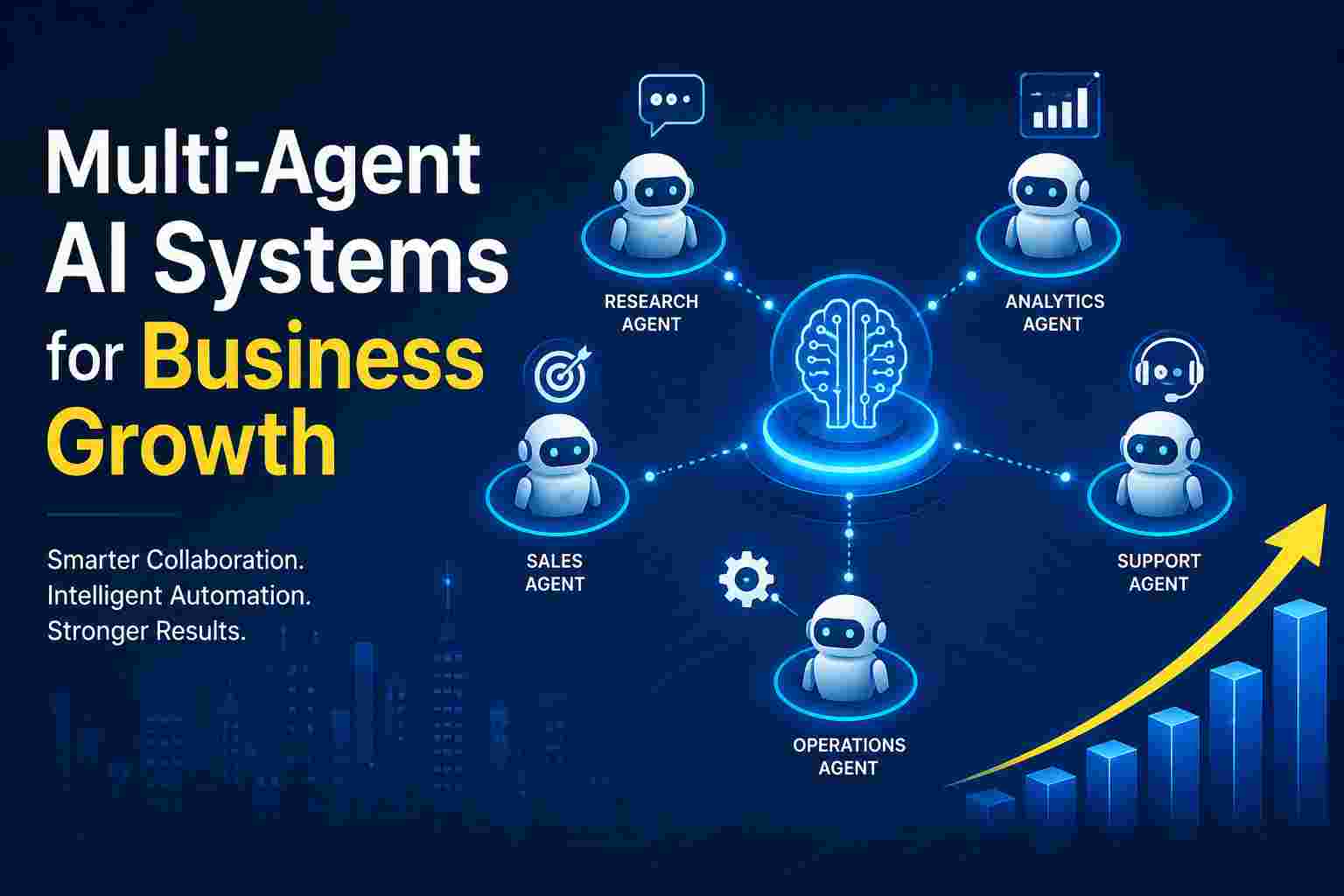
Here is where the real shift happens. When multiple AI agents are connected in a shared system, each handling a specific job while passing information and results to the next, the output is something no single tool could ever achieve alone.
This is the core idea behind multi-agent AI systems. Instead of one AI trying to juggle everything, you have specialized agents working in parallel, each focused on what it does best, and a coordination layer that ties it all together.
It is similar to how a well-run business department works. The analyst gathers data, hands it to the strategist, who feeds insights to the operations team, who act on it in real time. Except here, it all happens in seconds, without meetings or miscommunication.
The shift toward agent-based AI is not just a trend. It is being driven by very real business pressures.
Modern businesses run dozens of workflows simultaneously. Lead qualification, customer onboarding, inventory forecasting, compliance checks, and content production all demand attention at the same time. No single AI model or automation tool can keep up with the full complexity of that kind of environment.
Agent-based systems break that problem into manageable, specialized tasks and handle them in parallel.
When AI agents coordinate, decisions that used to take days can happen in hours or even minutes. A customer inquiry triggers a support agent. That agent checks order history through a data agent. The result gets escalated through a priority agent if needed. The customer gets a resolution fast. That is the kind of speed that builds loyalty and sets companies apart.
Hiring more people to scale operations is expensive. Adding another agent to a system is not. Businesses can extend the capacity of their AI infrastructure without the delays and overhead that come with growing a human team.
This is not theoretical. Businesses across industries are already applying these concepts to solve real problems.
Agents handle lead scoring, send personalized follow-up messages, update the CRM, and alert the sales team only when a prospect is genuinely warm. Sales reps spend their time closing, not chasing.
A front-facing conversational agent handles the initial query. If it cannot resolve the issue, it hands off to a specialist agent with relevant context already loaded. The customer never has to repeat themselves.
One agent monitors transactions for anomalies. Another cross-references regulatory requirements. A third generates audit-ready reports. What used to require a team of analysts can now happen continuously, around the clock.
Research agents pull together data and trends. Writing agents draft content. Review agents check for tone, accuracy, and SEO alignment. The result is a production pipeline that keeps marketing moving at a pace human teams struggle to match alone.
One question that comes up often is: who is in charge?
In most agent systems, there is either an orchestrator agent that directs the others, or a shared protocol that allows agents to communicate peer-to-peer. Some systems blend both approaches depending on the complexity of the task.
The key principles that make coordination work are:
Clear role definitions. Each agent has a defined scope. It does not try to do everything.
Shared memory or context. Agents pass information efficiently so nothing is duplicated and nothing is lost between handoffs.
Feedback loops. Agents check the results of their actions and adjust. This is what separates smart coordination from simple automation.
Error handling. If one agent fails or encounters an unexpected situation, the system does not collapse. It reroutes.
You do not need to understand the technical architecture to see the business case. The question worth asking is straightforward: what are your team’s biggest bottlenecks right now?
Wherever the answer involves repetitive coordination, manual handoffs between departments, slow response times, or inconsistent quality across high-volume tasks, an agent-based approach is worth exploring.
The companies moving quickly in this space are not necessarily the largest ones. They are the ones willing to rethink how work gets done and open to building operational infrastructure that compounds over time.
A common misconception is that adopting this kind of AI approach requires a massive overhaul of existing systems. That is rarely the case.
Most businesses start with one workflow. They identify a specific process that is slow, expensive, or prone to error. They build or deploy an agent-based solution for that one problem. They learn from it. Then they expand.
The value of starting focused is that it gives your team time to understand how agents behave in your specific environment before scaling. Crawl, then run.
We are at a point where AI is moving from being a productivity tool to being a genuine operational layer in business. The organizations that figure out how to coordinate agents effectively are building a form of infrastructure that grows smarter and more capable over time.
It is not about replacing people. It is about freeing your people to work on the problems that actually require human judgment, creativity, and relationships while agents handle the volume, the coordination, and the consistency.
The businesses that will look back on this period as a turning point are not the ones who waited for the technology to be perfect. They are the ones who started experimenting while it was still early, learned fast, and built the operational muscle to keep going.
If your growth is being held back by operational complexity, this might be exactly the conversation worth starting.

© 2025 Crivva - Hosted by Airy Hosting Managed Website Hosting.