


The subscription software industry has fundamentally changed how businesses acquire customers, moving away from expensive traditional advertising toward performance-driven growth strategies that reward actual results rather than promised reach. Among these modern acquisition channels, referral and affiliate partnerships stand out as particularly effective mechanisms that transform satisfied users, industry influencers, and complementary businesses into active revenue generators. This shift reflects broader changes in how consumers discover and evaluate software solutions—trusting peer recommendations and expert endorsements far more than corporate marketing messages.
For SaaS founders navigating increasingly competitive markets where customer acquisition costs continue rising across paid channels, building effective referral ecosystems represents not just an opportunity but a strategic necessity. When properly structured and managed, these programs create self-reinforcing growth loops where every new customer becomes a potential advocate, every partner relationship opens doors to new audiences, and marketing budgets stretch further while delivering better-qualified leads than most alternative channels.
Traditional product companies face fundamental constraints when designing affiliate compensation because single transactions limit how much they can reasonably pay while maintaining profitability. Software subscriptions operate under completely different economics that enable far more generous partner rewards while still achieving attractive unit economics and long-term profitability.
Consider a typical SaaS product priced at sixty dollars monthly with seventy percent gross margins. Each subscription generates forty-two dollars in monthly profit. Offering a thirty-five percent recurring commission costs twenty-one dollars monthly but still yields twenty-one dollars in profit from the first month forward. Over an eighteen-month average customer lifetime, that single referral generates seven hundred fifty-six dollars in total profit while compensating the affiliate three hundred seventy-eight dollars—creating a highly profitable customer acquisition channel with favorable lifetime economics.
Successful referral programs attract and engage diverse partner types, each contributing unique value through different promotional channels and audience access. Understanding these partner categories helps companies recruit strategically and provide appropriate support for different relationship types.
Your existing user base represents the most accessible and often highest-converting source of potential affiliates. Customers who already love your product understand its value proposition, can speak authentically about their experiences, and often interact with others facing similar problems your software solves.
The key to customer affiliate conversion lies in removing friction from the signup and promotion process. Many satisfied users would happily recommend your product but never take action because the process seems complicated or they’re unsure how to discuss it effectively. Providing dead-simple enrollment, pre-written promotional copy they can customize, and clear guidance on sharing approaches dramatically increases participation rates.
Commission structure represents one of your most important strategic decisions when launching referral programs. Set rates too conservatively and you’ll struggle attracting partners who have numerous alternatives. Price too aggressively and you’ll undermine your own economics or create unsustainable expectations that cause problems later.
Industry research across hundreds of SaaS affiliate programs reveals that most successful initiatives offer between twenty-five and forty percent recurring commissions, with the specific rate reflecting factors including pricing tier, market maturity, competitive intensity, and target customer lifetime value. Premium-priced enterprise tools often offer lower percentage rates but substantially higher absolute commission amounts, while consumer-focused products with lower price points typically offer higher percentages to generate meaningful affiliate income.
Beyond base commission rates, consider implementing tiered structures that reward exceptional performance. Partners consistently driving significant referral volume might unlock thirty-five percent commissions after their first ten conversions, then forty percent after fifty conversions. These performance escalators motivate dedicated promotional effort while ensuring that premium rates go to partners delivering meaningful results.
Limited-time incentive campaigns can accelerate activity during product launches, seasonal promotions, or slow periods. Offering double commissions for the first three months on all new referrals or bonus payments for hitting specific volume thresholds creates urgency and focus that drives increased promotional activity from your partner base.
Behind every successful referral program operates sophisticated technical infrastructure that tracks clicks, attributes conversions accurately, calculates commissions across complex scenarios, and integrates seamlessly with your existing billing and payment systems. Getting these technical foundations right proves critical for both operational efficiency and partner trust.
Reliable tracking must follow users from initial referral link clicks through potentially days or weeks of consideration before they finally sign up for trials or paid subscriptions. Cookie-based tracking traditionally handled this attribution, though modern privacy regulations and browser restrictions require more sophisticated approaches using first-party tracking, server-side attribution, or hybrid methodologies that maintain accuracy while respecting user privacy.
For recurring commission programs, your affiliate system must integrate deeply with subscription billing platforms like Stripe, Paddle, or Lemon Squeezy to track not just initial conversions but ongoing subscription status, upgrades, downgrades, and cancellations. These integrations ensure commission calculations remain accurate as customer relationships evolve over time.
Webhooks from billing platforms notify your affiliate system of relevant subscription events in real-time, triggering appropriate commission adjustments. When customers upgrade from basic to premium plans, affiliates should automatically receive higher commissions reflecting increased revenue. Conversely, cancellations must stop commission payments to maintain accurate financial tracking.
Building these integrations from scratch requires substantial development resources and ongoing maintenance as billing platforms update their APIs. Modern referral platforms handle these complexities through pre-built integrations maintained by specialized teams, allowing software companies to launch sophisticated tracking without custom development.
Technical capability matters little if affiliates find your program difficult to access or frustrating to use. User experience dramatically influences both initial signup rates and ongoing promotional activity, with friction at any point in the affiliate journey reducing program effectiveness.
Traditional affiliate platforms require partners to create separate accounts on external websites, remember new login credentials, and navigate unfamiliar dashboards completely disconnected from your product. This fragmentation creates multiple abandonment points where interested affiliates never complete signup or activated partners gradually drift away due to access hassles.
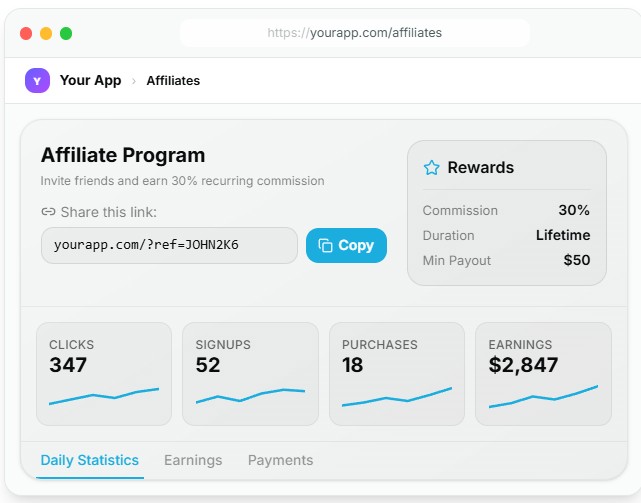
Embedding affiliate functionality directly within your product eliminates the friction created by external platforms while delivering substantially better user experiences. Existing customers who become affiliates access their dashboards and promotional tools through your familiar interface without separate logins or authentication flows. This seamless integration dramatically increases both signup conversion and long-term engagement.
Implementation simplicity matters as much as end-user experience. Platforms like Refgrow enable embedded affiliate programs through single lines of code, eliminating weeks of custom development while delivering professional functionality. This accessibility means even bootstrapped startups can launch sophisticated referral programs without technical teams or substantial budgets.
Infrastructure alone doesn’t create successful programs—you need active affiliates actually promoting your product. Strategic recruitment determines whether programs languish with minimal participation or generate meaningful revenue from engaged partner networks.
Begin recruitment by identifying individuals and organizations already discussing problems your software solves or recommending competing products. These prospects demonstrate relevant audience access and topical authority, making them ideal partnership candidates. Personalized outreach explaining specifically why partnership makes sense for their audience converts far better than generic recruitment templates.
Rather than manually hunting for individual partners, consider affiliate networks and directories where experienced promoters actively seek new programs. These marketplaces connect software companies with affiliates who have proven track records promoting similar products and audiences predisposed to subscription software.
Quality networks curate their affiliate communities, ensuring participants meet minimum quality standards and have demonstrated ability to drive actual conversions rather than just generating clicks. This pre-vetting saves substantial time compared to evaluating individual applicants while reducing fraud risk from low-quality partners seeking quick payouts.
Recruited affiliates need more than commissions and tracking links to succeed. Comprehensive enablement programs that educate partners about your product, provide proven promotional materials, and maintain ongoing communication dramatically improve results compared to hands-off approaches that leave partners struggling to create effective promotions.
Develop detailed swipe files containing pre-written content affiliates can customize and deploy across various channels. Include social media posts for different platforms, email sequences for list-based promotion, blog post outlines addressing common use cases, and video script frameworks for content creators. These resources reduce the work required to start promoting while ensuring messaging accuracy.
Reliable, timely compensation builds trust and keeps affiliates motivated while delayed or inaccurate payments damage relationships and reduce promotional activity. As programs scale beyond handfuls of partners, manual payment processing becomes unsustainable, requiring automated systems that handle commission calculations, payout scheduling, and financial record-keeping.
Most successful SaaS referral programs operate on monthly payment cycles where affiliates receive commissions for the previous month’s earnings above minimum thresholds designed to reduce transaction costs. Thresholds typically range from fifty to one hundred dollars, balancing affiliate preference for frequent payments against practical payment processing economics.
Software companies serving international markets must accommodate affiliates across numerous countries with varying payment preferences and regulatory requirements. Supporting multiple payout methods including PayPal, Wise, bank transfers, and regional processors ensures all partners can receive commissions through convenient channels.
Tax compliance grows complex with international partners subject to different reporting requirements and withholding obligations. Automated systems that generate appropriate documentation, handle VAT calculations for European partners, and produce necessary tax forms reduce compliance risks while simplifying operations.
Successful programs evolve as businesses grow, requiring periodic adjustments to compensation structures, recruitment strategies, partner support models, and operational systems. What suffices for early-stage companies with dozens of affiliates differs substantially from requirements of mature programs managing hundreds or thousands of active partners.
Automation becomes essential at scale for maintaining operational efficiency without proportionally expanding team size. Systems handling routine partner communications, performance notifications, commission calculations, payout processing, and basic support inquiries free teams to focus on strategic initiatives like elite partner management and program optimization rather than administrative tasks.
The technology powering your referral program significantly impacts both operational burden and partner experience. Legacy platforms often charge premium prices, impose transaction fees eating into margins, or limit revenue thresholds restricting growth. These solutions frequently require extensive setup time and technical expertise to implement properly.
Modern alternatives address these limitations through simplified implementation, transparent pricing without hidden fees, and embedded experiences that integrate directly into your product. Solutions like Refgrow exemplify this new generation of affiliate platforms, offering comprehensive functionality at accessible price points starting around thirty dollars monthly with zero transaction fees or revenue caps.
When comparing platforms, assess capabilities across tracking accuracy, payment processor integrations, commission flexibility, customization options, reporting depth, automation features, and user experience quality. Not all platforms offer equivalent functionality despite similar marketing claims.
Integration breadth matters particularly for companies using less common billing providers or requiring connections with multiple payment processors. Platforms with pre-built integrations for your existing stack save substantial development work compared to those requiring custom implementations.
Affiliate programs represent marketing investments requiring proper ROI evaluation to justify continued resource allocation. While tracking basic metrics like referred signups provides some visibility, comprehensive assessment demands examining full customer economics including lifetime value, retention rates, and true acquisition costs after all commission expenses.
Calculate blended customer acquisition cost for affiliate channels by dividing total commission payments plus program operational costs by the number of acquired customers. Compare this figure against CAC from paid advertising, content marketing, and other channels to understand relative efficiency.
As privacy regulations tighten, third-party tracking capabilities diminish, and consumer expectations around transparency increase, referral programs must adapt to remain effective and compliant. First-party data strategies, server-side tracking implementations, and transparent disclosure practices position programs to thrive despite evolving technical and regulatory landscapes.
Invest in building direct relationships with your best affiliates rather than relying entirely on platforms or networks. These direct partnerships weather industry changes better than arms-length relationships mediated entirely through technology platforms that may change policies or pricing unexpectedly.
Well-executed referral programs create compounding growth advantages that strengthen over time as partner networks expand, top performers optimize their promotional approaches, and word-of-mouth effects amplify results beyond direct affiliate contributions. This makes them among the most valuable acquisition channels for SaaS companies willing to invest in proper setup and ongoing management.

© 2025 Crivva - Hosted by Airy Hosting Managed Website Hosting.