


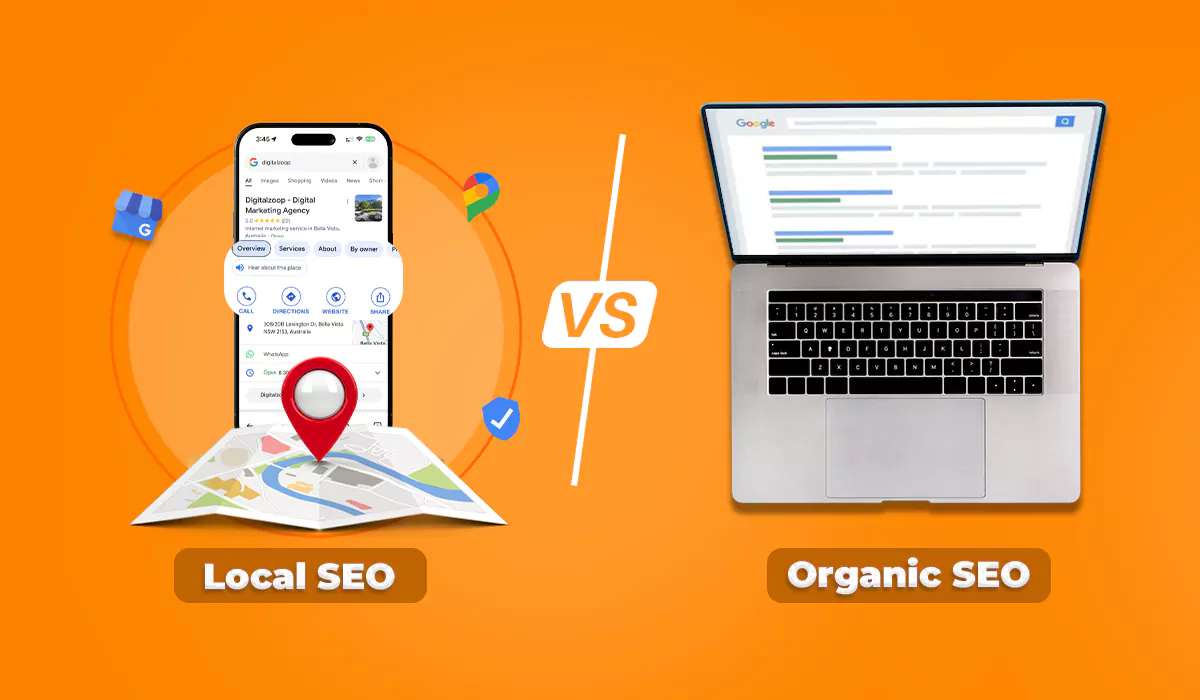
If you’re trying to grow search traffic, leads, and enquiries in Australia, the “local vs organic SEO” question comes up fast. They sit under the same SEO umbrella, but they appear in different parts of Google and are driven by different ranking factors. Most businesses do best when they treat them as two tracks in one SEO strategy: local SEO to win nearby demand and maps visibility, and organic SEO to build authority and capture broader searches over time.
Organic SEO is the process of improving your website so it ranks in Google’s unpaid results for relevant searches, without relying on ads. It focuses on content relevance, technical performance, internal linking, and building authority so Google trusts your pages. Organic SEO is often called natural search engine optimisation because it earns visibility through quality and usefulness. It helps you rank for informational, commercial, and comparison keywords across Australia and beyond.
Organic SEO works by helping Google crawl, understand, and rank your pages for the intent behind a search query. You improve rankings by matching search intent, using clear headings, providing genuinely helpful answers, and strengthening site architecture with internal links. Google also evaluates authority signals, such as high-quality backlinks and topical completeness. The goal is to become the best available result for a topic, not just repeat keywords.
The biggest benefit of organic SEO is compounding growth: your pages can keep driving traffic and leads long after they are published. Organic SEO builds trust because many users prefer earned rankings over ads, especially for research-heavy decisions. It also lowers customer acquisition costs over time by reducing reliance on paid clicks. For Australian businesses, organic SEO is a strong, long-term channel for building authority, driving brand discovery, and generating consistent enquiries.
Local SEO helps your business show up for location-based searches, especially in Google Maps and the local map pack. It focuses on your Google Business Profile, consistent business details across the web, local reviews, and location-relevant landing pages. Local SEO is designed for service-area and shopfront businesses that rely on nearby customers. It improves local organic rankings for searches like “near me” and “in [suburb]”.
Local SEO works by signalling relevance, distance, and prominence in local search results. Google looks at your business category, services, proximity to the searcher, review quality and volume, and how consistently your business information appears across the web. A strong Google Business Profile, genuine reviews, accurate NAP details (name, address, phone), and local landing pages improve visibility. Local SEO is often faster to influence than national organic SEO because competition is geographically limited.
The real difference is where you rank and what you’re optimising for. Organic SEO targets the standard unpaid listings across broader searches, while local SEO targets map-driven results and location intent. Organic SEO leans on content depth, site structure, and authority signals. Local SEO leans on Google Business Profile strength, local relevance, proximity, reviews, and business citations. Most Australian businesses need both because customers often research broadly before choosing locally.
Local SEO delivers high-intent leads because it targets people who are ready to act, such as by calling, requesting a quote, or visiting a location. It also builds trust through reviews and visible business information, which can lift conversion rates even when you are not the cheapest option. Local visibility can reduce dependence on paid ads for urgent searches. For service businesses, local SEO often becomes the strongest driver of qualified enquiries.
The right approach depends on how you sell and where you deliver. If you serve customers face-to-face in a region, local SEO should be a priority because maps and “near me” searches drive enquiries. If you sell online across Australia or compete in national categories, organic SEO should lead because you need topic authority and a broader reach. Many businesses sit in the middle and should run both to capture discovery and conversion searches.
To optimise for organic searches, start with pages that match real intent and make the topic easy for Google to understand. Use a clear title, a descriptive H1, and scannable H2 sections that answer sub-questions directly. Build internal links from related articles to key service pages, and improve page load speed and the mobile experience so users stay and convert. Avoid thin pages, keyword stuffing, and duplicated location variants.
Local SEO starts with a complete Google Business Profile and continues with strong on-site signals that prove you serve the area. Choose the right primary category, add services, keep hours accurate, and upload real photos regularly. On your website, create local landing pages that are genuinely useful, not thin suburb swaps. Back it up with consistent NAP details across directories and encourage steady, authentic customer reviews.
Use local SEO when your growth depends on nearby customers, and you want visibility in Maps, the map pack, and “near me” searches. Use organic SEO when you need to rank for broader topics, comparison searches, and non-location keywords that drive discovery across Australia. Many businesses switch between the two depending on the funnel stage: organic for early research, local for the final shortlist. A smart SEO strategy aligns with customer intent.
Use both when customers research first and then buy locally, which is common for clinics, trades, professional services, and home improvement. Organic SEO builds authority by answering broader questions and ranking for non-location topics. Local SEO then captures high-intent searches when people are ready to act and want a nearby provider. Running both also protects you against volatility, because visibility is spread across multiple SERP areas rather than just one ranking type.
Combining local and organic SEO improves coverage across the entire customer journey. Organic content captures awareness and research queries, while local optimisation captures action-based searches when customers compare nearby providers. Together, they also strengthen each other: better content increases trust and brand searches, while local prominence improves credibility signals through reviews and citations. The result is stronger local organic rankings, more qualified traffic, and a steadier lead pipeline with less reliance on paid ads.
Learn more: https://www.digitalzoop.com.au/local-vs-organic-seo-differences/

© 2025 Crivva - Hosted by Airy Hosting Managed Website Hosting.