

A warehouse owner in Texas recently approved a rooftop solar project that checked all the expected boxes. The energy production looked promising, the payback period was reasonable, and the installation schedule aligned with the company’s goals.
Then a different conversation started.
The building’s roof was already more than a decade old.
Would the roof still be in good condition halfway through the life of the solar system? If repairs became necessary, would the mounting system make that process easier or more complicated?
Questions like these are becoming more common as commercial solar projects continue to grow. While module efficiency and production estimates often dominate project discussions, many experienced contractors and facility managers eventually focus on something else—the long-term relationship between the solar mounting system and the roof beneath it.
This is where attachment selection becomes much more important than it may initially appear.
A solar array and a commercial roof do not always operate on the same timeline.
Many commercial solar systems are expected to remain in service for twenty-five years or more. Meanwhile, the roof supporting the array may already be several years into its lifecycle before installation begins.
That difference creates practical challenges.
At some point, the roof may require repairs, inspections, restoration work, or complete replacement. The way the solar system is attached to the building can directly influence how difficult those future activities become.
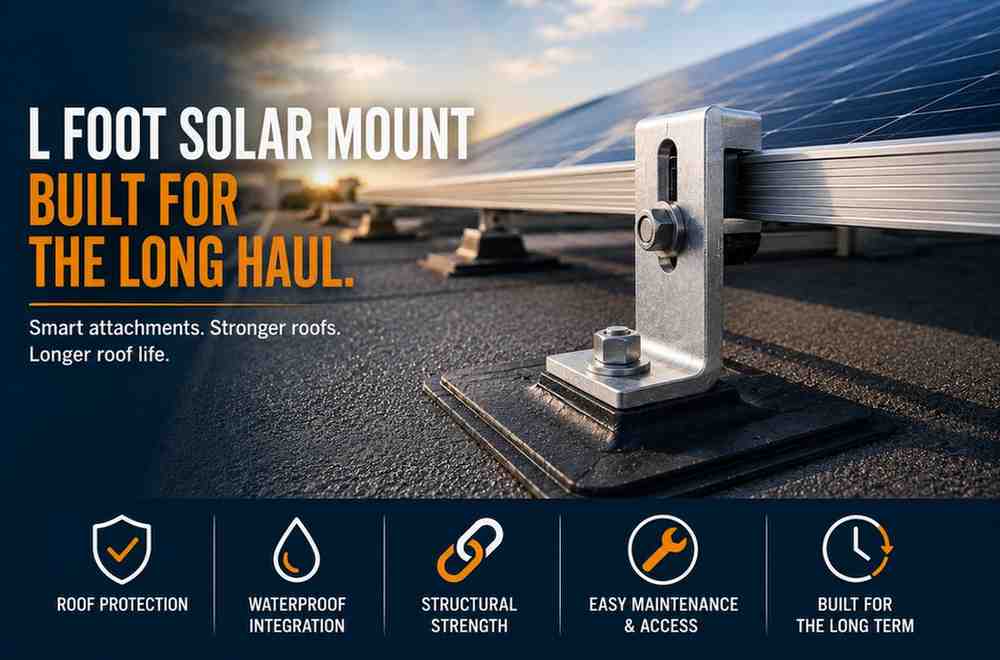
This is why experienced project teams often evaluate a L foot solar mount not only for its structural role but also for how it fits into the broader lifecycle of the roof.
Most solar proposals focus on installation.
That’s understandable because installation is where schedules, labor, and budgets are concentrated.
The reality is that the installation phase represents only a small portion of the system’s total lifespan.
Years later, roofing contractors may need access to damaged sections of the roof. Maintenance crews may need to inspect flashing details. Building owners may eventually face a reroofing project while the solar array remains fully operational.
When attachment planning doesn’t account for these realities, future work often becomes more expensive and more disruptive than expected.
Contractors who regularly work on reroofing projects often see the same pattern. The systems that are easiest to service usually benefited from thoughtful planning long before the first module was installed.
Ask a roofing contractor to evaluate an existing solar installation and they rarely start by discussing the panels.
The reason is simple.
A solar system may generate electricity, but the roof remains responsible for protecting the building.
Any attachment strategy must support both objectives.
That balance becomes especially important on large commercial roofs where future access requirements are often difficult to predict.
Among the many attachment options available for rooftop solar systems, the L foot solar mount remains one of the most commonly used solutions for transferring loads from the mounting system into the building structure.
Its role extends beyond simply securing rails.
The attachment strategy influences:
For project teams evaluating attachment systems, the conversation is rarely about hardware alone.
It is about how that hardware interacts with the roof throughout the life of the building.
Most attachment discussions begin with structural performance.
In practice, waterproofing concerns often become equally important.
Every roof penetration introduces a location that must continue performing through seasonal weather changes, thermal movement, and years of exposure.
This is one reason many project teams carefully evaluate solutions that support a waterproof solar mount strategy. Proper integration between mounting hardware, flashing systems, and roofing materials can help reduce long-term water intrusion risks while supporting roof longevity.
The objective is not simply preventing leaks immediately after installation.
The objective is maintaining reliable roof performance for years to come.
Older solar installations often provide valuable insight into attachment planning.
Projects that continue performing well after ten or fifteen years usually have several things in common.
None of these decisions seem particularly dramatic during construction.
Their value becomes much more obvious later.
Especially when the building owner needs to perform maintenance without disrupting the solar investment.
Roofing professionals have consistently emphasized the importance of treating rooftop solar systems as part of the broader roof assembly rather than as separate pieces of equipment.
Attachment planning, waterproofing integration, roof compatibility, and maintenance access all contribute to long-term project success.
This perspective aligns closely with what contractors, facility managers, and building owners often discover through experience. The best-performing projects are rarely the result of a single product. They are usually the result of coordinated decisions made early in the planning process.
The conversation around rooftop solar often focuses on modules, production estimates, and energy savings. Those factors matter.
However, the long-term success of a project frequently depends on decisions that receive far less attention during the planning stage.
Selecting the right L-foot solar mount is not simply a structural decision. It is also a roof lifecycle decision. The attachment strategy chosen today can influence maintenance requirements, waterproofing performance, and future reroofing activities for years to come.
For building owners and project teams, that broader perspective often leads to better outcomes and fewer surprises down the road.
An L-foot solar mount is a structural attachment component commonly used to connect solar mounting systems to roof structures while transferring loads from the array into the building.
Attachment systems influence waterproofing performance, roof compatibility, maintenance access, and long-term serviceability.
Yes. Attachment placement and mounting design can significantly affect how easily solar equipment can be removed and reinstalled during roof replacement.
A waterproof solar mount strategy focuses on integrating mounting hardware with flashing and roofing systems to help reduce long-term water intrusion risks.
Absolutely. Understanding the roof’s remaining service life can help prevent future disruptions and improve long-term planning.
Commercial teams often evaluate roof compatibility, waterproofing integration, maintenance accessibility, structural performance, and lifecycle value when comparing attachment options.

© 2025 Crivva - Hosted by Airy Hosting Managed Website Hosting.