

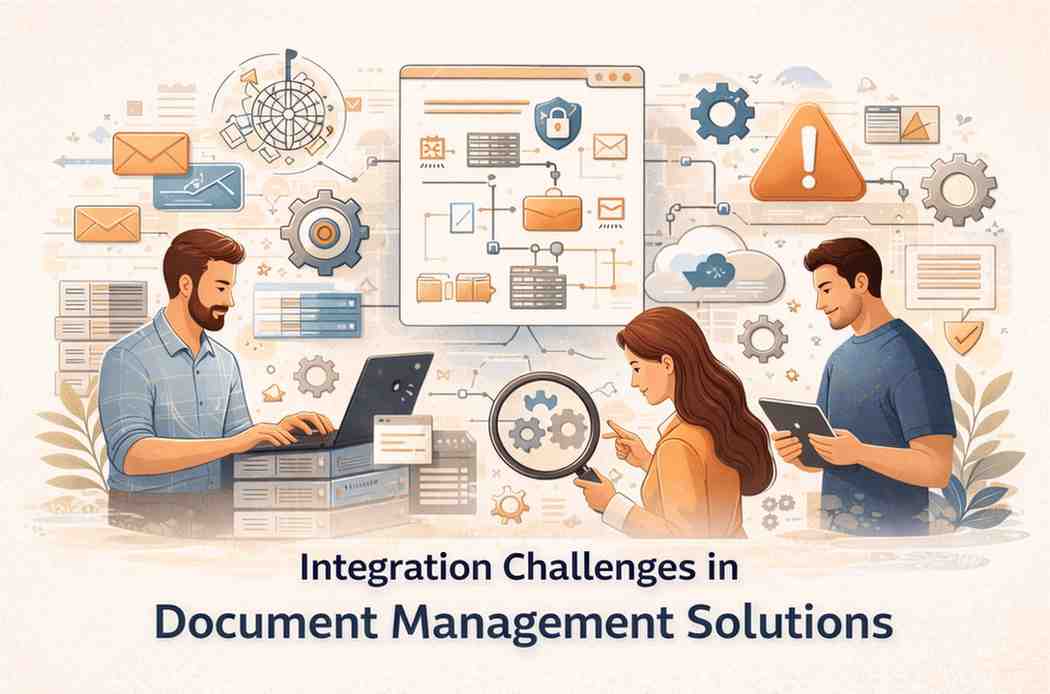
As organizations accelerate digital transformation, document management solutions have become a critical foundation for daily operations. From contracts and invoices to compliance records and internal documentation, businesses rely on document management systems (DMS) to store, retrieve and manage information efficiently. However, the true value of a document management solution is unlocked only when it integrates seamlessly with existing tools, platforms and workflows.
Integration is often the most complex and underestimated aspect of implementing a document management solution. While modern systems promise flexibility and scalability, real-world environments involve legacy software, diverse data formats, security constraints and evolving business requirements. This blog explores the most common integration challenges in document management solutions and provides practical insights for overcoming them in global and enterprise-scale environments.
Document management systems rarely operate as standalone platforms. In most organizations, they must integrate with ERP systems, CRM platforms, accounting software, HR tools and collaboration applications. Without proper integration, document workflows become fragmented, leading to inefficiencies, errors and poor user adoption.
Integration enables:
For global organizations, integration is even more critical, as document workflows often span departments, regions and time zones.
Before addressing integration challenges, it is important to understand the complexity of modern IT ecosystems. Organizations typically operate with a mix of cloud-based platforms, on-premise systems and third-party tools acquired over time.
Document management solutions must integrate across:
Each integration point introduces technical, operational and security considerations that must be carefully managed.
One of the most persistent challenges in document management integration is compatibility with legacy systems. Many organizations still rely on older ERP or database systems that were not designed with modern API-based integrations in mind.
These systems often:
Integrating a modern document management solution with such systems often demands significant customization and ongoing maintenance.
Document data is frequently stored across multiple systems, each with its own structure, naming conventions and metadata standards. When integrating document management solutions, these inconsistencies can create data silos and synchronization issues.
Common problems include:
Without a unified data strategy, integration efforts can amplify complexity rather than reduce it.
Documents often contain sensitive business, financial, or personal information. Integrating document management solutions across systems increases the attack surface and complicates access control.
Key security challenges include:
Security considerations must be embedded into integration design from the outset, not treated as an afterthought.
Most modern document management solutions rely on APIs for integration. However, API limitations can significantly impact integration flexibility and performance.
Some document management platforms expose limited APIs that do not support advanced workflows or customization needs. This can restrict automation and force manual workarounds.
Common API-related issues include:
These limitations increase development effort and long-term maintenance costs.
As document volumes grow, integration performance becomes a critical concern. Poorly designed integrations can lead to latency, system slowdowns, or even downtime during peak usage.
Performance challenges often arise from:
Scalable integration architectures are essential for organizations handling large document repositories or high transaction volumes.
Organizations offering document management solutions to clients under their own brand face a unique set of integration challenges. A White Label Document Management solution must be flexible enough to integrate into diverse client environments while maintaining a consistent core platform.
White label platforms must support customization for branding, workflows and integrations without creating fragmented codebases.
Integration challenges include:
Balancing customization with maintainability is a major technical and strategic challenge.
In a white label document management system, multiple clients often share the same underlying infrastructure. Integration logic must be carefully designed to isolate data and workflows while enabling seamless connectivity.
Key concerns include:
A robust integration framework is essential to support growth without compromising security or stability.
Document management solutions are frequently used to automate workflows such as approvals, reviews and document generation. Integrating these workflows across systems introduces additional complexity.
When workflows span multiple platforms, coordination becomes challenging. For example, a document approval may depend on data from an ERP system and trigger actions in a CRM platform.
Common orchestration challenges include:
Without proper orchestration, workflows can become brittle and difficult to troubleshoot.
Integrated workflows must adapt as business processes evolve. Changes in one system can have cascading effects across integrated platforms.
This often results in:
Effective version control and testing strategies are critical to maintaining stable integrations.
For organizations operating globally, integration challenges are compounded by regulatory and compliance requirements.
Different regions impose different rules on how documents are stored, processed and transferred. Integration architectures must account for these variations.
Key considerations include:
Failure to address these requirements can result in legal risks and operational disruptions.
Global organizations often use region-specific systems for finance, HR, or compliance. Document management integrations must accommodate these variations without duplicating effort.
This requires:
While integration challenges are complex, they can be addressed with the right architectural and organizational approach.
Middleware solutions can act as a bridge between document management systems and other platforms, reducing direct dependencies.
Benefits include:
Middleware can significantly reduce long-term integration complexity.
Establishing standardized data models and integration patterns improves consistency and reduces friction across systems.
Best practices include:
Standardization enables faster development and more reliable integrations.
Integration should be viewed as an ongoing capability, not a one-time project. Scalable integration strategies account for future growth and change.
This involves:
A forward-looking approach minimizes technical debt and supports sustainable growth.
Integration challenges in document management solutions are unavoidable, but they are also manageable with the right strategy. From legacy system compatibility and API limitations to security concerns and global compliance requirements, integration touches every aspect of a document management ecosystem.
For organizations building or adopting document management platforms—especially those offering a white label document management system—success depends on flexible architecture, strong governance and a clear understanding of integration complexity. By addressing these challenges proactively, businesses can unlock the full value of document management solutions and build scalable, future-ready digital workflows.

© 2025 Crivva - Hosted by Airy Hosting Managed Website Hosting.