

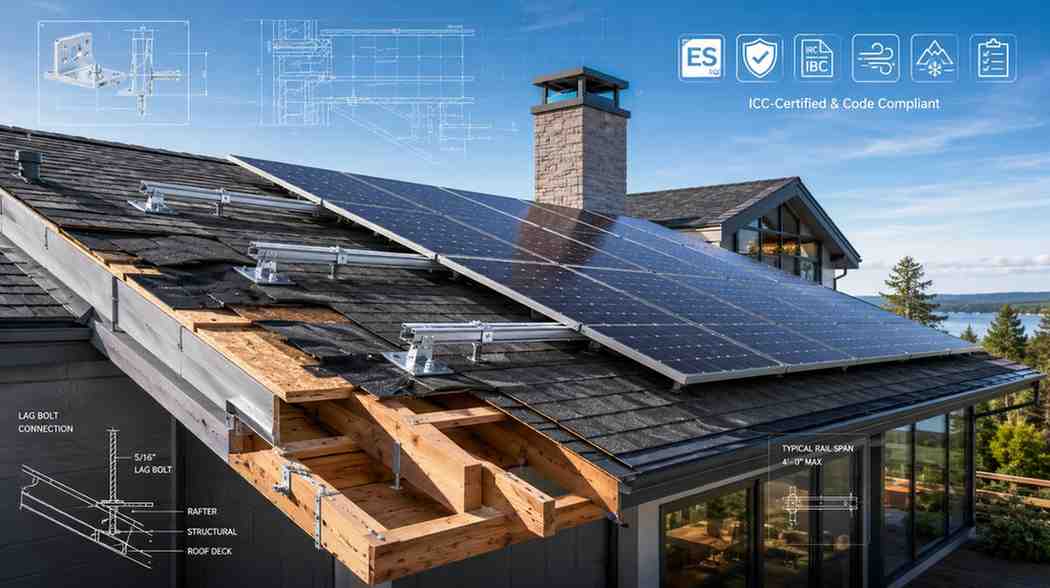
A homeowner schedules a rooftop solar install, the panels arrive, the crew shows upand then the inspector flags the racking system. Not the electrical work, not the panels themselves, but the metal rails and clamps holding everything to the roof deck. This happens more often than people expect, and it’s rarely because the hardware is defective. It’s because the paperwork behind it doesn’t hold up: no evaluation report number, a span that exceeds what the manufacturer tested, or an attachment point that doesn’t match the site’s wind or snow zone.
This is the part of a solar install that gets the least attention and causes the most delay. Understanding how mounting hardware actually gets certified and what that certification does and doesn’t cover saves a lot of back-and-forth with plan reviewers.
The International Code Council doesn’t test hardware directly. Its evaluation arm, ICC-ES, reviews products against published acceptance criteria and issues an Evaluation Service Report (ESR) when a product passes. For PV racking, the relevant document is AC428 Acceptance Criteria for Modular Framing Systems Used to Support Photovoltaic Modules. It sets structural design requirements- dead load, live load, snow, seismic, and wind for both flush-mounted (roof) and freestanding (ground-mounted) systems, all referenced back to the International Building Code, the International Residential Code, and ASCE 7 load combinations.
When a manufacturer holds an ESR under AC428, it means an independent body verified the racking system’s connection capacity, weather resistance, and structural integrity through actual mechanical testing, not just design calculations on paper. That ESR number is what a plan reviewer is looking for on a permit application. Specifying ICC certified solar mounts with a valid, current ESR is usually the fastest way through structural plan check, because the reviewer isn’t evaluating the racking design from scratch they’re confirming the installed configuration matches what’s already been tested.
The catch: an ESR is only valid for the exact configuration it was tested under. Swap in a different rail profile, extend spans beyond what’s listed, or mix components from two product lines, and the certification no longer applies to what’s actually on the roof.
A racking system’s ESR is only as good as the connection beneath it. ASCE 7 requires wind, snow, dead, and seismic loads to be checked in combination and applied in three directions, not just straight down. That load has to travel through the mount, into the roof structure, and down to the framing. If any link in that chain is weak, the rating on the bracket is meaningless.
The most common failure point is attaching to roof sheathing instead of the rafter or truss beneath it. Sheathing is typically fastened to framing with a single nail at each intersection. If a racking foot lands near a panel edge or corner, the wind uplift load concentrates on that one nail instead of spreading across the structure. In a wind event, that nail can pull free, which is both a structural failure and a waterproofing failure at the same time, since the fastener hole is now working loose under a flashing that was never designed to move.
Other load-path mistakes that show up repeatedly in the field:
None of these show up as a visible defect. They show up during a wind event, a heavy snow load, or, more mundanely, during the structural review, when a reviewer cross-checks the attachment spacing against the ESR’s span tables and finds a mismatch.
Every rafter-mounted racking system puts a hole in the roof, and building codes treat that hole seriously. The IRC requires roof penetrations to be flashed and sealed to prevent water, rodent, and insect entry, and this applies specifically to solar mounting hardware, not just plumbing vents or chimneys. A waterproof solar mount relies on flashing that integrates with the roofing material’s own water-shedding layersnot on sealant sitting on top of the roof surface.
Sealant-only attachment was standard practice years ago, and it’s still the leading cause of solar-related roof leaks. UV exposure, thermal cycling, and the roof’s natural expansion and contraction break down sealant over time, and once it cracks, water tracks straight down the mounting bolt into the deck. The fix that codes and roofing manufacturers now expect is metal (or increasingly, tested polymer/butyl) flashing that tucks under the upslope shingle or tile course, so water sheds over the flashing the way it would over any other roof penetration.
Flashing detail differs by roofing type:
A growing number of AHJs now reference UL 2703A, a newer testing protocol built specifically to evaluate flashing systems’ tear strength, UV aging, thermal cycling, and water penetration resistance, separate from the structural testing under AC428.
AC428 and UL 2703 are frequently confused, but they answer different questions. AC428/ESR certification confirms the racking can structurally carry its loads. UL 2703 is a product safety standard covering fire classification (Class A, B, or C, depending on jurisdiction and lot-line proximity), plus bonding and grounding integrity between modules, rails, and the electrical grounding system. Many building and fire codes now require rooftop PV systems to carry a UL 2703 listing specifically for fire classification, separate from, and in addition to, structural certification.
A complete compliance package for an inspector typically includes all three: the ESR number for structural certification, the UL 2703 listing for fire and electrical bonding, and site-specific flashing documentation for water intrusion resistance. Missing any one of these is a common reason for a failed rooftop inspection.
Before a racking system goes on a roof, it’s worth confirming:
Solar racking hardware appears to be simpler: rails, clamps, lag bolts, but the compliance is complex. ICC-ES certification under AC428 ensures the system can handle structural loads under real tests, referencing IBC, IRC, and ASCE 7. UL 2703 addresses fire safety and electrical bonding. Waterproofing relies on proper flashing for the roofing material, not the racking brand. Successful rooftop approval depends on matching structural certification, safety listing, and flashing documentation, rather than assuming a certified product guarantees correct installation.
ICC-ES certification under AC428 assesses structural performance, including resistance to wind, snow, seismic, and dead loads. Waterproofing is separate, based on flashing design and roofing standards like UL 2703A.
An ICC-ES Evaluation Service Report (ESR) verifies structural compliance with building codes like IBC and IRC. A UL listing (e.g., UL 2703) confirms product safety, fire classification, bonding, and grounding. Most areas require rooftop PV installations.
Most U.S. building departments using IBC or IRC require structural documentation for racking systems, with ESR being the most direct method; some accept site-specific calculations.
Certified racking handles structural load capacity, not water intrusion at penetrations. Leaks occur when flashing is skipped, replaced with sealant, attachments land on sheathing, or flashing doesn’t match roofing material.

© 2025 Crivva - Hosted by Airy Hosting Managed Website Hosting.