


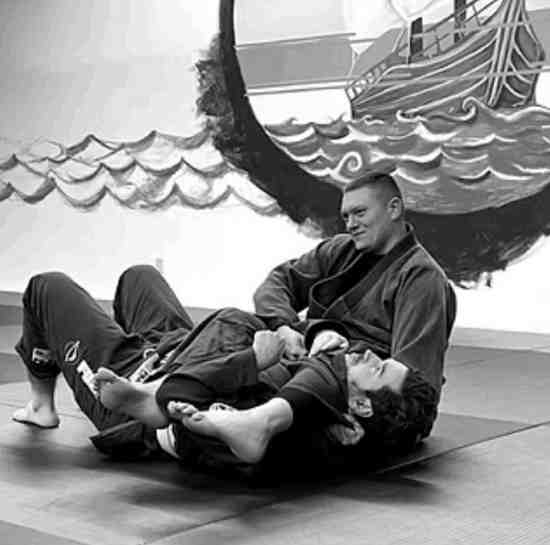
Brazilian Jiu Jitsu moves are designed to help a smaller, weaker individual defend against a larger opponent by using leverage, positioning, and technique. BJJ emphasizes the importance of controlling the opponent on the ground and systematically breaking their posture, balance, and defensive structure. Unlike other martial arts that rely heavily on punches and kicks, BJJ offers an avenue for self-defense that reduces the risk of injury while providing a highly effective method for neutralizing threats.
The guard is a foundational position in Brazilian Jiu Jitsu, where one practitioner is on their back controlling an opponent with their legs. While it may seem passive at first, the guard provides tremendous offensive and defensive options. There are several types of guards, each with distinct moves and strategies.
The closed guard is the most basic yet powerful position, where your legs are wrapped around your opponent’s waist while controlling their posture with grips on the sleeves, collar, or head. In this position, several fundamental Brazilian Jiu Jitsu moves are essential:
Hip Bump Sweep: This sweep uses momentum to off-balance your opponent, allowing you to transition to mount. By underhooking an arm and performing a bridge, you can roll the opponent over, securing a dominant position.
Armbar: From the closed guard, isolating an opponent’s arm and extending the hips can force a submission. Proper technique requires controlling the wrist, squeezing your knees, and keeping your hips close.
Triangle Choke: This move involves trapping the opponent’s neck and one arm between your legs, forming a triangle shape. It restricts blood flow to the brain, compelling a tap-out if applied correctly.
In open guard, the legs are not locked around the opponent, giving flexibility and mobility. This position allows practitioners to attack with sweeps, submissions, or transitions:
De La Riva Guard: A versatile guard where one leg hooks behind the opponent’s leg, allowing sweeps or back-takes.
Spider Guard: Using the opponent’s sleeves and your feet on their biceps, you can control posture and set up attacks such as omoplatas or triangle chokes.
Lasso Guard: Wrapping a leg around the opponent’s arm to control their movement, creating opportunities for sweeps and submissions.
Half guard occurs when one of your opponent’s legs is trapped between yours. While less dominant than closed guard, it offers strong options for both defense and attack:
Old School Sweep: Underhooking the opponent’s far leg and using a bridging motion can reverse the positions.
Kimura from Half Guard: Controlling an arm with a figure-four grip while transitioning hips creates submission opportunities.
Deep Half Guard: Sliding under the opponent’s hips allows for sweeps and positional control, especially effective against heavier opponents.
By mastering these guard positions, you lay the foundation for a comprehensive BJJ game. The guard is not just defensive; it is a launching pad for multiple attacks and transitions that can overwhelm your opponent when executed correctly.
Controlling the top position is crucial in Brazilian Jiu Jitsu because it provides leverage, balance, and submission opportunities. A practitioner on top can apply pressure, limit the opponent’s mobility, and systematically move toward dominant positions. Key top positions include the mount, side control, and back control.
Mounting an opponent involves sitting on their torso, controlling posture, and threatening submissions. From mount, several effective moves can be applied:
Americana Shoulder Lock: Controlling an opponent’s wrist and elbow in a figure-four grip allows you to torque the shoulder joint for submission.
Arm Triangle Choke: Using your arms and head to isolate the opponent’s neck and arm creates a strong chokehold.
S-Mount Transitions: Shifting to an S-mount, where one knee is near the opponent’s head, allows for armbars and high-percentage attacks.
Side control involves pinning the opponent from a perpendicular angle, with your weight distributed across their chest and hips:
Kimura from Side Control: Leveraging control over the opponent’s arm to apply a shoulder lock.
Knee-on-Belly Positioning: Applying pressure on the opponent’s torso for control, striking opportunities, or setting up submissions.
Switching to Mount: Effective transitions from side control to mount increase your dominance and open up submission options.
Back control is often considered the most dominant position in BJJ. Controlling the opponent’s back limits their mobility and exposes them to high-percentage submissions:
Rear Naked Choke: Using arms to constrict the opponent’s neck, cutting off airflow and blood flow for a safe and effective finish.
Bow and Arrow Choke: Utilizing the gi to apply a precise choke while controlling the opponent’s body with your legs.
Seatbelt Grip: Wrapping one arm over the shoulder and one under the armpit secures control for transitions to choke attempts.
Sweeps and takedowns are critical Brazilian Jiu Jitsu moves that allow practitioners to move from a defensive to a dominant position. Success in BJJ is not only about submissions; it is also about controlling the flow of the match by maintaining advantageous positions.
Sweeps allow you to reverse roles, moving from bottom to top while controlling the opponent:
Scissor Sweep: A basic but highly effective move from closed guard using a scissor motion of the legs.
Flower Sweep: Combining grips and momentum to sweep the opponent over, transitioning to mount or side control.
Lapel Guard Sweep: Using the gi for leverage, off-balancing the opponent while achieving a dominant position.
At the heart of Brazilian Jiu Jitsu lies the art of submission. Submissions allow a practitioner to force an opponent to concede without causing serious injury. Learning to apply submissions with precision, timing, and control is a hallmark of skilled BJJ players.
Chokes restrict airflow or blood flow, compelling an opponent to tap out:
Rear Naked Choke: Applied from back control, this is one of the most effective submissions in BJJ.
Triangle Choke: Trapping the neck and arm using the legs, creating a blood choke.
Guillotine Choke: Securing the opponent’s neck while controlling posture to apply pressure.
Joint locks target the limbs, forcing an opponent to submit due to pain or risk of injury:
Armbar: Extending the elbow while controlling the wrist from guard or mount.
Kimura: A shoulder lock applied from various positions, including guard or side control.
Omoplata: Using the legs to isolate the shoulder joint, a highly technical submission often set up from open guard.
Experienced practitioners combine setups, grips, and transitions to execute high-percentage finishes:
Leg Locks: Attacks such as straight ankle locks and heel hooks focus on lower body submissions.
Flow Chaining: Connecting multiple submissions into a fluid sequence to increase the likelihood of a tap.
Pressure and Positional Control: Maintaining top pressure to force openings for high-percentage finishes.
Mastering Brazilian Jiu Jitsu moves is not solely about physical execution; it also requires mental preparation. Developing focus, patience, and adaptability is critical to long-term success.
Patience: Learning BJJ moves takes time; rushing techniques leads to mistakes and potential injury.
Problem-Solving Mindset: BJJ is often compared to chess, where anticipating your opponent’s moves leads to strategic advantage.
Resilience: Embrace failures and losses as opportunities to improve, not setbacks.
Drill Consistently: Repetition builds muscle memory, allowing techniques to become instinctive.
Live Sparring: Rolling with different partners of varying styles and sizes enhances adaptability.
Study Techniques: Watching instructional videos, attending seminars, and analyzing high-level matches accelerates learning.
Conditioning: Strength, flexibility, and endurance complement technical skills, improving overall performance.
Adopting a holistic approach to training, combining mental preparation, drilling, and physical conditioning, ensures steady progress and mastery of Brazilian Jiu Jitsu moves.
Even experienced practitioners make errors in Brazilian Jiu Jitsu. Recognizing common mistakes and actively correcting them is essential:
Neglecting Fundamentals: Advanced moves are ineffective without a solid foundation in basic positions and controls.
Poor Posture and Balance: Loss of posture often leads to being swept or submitted; maintaining base is crucial.
Overcommitting to Submissions: Forcing moves without proper control often backfires; patience and setup are key.
Ignoring Positional Hierarchy: Understanding which positions offer leverage and control prevents wasted energy.
By addressing these mistakes through consistent practice and self-reflection, practitioners can accelerate their learning curve and reduce frustration.
For individuals looking to learn Brazilian Jiu Jitsu moves in a structured environment, joining a reputable academy is invaluable. Experienced instructors provide guidance, safety, and mentorship, allowing students to progress efficiently. For example, in locations like Brazilian jiu jitsu huntsville al, practitioners have access to gyms that cater to all skill levels, offering classes ranging from fundamentals to advanced techniques.
When selecting a training academy:
Look for certified instructors with competition experience.
Consider class size and student-to-instructor ratio for personalized attention.
Ensure a supportive and encouraging environment that promotes learning and safety.
Seek opportunities for seminars and open mat sessions to practice with diverse partners.
Being part of a community accelerates growth, fosters motivation, and allows practitioners to test their skills in a safe, constructive setting.
Mastering Brazilian Jiu Jitsu moves requires dedication, discipline, and a love for learning. From understanding guard positions to executing complex submissions, every aspect of BJJ builds upon fundamental principles of leverage, control, and timing. By consistently practicing, analyzing, and refining your techniques, you will see steady improvement in both skill and confidence.

© 2025 Crivva - Hosted by Airy Hosting Managed Website Hosting.