

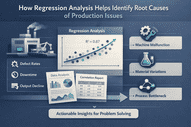
In production systems, identifying the root cause of issues is often more complex than detecting the issue itself. Failures can result from multiple interacting factors such as code changes, traffic spikes, infrastructure behavior, or data inconsistencies. Without a structured approach, teams may spend significant time investigating symptoms rather than addressing the actual problem.
This is where regression analysis becomes valuable. By analyzing relationships between variables and system behavior over time, teams can move beyond guesswork and identify the underlying causes of production issues more effectively.
Modern applications operate in dynamic environments where multiple components interact continuously. A single issue can have several contributing factors, making it difficult to isolate the exact cause.
Common challenges include:
Without proper regression analysis, teams often rely on assumptions, which can lead to incomplete fixes or recurring issues.
Regression analysis helps teams understand how different variables influence system behavior. Instead of examining events in isolation, it identifies patterns and relationships within data.
For example, teams can analyze how:
By identifying these relationships, teams can narrow down potential causes and focus their investigation more effectively.
One of the key advantages of regression analysis is its ability to highlight correlations between variables. While correlation alone does not confirm causation, it provides a strong starting point for investigation.
Teams can use this insight to:
This structured approach reduces the time spent exploring irrelevant possibilities.
In practice, data analysis alone is not sufficient to confirm root causes. Teams often combine regression analysis with validation techniques such as regression testing to verify whether identified factors actually trigger the issue.
This combination allows teams to:
By aligning analytical insights with testing validation, teams can achieve more accurate and reliable results.
Production issues are often caused by dependencies that are not immediately visible. These may include interactions between services, shared resources, or external integrations.
Regression analysis helps uncover such dependencies by:
Understanding these dependencies is critical for preventing similar issues in the future.
As teams apply regression analysis consistently, they begin to build a deeper understanding of system behavior. Over time, this leads to:
This continuous improvement strengthens overall system reliability and reduces the frequency of recurring issues.
In one production system, a team experienced intermittent performance degradation without any obvious errors. Initial investigations focused on recent code changes, but no clear issue was identified.
By applying regression analysis to historical data, the team discovered a strong correlation between increased response times and specific traffic patterns during peak hours. Further investigation revealed that a database query was not scaling efficiently under higher load.
To validate this finding, the team recreated similar conditions and confirmed the issue. After optimizing the query, performance stabilized, and the issue was resolved.
This example highlights how data-driven analysis can uncover root causes that are not immediately visible through traditional debugging methods.
Regression analysis plays a critical role in modern production environments by enabling teams to move from reactive debugging to data-driven problem solving. By identifying patterns, validating hypotheses, and uncovering hidden relationships, it helps teams resolve issues more effectively and maintain stable, reliable systems over time.
In production environments, where systems are constantly evolving and operating under varying conditions, relying solely on intuition or isolated debugging techniques is no longer sufficient. Regression analysis introduces a structured, data-driven approach that helps teams make sense of complex system behavior. By analyzing trends, correlations, and patterns across historical data, teams gain deeper visibility into how different factors influence system performance and stability.
What makes this approach particularly valuable over time is its cumulative impact. Each analysis contributes to a growing understanding of the system, enabling teams to respond to incidents more efficiently and with greater confidence. Instead of repeatedly investigating similar issues from scratch, teams begin to recognize familiar patterns and can quickly narrow down potential causes. This reduces both the time to resolution and the risk of incomplete fixes.
Another important aspect is the shift in mindset that regression analysis encourages. Teams move from reactive problem-solving to proactive system monitoring. By continuously analyzing key metrics and identifying deviations early, potential issues can be detected before they escalate into major production incidents. This not only improves system reliability but also enhances the overall user experience.
Additionally, regression analysis supports better collaboration across teams. Developers, QA engineers, and operations teams can align around data-backed insights rather than assumptions. This shared understanding leads to more effective communication, clearer decision-making, and stronger alignment between technical and business goals.
Over time, organizations that consistently apply regression analysis develop more resilient systems. They are better equipped to handle scale, adapt to change, and maintain performance under pressure. In a landscape where production stability directly impacts user trust and business outcomes, adopting a data-driven approach to root cause identification is no longer optional but essential. As emphasized earlier, by analyzing relationships between variables and system behavior over time, teams can move beyond guesswork and identify the underlying causes of production issues more effectively.

© 2025 Crivva - Hosted by Airy Hosting Managed Website Hosting.