

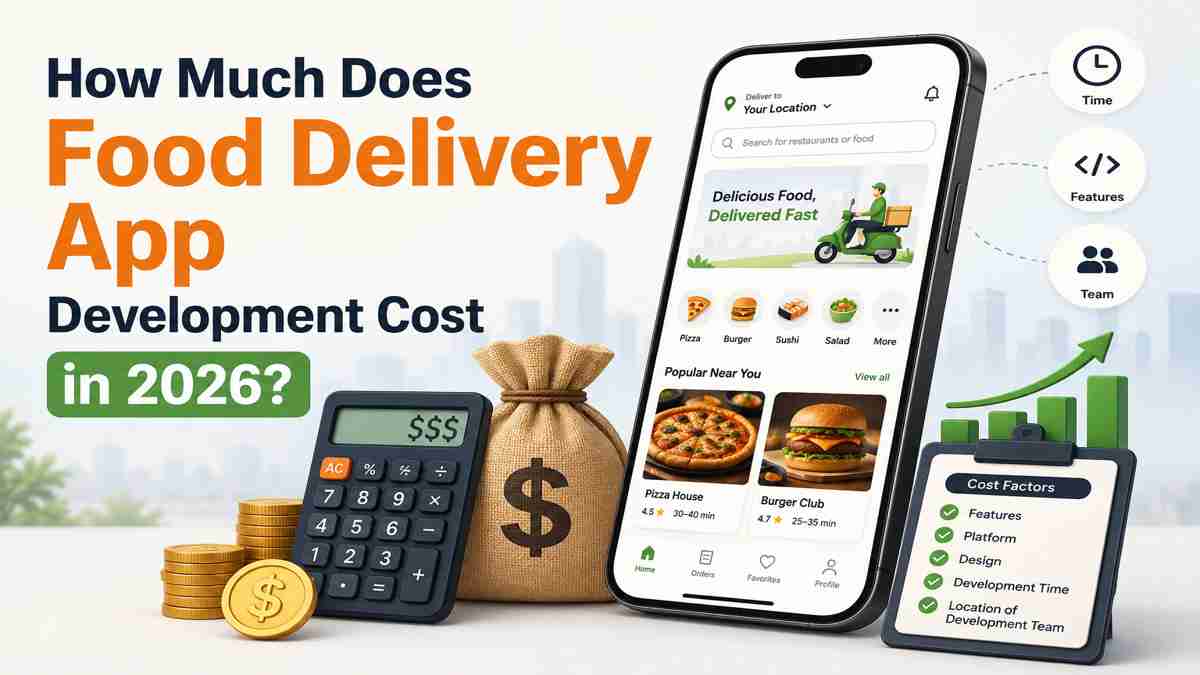
When you are working on building your own food ordering platform, the main question you probably have is the cost — how much it would be. But there is not a universal answer for all projects, as the cost of developing a food delivery app depends on the requirements and the developer you choose to do the job.
In this blog, we will break down the factors that change the price, and a few ways you can keep your budget under control without cutting corners on quality.
The food delivery app does not have a set price range. Whatever figures that you find on the internet are just estimates, because the price is different depending on each developing firm. The price generally depends on the complexity of your app as follows:
When you look for food delivery app development services, you will notice that pricing is never fixed. It changes based on several moving parts.
A food delivery platform is usually not just one app. It is a set of three:
Building all three obviously costs more than building just one, so decide early which parts you actually need at launch.
The basics of sign up, browsing the menu, and checking out your cart are relatively inexpensive to develop. However, the cost increases when you add:
Each added feature means more development hours, which means a higher bill.
Are you planning to create an app that works on iOS and Android, or both? It is much cheaper to build with cross-platform frameworks like Flutter or React Native — which let you develop once and deploy everywhere — compared to native development, where you build separate codebases for each platform. Cross-platform development is a better option if you aim to keep your app development costs under control.
A clean design without fancy animation or special graphics costs less. For your first app, this is generally sufficient, since all you need is a functioning design. You can always add polish later, after gaining experience and users.
Your app needs a solid backend to handle orders, user data, and restaurant listings. On top of that, most apps rely on third-party services such as:
These services usually come with usage-based costs, which add up to your total budget.
Once you know what features you want, the next big decision is who builds the app for you. You could try to hire individual freelancers or build a team in-house, but for most US businesses, working with an established food delivery app development company works out better in the long run. Here’s why:
If you’re a US-based business planning to launch a food delivery app, partnering with a professional food delivery app development company gives you a dependable partner from planning through launch and beyond, rather than piecing the process together yourself.
There is no need for every feature on the first day. Here are some suggestions to reduce costs without sacrificing quality:
Select a developer partner who has a track record of food delivery apps range to prevent costly changes Launching an MVP allows you to get real user feedback early, which means you can invest later in features that people really need, not just ones that you would have thought of.
There isn’t a set price for the development of an app for food delivery. Your final app for food delivery cost for development will be based on the features you pick and the platforms you choose to target and the complexity of your design and the staff you select. An app that is simple will cost less than a platform with all the features, therefore the best place to start is to identify the requirements of your app before you ask for a quote.
The best strategy is to start with a detailed list of essential features and then create an MVP and expand the app based on actual consumer needs. So, your money will be used for what is most beneficial to your business, not features that no one uses.
If you’re ready to take the next step, speak to a couple of developers of apps, look at their previous food delivery initiatives and ask for the exact cost breakdown before you sign up. A little bit of research today can help you save a lot of dollars later.

© 2025 Crivva - Hosted by Airy Hosting Managed Website Hosting.