


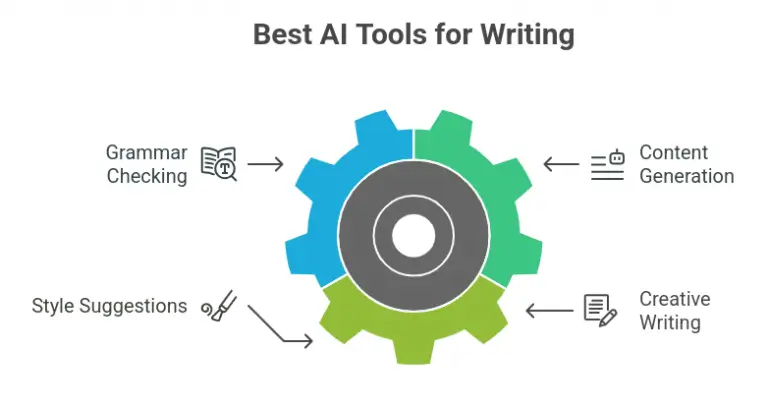
The way humans create written content has undergone a fundamental transformation over the past few years. What began as simple grammar checkers and autocomplete suggestions has evolved into sophisticated neural networks capable of drafting full articles, marketing copy, academic summaries, and business reports in seconds. By 2026, AI writing tools are no longer a novelty — they are a fixture in the daily workflows of authors, students, marketers, and educators worldwide.
Yet this rapid adoption has also surfaced a new set of challenges. As AI-generated content floods the internet, questions about authenticity, originality, and quality have become impossible to ignore. The tools that once promised to save time are now forcing creators to invest that saved time in something equally important: making their content genuinely human.
Modern AI writing assistants are built on large language models — neural networks trained on vast corpora of text that allow them to predict, generate, and restructure language with remarkable fluency. For marketers, this means drafting product descriptions, email sequences, and social media posts in a fraction of the time. For students, it offers a scaffold for structuring arguments and summarizing research. For authors, it serves as a brainstorming partner that never runs out of ideas.
The productivity gains are real and measurable. Marketing teams that once spent days producing content calendars can now generate a month’s worth of drafts in an afternoon. Academic writers use AI tools to outline complex papers and identify gaps in their arguments. Copywriters use neural networks to A/B test dozens of headline variations simultaneously.
But productivity is only one side of the equation.
Despite its impressive fluency, AI-generated writing has a recognizable fingerprint. Sentences tend to follow predictable rhythmic patterns. Transitions are clean but mechanical. Vocabulary clusters around safe, frequently used phrases. The writing is technically correct — sometimes even impressive — but it lacks the irregular cadence, personal voice, and subtle imperfections that signal genuine human thought.
Readers notice this, even when they cannot articulate why. A blog post that reads like it was assembled from parts rather than written from experience creates a subtle but real sense of distance. For brands, this undermines trust. For students submitting academic work, it raises ethical red flags. For authors, it simply does not feel like their voice.
This has given rise to one of the most important subcategories in AI content tools: humanization. The core idea is to take AI-generated text and refine it so that it reads naturally, with varied sentence rhythm, more idiomatic phrasing, and the kind of tonal warmth that algorithms struggle to produce on their own. Services that offer the ability to humanize AI output — such as the free online tool provided by Hukhta — have become an essential step in many content pipelines, sitting between raw AI generation and final publication.
The process typically involves restructuring overly symmetrical sentences, replacing repetitive transitional phrases, injecting colloquial nuance where appropriate, and ensuring the text reflects a consistent human perspective rather than a statistical average of many voices.
The answer is surprisingly broad. Marketers arguably see the most immediate return — AI tools accelerate everything from SEO content production to ad copy generation. But the benefits extend well beyond commercial writing.
Students use AI assistants to overcome writer’s block, organize research notes into coherent drafts, and explore how an argument might be structured before committing to a direction. Teachers and academics use them to generate reading materials, quiz questions, and lecture summaries. Independent authors use AI to develop secondary characters, world-building details, and plot alternatives they might not have considered alone.
Non-native English speakers represent another major beneficiary group. For professionals and students writing in a second or third language, AI tools offer a significant leveling of the playing field — providing fluent phrasing suggestions and helping avoid common grammatical patterns that betray non-native writing.
A separate but equally important use case is content rewriting — the task of taking existing text and transforming it to serve a different purpose, audience, or platform. This is distinct from humanization. Where humanization addresses the tone and naturalness of AI-generated content, rewriting is about strategic adaptation.
A technical white paper may need to be rewritten as a blog post for a general audience. A product description written for engineers may need to be adapted for retail consumers. An academic abstract may need to be simplified for a press release. In each case, the underlying information stays consistent, but the language, structure, and framing shift significantly.
AI-powered rewriting tools handle this kind of transformation with increasing sophistication. Hukhta, for instance, offers a dedicated rewrite tool designed specifically for this task — allowing users to input existing content and receive a restructured version optimized for clarity, audience fit, or uniqueness. For content teams managing multiple channels and audience segments simultaneously, this kind of tool dramatically reduces the time spent manually adapting material.
Rewriting also addresses the issue of content uniqueness. Duplicate or near-duplicate content is penalized by search engines and flagged by academic integrity systems. AI rewriting tools help creators produce fresh versions of existing material that pass both algorithmic and human scrutiny.
As these tools become more capable, the conversation around responsible use has grown more nuanced. The consensus emerging in 2026 is not that AI writing is inherently good or bad, but that its value depends entirely on how it is used.
AI works best as a collaborator, not a replacement. The most effective content creators use neural networks to handle the mechanical and repetitive aspects of writing — drafting outlines, generating variations, expanding bullet points — while reserving the creative, strategic, and editorial judgment for themselves. The result is content that benefits from AI efficiency without surrendering human authenticity.
Transparency is also becoming a norm in certain sectors. Academic institutions, journalism outlets, and some marketing organizations are developing disclosure standards for AI-assisted content. This is a healthy development — it acknowledges the reality of how content is made today while preserving the accountability that gives writing its value.
By the end of 2026, the boundary between AI-assisted and purely human-written content will continue to blur. The tools will become more capable, more context-aware, and better at mimicking the specific voice of individual writers. Detection tools will grow more sophisticated in response. And the creative professionals who thrive will be those who understand how to work with these systems intelligently — using AI to extend their capacity without allowing it to flatten their voice.
The challenge is not whether to use AI in content creation. For most professionals, that question is already settled. The real challenge is using it well: producing work that is fast and efficient without being generic, and that is original in the deepest sense — meaning it carries a perspective, a judgment, and a humanity that no algorithm can fully replicate on its own.

© 2025 Crivva - Hosted by Airy Hosting Managed Website Hosting.