

Every year, underground utility damage leads to costly repairs, project delays, service interruptions, and serious safety risks. Despite advances in technology and established 811 processes, utility strikes still occur because of human error, communication gaps, outdated workflows, and limited visibility into project data.
As infrastructure projects become more complex, utility companies and contractors are looking for smarter ways to reduce risk. Artificial intelligence (AI) is quickly becoming one of the most valuable tools in modern utility damage prevention, helping organizations make faster decisions, improve accuracy, and streamline daily operations.
In this guide, we’ll explore how AI damage prevention software is transforming the industry, the benefits it offers, and why more organizations are investing in intelligent digital solutions to protect underground infrastructure.
Preventing damage to underground utilities has always required careful planning, accurate locate information, and strong communication between utility owners, contractors, and field crews.
However, today’s projects generate more data than ever before.
Organizations must manage:
Managing this information manually can slow operations and increase the likelihood of mistakes.
That’s why many organizations are turning to AI damage prevention software to automate repetitive tasks, identify potential risks, and improve decision-making across every stage of a project.
AI damage prevention software uses artificial intelligence, automation, and data analysis to help utility companies and contractors reduce the risk of underground utility damage.
Unlike traditional systems that simply store information, AI-powered platforms analyze large amounts of data to identify patterns, detect potential issues, and provide recommendations before problems occur.
Depending on the platform, AI can help organizations:
Rather than replacing experienced professionals, AI acts as an intelligent assistant that helps teams work more efficiently.
Not every excavation ticket carries the same level of risk.
Some involve routine residential projects, while others may affect major utility corridors or densely populated areas.
Traditionally, reviewing and prioritizing tickets requires significant manual effort.
With AI, organizations can analyze ticket information automatically and highlight requests that may require immediate attention based on factors such as location, project complexity, or historical data.
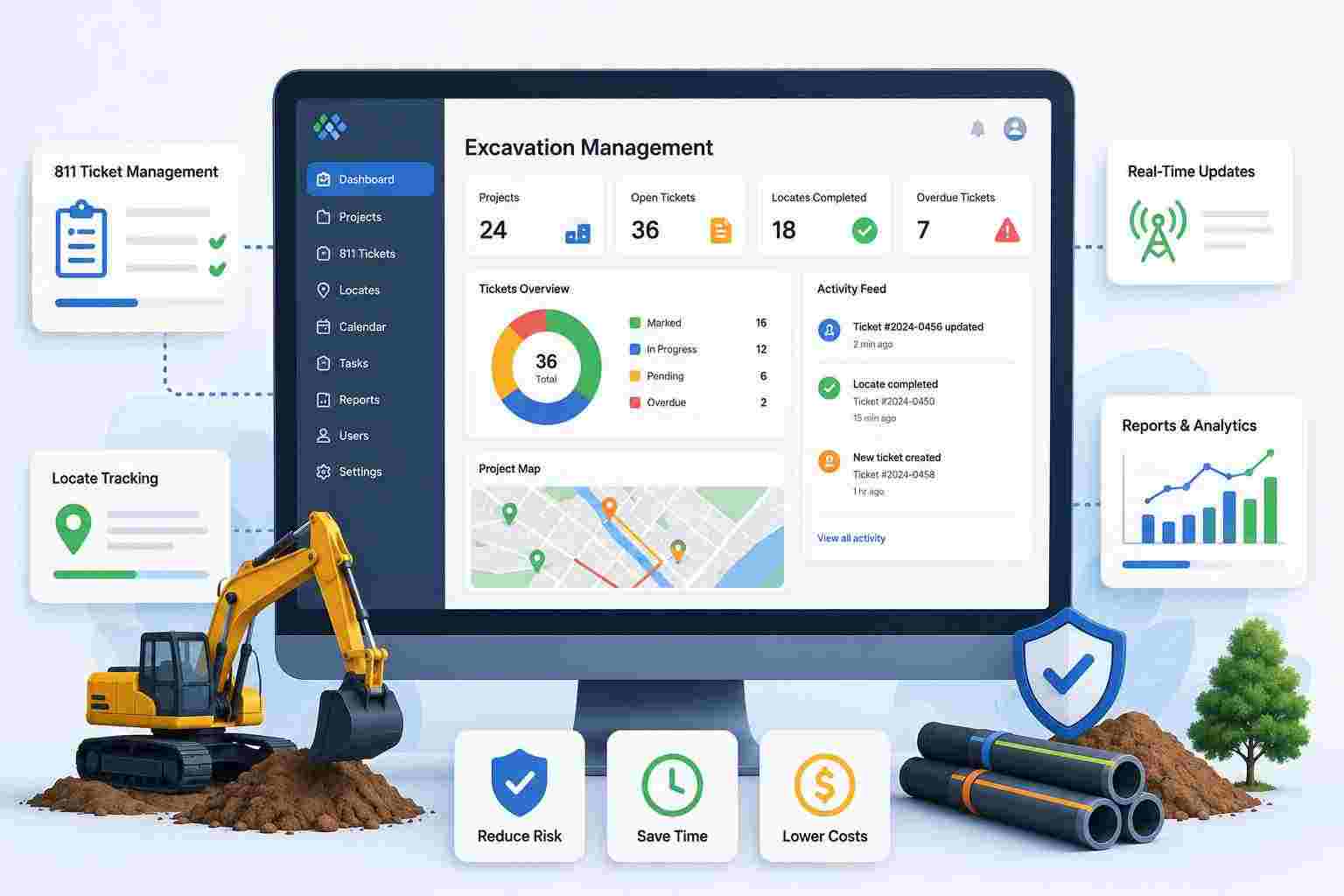
When combined with 811 ticket management software, AI helps teams focus resources where they are needed most.
Utility operations involve hundreds of daily decisions.
Managers often spend valuable time reviewing reports, assigning work, tracking locate requests, and monitoring project status.
AI simplifies many of these routine tasks by automatically processing information and presenting actionable insights.
Instead of searching through spreadsheets or multiple software systems, project managers receive organized information that supports faster, more informed decisions.
This allows teams to respond quickly without sacrificing accuracy.
One of AI’s greatest strengths is its ability to identify patterns that humans may overlook.
By analyzing historical excavation data, project records, and utility information, AI can help identify conditions that may increase the risk of utility damage.
Examples include:
This proactive approach allows organizations to address potential risks before excavation begins instead of reacting after damage has already occurred.
Managing locate requests manually becomes increasingly difficult as project volume grows.
AI supports utility locate management software by helping organizations:
Better organization leads to improved response times and a more efficient locate process for both office staff and field crews.
Modern GIS utility mapping software contains enormous amounts of valuable infrastructure data.
AI makes this data even more useful by identifying trends, highlighting inconsistencies, and supporting better planning.
Instead of manually reviewing maps and project records, teams can use AI-generated insights to understand how excavation activities relate to underground infrastructure.
This helps improve planning while reducing unnecessary excavation risks.
Communication remains one of the biggest challenges in utility operations.
Project managers, locate technicians, contractors, and office staff all rely on timely information to make informed decisions.
AI can improve communication by:
Keeping everyone informed helps reduce misunderstandings that often contribute to project delays.
Creating reports manually takes time.
AI simplifies reporting by automatically gathering operational data and generating meaningful insights.
Organizations can quickly evaluate:
These insights help managers identify opportunities for continuous improvement.
Some professionals worry that artificial intelligence will replace experienced utility workers.
In reality, AI is designed to support—not replace—human expertise.
Experienced locators, project managers, and field crews continue to make critical decisions based on their knowledge and field observations.
AI simply provides better information, faster analysis, and improved visibility that allows professionals to make more confident decisions.
The best results come from combining experienced people with intelligent technology.
Not every software platform offers the same capabilities.
When evaluating AI damage prevention software, organizations should look for features such as:
A solution that combines these capabilities into an integrated damage prevention platform can help simplify operations while improving overall efficiency.
Organizations achieve the best results when AI supports well-established operational processes.
Some best practices include:
Technology works best when combined with consistent processes and experienced teams.
AI damage prevention software uses artificial intelligence to help utility companies and contractors improve ticket management, identify risks, automate workflows, and reduce the likelihood of underground utility damage.
No. AI cannot eliminate every risk. However, it helps organizations make better decisions, improve planning, and reduce human error, significantly supporting utility damage prevention efforts.
AI helps organize locate requests, prioritize work, monitor progress, detect delays, and improve overall workflow efficiency within utility locate management software.
No. AI supports experienced professionals by providing better data analysis, automation, and operational insights. Human expertise remains essential throughout the excavation process.
Not at all. Organizations of all sizes can benefit from AI-powered automation, reporting, and improved project visibility.
Artificial intelligence is changing the way utility companies and contractors approach utility damage prevention. By improving ticket management, streamlining workflows, enhancing GIS analysis, and providing actionable insights, AI damage prevention software helps organizations work more efficiently while reducing operational risk.
As infrastructure projects continue to grow in complexity, combining experienced professionals with intelligent technology will become increasingly important. Organizations that embrace AI today are better positioned to improve safety, increase productivity, and make more informed decisions in the future.
At Norfield, we help utility organizations modernize their operations with innovative digital solutions. Our platforms are designed to support utility damage prevention, simplify 811 ticket management, improve utility locate management, and provide the tools teams need to operate more efficiently in an increasingly connected industry.

© 2025 Crivva - Hosted by Airy Hosting Managed Website Hosting.