If you walk through the floor of any PVC processing facility, the most visible quality problem usually isn’t dimensional tolerance or surface finish, it’s the colour. A slight shade variance between production runs and a streak across a pipe extrusion that wasn’t there last month. A dry blend that looked uniform coming out of the mixer, but produced inconsistent output at the extruder die.
The instinct is to adjust the formulation, add more pigment, change the stabiliser grade, and then run a longer mix time. But in most cases, the formulation isn’t the variable; the mixing process is, and no reformulation corrects a mixing system that was never matched to the dispersion demands of the material in the first place.
Colour consistency in plastic mixing is fundamentally a dispersion problem. Pigment particles, whether titanium dioxide in rigid PVC profiles, carbon black in conduit pipe, or organic colorants in flexible film, arrive as agglomerates. Clusters of particles are bonded together by surface energy, moisture, or the manufacturing process of the pigment itself. The mixer’s job is to break those clusters apart and distribute individual particles uniformly across the resin matrix before the batch exits the vessel.
The failure is rarely the pigment grade or the resin. It is almost always insufficient or poorly controlled shear at the mixing stage. Proven mixing solutions for PVC are built around this specific mechanism: generating the shear intensity required to individualize pigment particles while maintaining the temperature discipline that prevents resin degradation during the process.
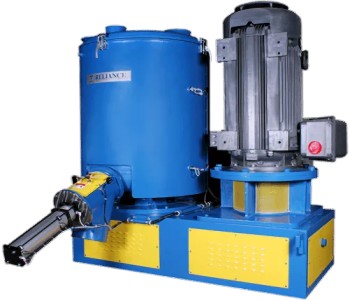
A high-intensity mixer for colour dispersion works through a combination of tip speed, vortex geometry, and thermal management rather than through mixing time alone. At the tool tip speeds used in PVC compounding (typically 40 metres per second), the mixing tools generate a deep, sustained vortex that forces material upward along the vessel walls and back toward the centre in continuous circulation. Every particle in the batch passes repeatedly through the high-shear zone near the tool tips, ensuring that no portion of the material mass avoids the dispersive action.
The vortex is not incidental: It is the mechanism. A properly designed high-intensity mixer for colour dispersion creates a flow pattern where the entire material charge circulates through the active shear zone within each mixing cycle, not just the portion nearest the tools. Dead zones, where material stagnates along vessel walls or at the base, are precisely where unbroken agglomerates survive and cause downstream colour defects.
What separates well-engineered systems from general-purpose blenders adapted for this application is how the shear is controlled across the mixing cycle, and not just how much shear is generated at peak speed. An integrated cooling stage following the high-intensity phase locks in the dispersion by rapidly stabilising the compound before discharge, preventing thermal degradation and preserving the colour uniformity achieved during mixing.
The distinction between a purpose-built PVC mixing system and a general industrial blender adapted for plastic compounding is not primarily one of size or motor power. It is one of the specialties of engineering.
Proven mixing solutions for PVC are designed around the actual process requirements of PVC compounding: tool geometries that create the correct vortex flow for resin particle sizes in the 100–200 micron range; discharge mechanisms that empty the vessel rapidly without leaving residual material that contaminates the next batch; and control architectures typically PLC-based with VFD speed control, that allow the mixing cycle to be programmed in stages aligned with additive introduction temperatures rather than running at a fixed speed throughout.
General blenders, by contrast, are typically optimised for throughput across a wide range of materials. They may achieve acceptable mixing for commodity applications, but the precision required for colour consistency in plastic mixing, particularly across long production runs where batch-to-batch repeatability is the actual performance standard, demands equipment designed specifically for the thermal and mechanical demands of PVC compounding. The difference shows up most clearly in colour-critical applications: architectural PVC profiles, coloured conduit, flexible sheeting, where shade matching across weeks of production is a customer requirement rather than a preference.
Manufacturers such as Reliance Mixers have engineered high-intensity mixer systems for exactly this application context, with tip speeds calibrated for PVC compounding, integrated cooling mixer configurations, and application-specific tool designs that address the dispersion requirements of pigmented PVC dry blends as a primary use case rather than an afterthought.
For PVC manufacturers evaluating high-intensity mixer systems for colour dispersion, the technically meaningful selection criteria go beyond rated volume and motor horsepower. The questions that actually predict colour consistency performance in production are:
These criteria reflect the actual performance variables that determine colour consistency in plastic mixing at production scale. A mixing system that satisfies all of them as designed, not through operator workarounds, is what the term proven mixing solutions for PVC is meant to describe. Technical specifications and configuration options aligned with these requirements are detailed within Reliance Mixers’ PVC industry resource, which covers integrated high-intensity and cooling mixer systems for PVC compounding applications.
There is a reason that experienced PVC processors treat the mixing specification as a primary engineering decision rather than an equipment procurement detail. Colour consistency in plastic mixing cannot be adjusted at the extruder, corrected at the calendar, or recovered at the quality inspection point. The dispersion quality achieved or not achieved inside the mixing vessel determines what every downstream process has to work with.
Understanding what a high-intensity mixer for colour dispersion actually does mechanically, how staged temperature control protects resin integrity during the process, and what distinguishes proven mixing solutions for PVC from adapted general-purpose equipment gives processors the framework to make decisions that show up in finished product quality rather than in reformulation costs and scrap figures. The mixing stage is where colour consistency is either built into the product or permanently compromised. Engineering it correctly is the most direct path to the performance that PVC applications demand.

© 2025 Crivva - Hosted by Airy Hosting Managed Website Hosting.