

Healthcare facilities face a critical operational challenge: ensuring patient safety and protecting sensitive assets while maintaining smooth, 24/7 operations. Security breaches, unauthorized access, and non-compliance with privacy regulations can have serious financial, legal, and reputational consequences. For hospital administrators, clinic managers, and healthcare executives, investing in robust access control for hospital and healthcare facilities is a strategic decision that safeguards both people and operations.
Advanced solutions, such as Millennium’s advanced access control software, are transforming the way healthcare providers manage security. From monitoring staff movements to controlling access to high-risk areas, these systems offer a scalable, efficient, and compliant approach to facility security. This guide provides a comprehensive overview of access control systems in healthcare, their benefits, and practical strategies for implementation.
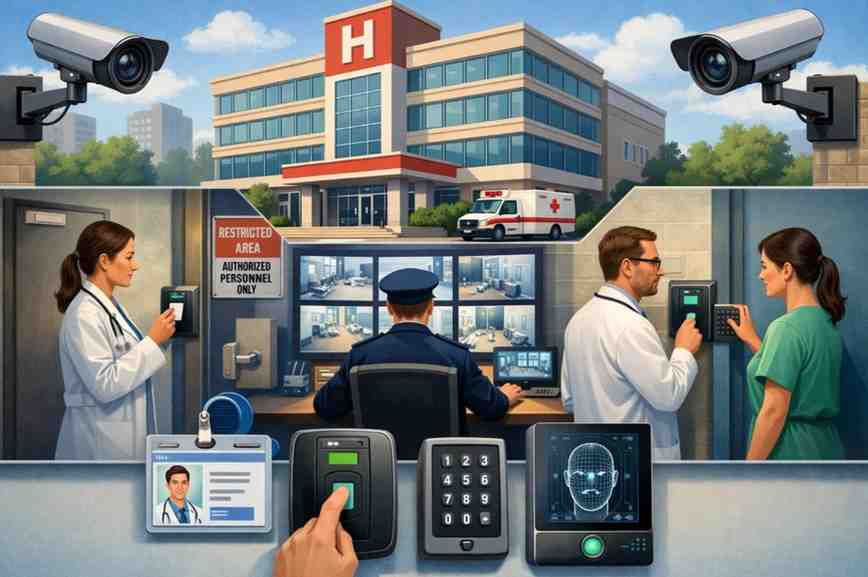
Unlike traditional business environments, hospitals and healthcare facilities operate around the clock, host diverse personnel, and store highly sensitive information. The stakes are high: unauthorized access can lead to theft of medications, tampering with medical equipment, breaches of patient privacy, and even threats to patient safety.
Implementing a comprehensive access control for hospital and healthcare ensures that:
A well-designed access control system is both a security measure and an operational tool, enabling administrators to maintain oversight without slowing down healthcare delivery.
Healthcare providers can choose from several types of access control systems, depending on the level of security needed and the facility’s operational requirements.
Keycards remain one of the most widely used access control methods in hospitals. Staff are issued cards with permissions that match their roles. Keycard systems provide:
Keycards are simple to use and cost-effective, making them ideal for large hospitals with diverse staff roles.
Biometric systems—using fingerprints, facial recognition, or iris scans—offer high-security solutions for sensitive areas. Advantages include:
Biometrics are particularly suitable for intensive care units, medication storage rooms, and high-security laboratories.
With healthcare becoming increasingly mobile, access control via smartphones or wearable devices is gaining popularity. Benefits include:
Mobile-based access reduces reliance on physical credentials while enhancing operational flexibility.
The backbone of modern healthcare security is sophisticated software. Advanced access control software, such as Millennium, allows hospitals to:
Millennium’s software combines security, compliance, and operational efficiency into one centralized solution, making it ideal for large, multi-location healthcare providers.
Implementing a robust access control system provides measurable benefits that go beyond security.
Limiting access to critical areas ensures that only trained professionals can enter operating rooms, intensive care units, and medication storage. This minimizes errors, reduces exposure to risks, and protects vulnerable patients.
Electronic health records (EHRs), patient histories, and administrative data are highly confidential. Access control systems help prevent unauthorized personnel from accessing this information, ensuring compliance with privacy regulations such as HIPAA and GDPR.
Hospitals contain valuable equipment, pharmaceuticals, and medical devices that are vulnerable to theft or misuse. Access control systems monitor who enters restricted areas and when, reducing theft and improving accountability.
Access control provides audit trails and logs that are essential for meeting regulatory requirements. Whether it’s HIPAA, GDPR, or local healthcare regulations, proper access management demonstrates compliance and prepares hospitals for inspections and audits.
Modern access control systems do more than restrict entry. By integrating with hospital management software, they streamline workflows, reduce administrative overhead, and provide actionable insights through analytics and reporting.
Before deploying a system, healthcare providers should carefully evaluate their facility’s needs. Key factors include:
Different areas require varying security levels. For example:
Understanding the facility’s risk profile is essential for system design.
Access control should integrate seamlessly with surveillance cameras, alarm systems, and hospital management platforms. Integration allows centralized monitoring and faster response to incidents.
Hospitals expand, merge, or reorganize departments frequently. A scalable system ensures that new areas, staff, and roles can be added without disrupting existing security.
Healthcare staff operate in high-pressure, time-sensitive environments. Systems must be intuitive, fast, and reliable to avoid delays that could impact patient care.
The system should provide detailed logs and analytics for compliance, security reviews, and operational insights.
Millennium is a leading provider of advanced access control software, purpose-built for healthcare environments. Here’s why it stands out:
Millennium allows administrators to manage access across multiple facilities from a single interface, reducing complexity and improving oversight.
Permissions can be customized based on role, department, or shift, ensuring staff access only the areas necessary for their duties.
Security teams can track entries and exits in real time, receive immediate alerts for unauthorized access attempts, and respond quickly to incidents.
Millennium generates comprehensive reports for audits, regulatory compliance, and internal reviews, helping healthcare facilities meet stringent standards efficiently.
The software integrates with cameras, alarm systems, and hospital management software, creating a unified security ecosystem that enhances operational efficiency.
To maximize effectiveness, healthcare providers should follow these best practices:
Healthcare access control is evolving with technology. Key trends include:
Robust access control for hospital and healthcare is a strategic imperative for modern healthcare providers. By leveraging advanced access control software like Millennium, hospitals can protect patients, staff, and sensitive assets while maintaining operational efficiency and regulatory compliance.
From securing critical areas to monitoring staff movements and generating detailed compliance reports, a well-designed access control system enhances both safety and efficiency. For healthcare providers, investing in advanced access control is not just about security—it’s about safeguarding the organization, its patients, and its reputation.

© 2025 Crivva - Hosted by Airy Hosting Managed Website Hosting.